


Cornell’s rising tuition and fees have pushed the estimated total cost of attendance past $100,000 when including the student health insurance plan for some undergraduates in the 2025-2026 academic year.
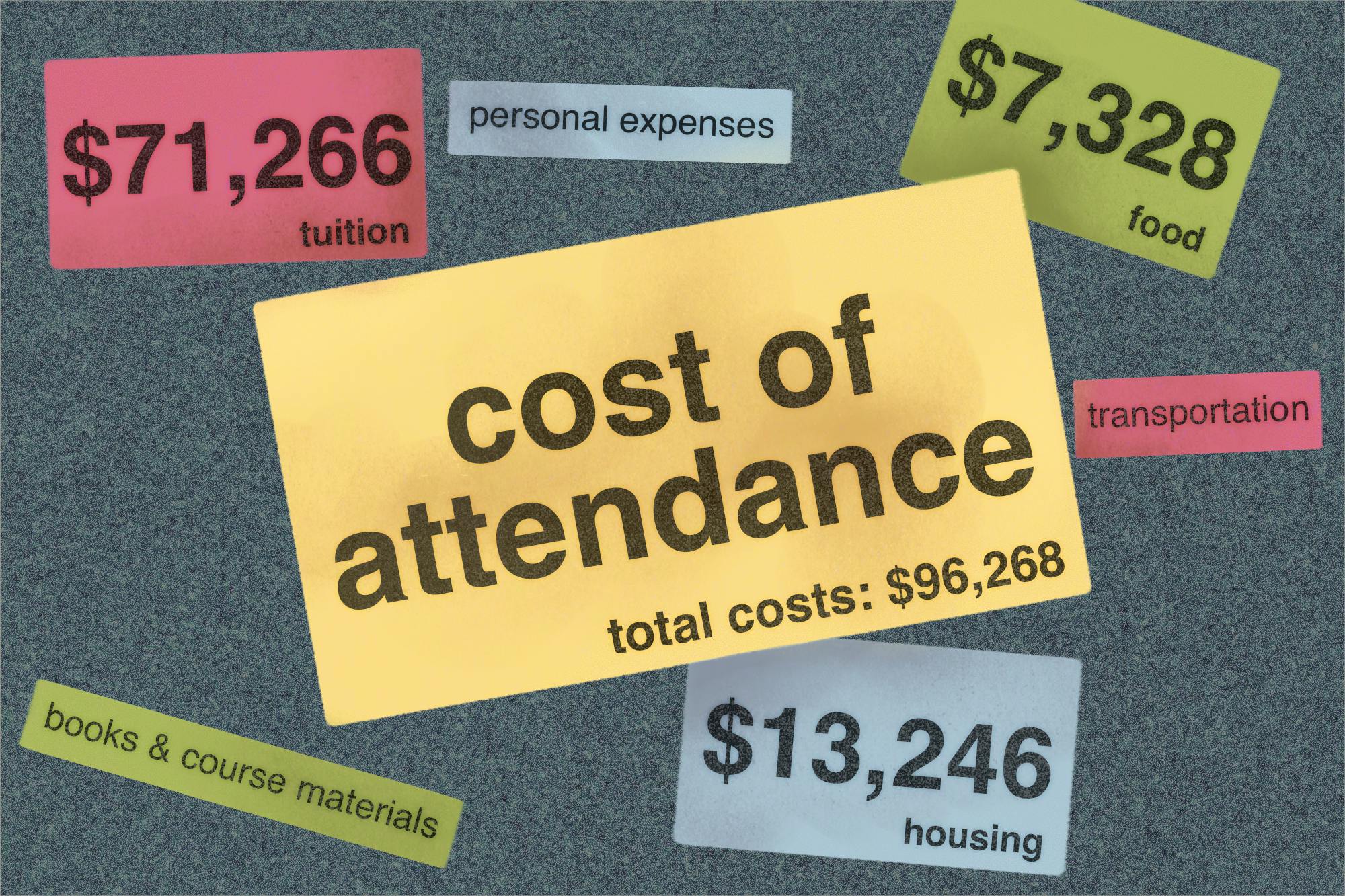
The billed costs for “typical full-time” undergraduate students in endowed colleges total $92,844, according to Cornell’s Office of Financial Aid and Student Employment. This includes $71,266 for tuition, $13,246 for housing, $7,328 for food, $424 for the student activity fee and $580 for the Cornell Health fee.
In addition, Cornell estimates non-billed costs such as books, course materials and personal expenses at $3,434, bringing the combined total of billed and non-billed costs to $96,268.
The 2025–2026 cost estimate does not include the Cornell Student Health Insurance Plan, which all students are automatically enrolled in. For new students this year, the plan charges a collective $3,685 for the fall and spring semesters, an increase of $176 from the 2024–2025 academic year. Returning students face a charge of $4,020, raised $192 from the previous year.
The total cost of attendance, including the Student Health Insurance Plan, equates to $100,288 for returning students and $99,953 for new students in the 2025-2026 academic year.
A student can opt out of Cornell’s Student Health Insurance Plan by submitting a waiver stating that their current insurance meets all University coverage requirements, including year-round, U.S.-based and Affordable Care Act-compliant care. Incoming and returning students had to submit a waiver by July 31 to opt out of the Student Health Insurance Plan for the upcoming year.
Other expenses not factored into the official estimate include transportation, such as resident parking permits priced at $752.86 per year and OMNI Ride TCAT passes at $200. Additionally, optional gym memberships are not included, ranging from $150 to $168 depending on purchase date.
The cost of attendance has been steadily increasing, with Cornell’s estimated cost of attendance (excluding the Cornell Student Health Insurance Plan) being $88,150 in 2023-2024 and $92,150 in 2024-2025.
According to a University spokesperson, the increases in cost of attendance reflect Cornell’s efforts to sustain academic quality while expanding financial aid.
“Tuition increases, when paired with investments in financial aid, allow the university to continue to operate and help keep Cornell affordable for middle- and lower-income students,” the spokesperson wrote in an email to The Sun. The spokesperson added that Cornell has committed a record $459 million to institutional financial aid, calling the University “more accessible and affordable than ever.”
Some students, however, say the rising costs still weigh heavily on families. Hayden Watkins ’28, vice president for finance on the Student Assembly, said the increases add pressure on families to make Cornell affordable.
“My family had to do some financial gymnastics, even with aid, to make it possible for me to be here for four years,” he said. “It makes me feel like I need to show that their investment in my education is worthwhile.”
That strain can be especially challenging for first-generation and limited-income students, according to Michelle Van-Ess Grant, senior associate dean of students in the Centers for Student Equity, Empowerment, and Belonging.
“Beyond tuition, the expenses of books, travel, professional clothing, and even basic needs can weigh heavily,” she wrote.
Grant said first-generation and limited-income students are increasingly open about discussing affordability and access, and the First Generation and Limited-income Student Support Office “continues to provide resources to fill in the gaps when needed.”
President Michael Kotlikoff cited “inflationary pressure” as a key driver of rising cost of attendance during a March 2024 budget discussion, saying that they “recognize the impact of inflation on our students and their families” and are “committed to controlling costs while maintaining the excellence of a Cornell education.”
Cornell was named along with 32 other elite universities in a federal antitrust lawsuit filed on Aug. 8, which alleges that from 1986 to 2025, tuition inflation at these institutions consistently outpaced both overall inflation and the Higher Education Price Index.

The University, nevertheless, maintains that it is committed to supporting students facing financial strain.
“Cornell is committed to fostering an inclusive and welcoming environment,” Grant wrote. “Resources available through the Financial Aid Office and the Access Fund, like Swipe Out Hunger or the Kessler Scholars Program, help students ease financial strain and focus on connections, learning, and thriving as part of the Cornell community.”

Emma Galgano is a member of the Class of 2027 in the College of Arts and Sciences. She is a senior writer for the News department and can be reached at egalgano@cornellsun.com.


