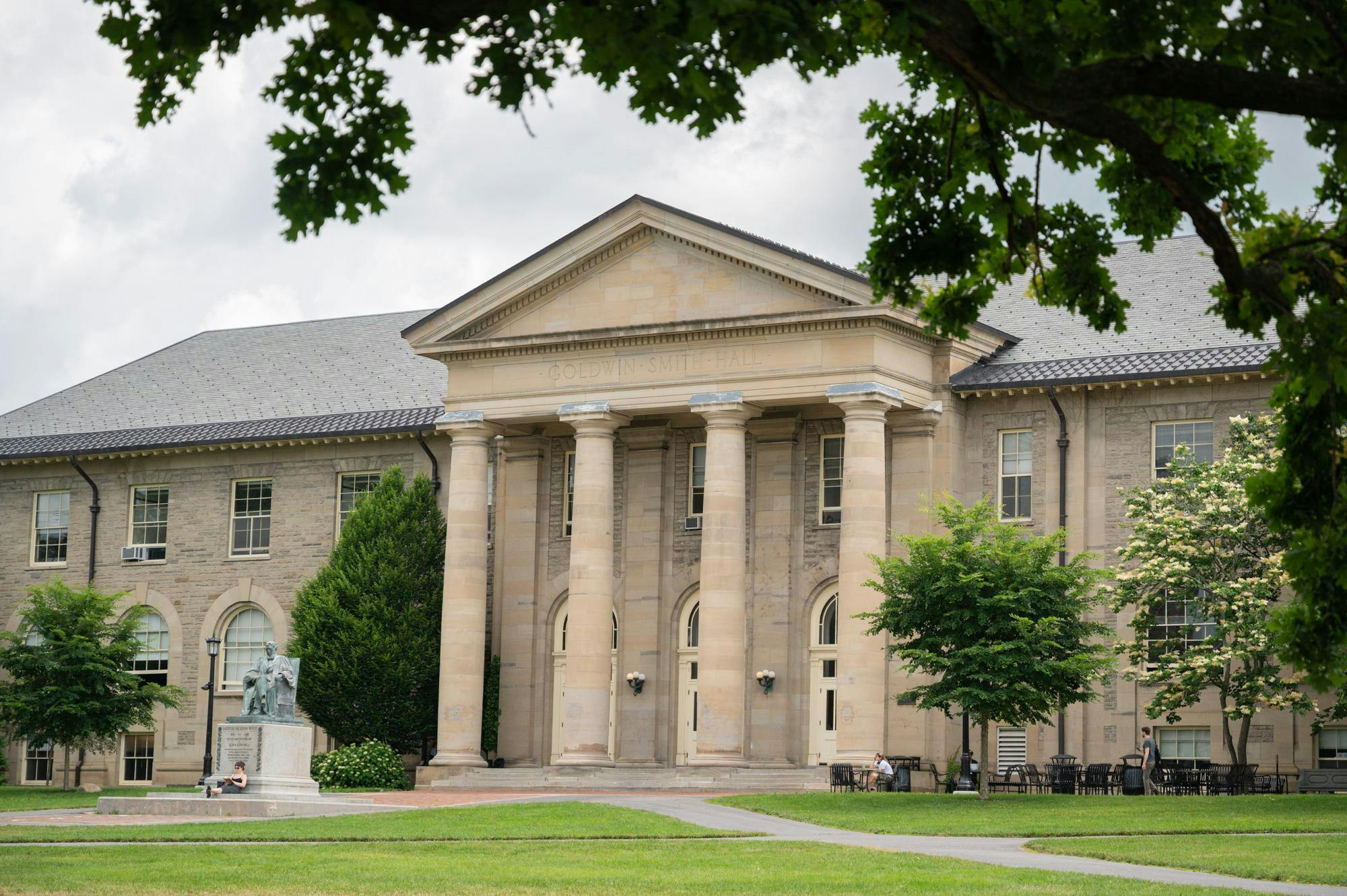
Cornell is among 32 prestigious U.S. colleges and universities named in a federal antitrust lawsuit filed on August 8. The lawsuit accuses the institutions of collusion through the sharing of admitted student lists and misleading applicants by falsely portraying their early decision policies as binding.
The lawsuit, seeking class-action status, was filed in the United States District Court for the District of Massachusetts by three current college students and a recent graduate, all from defendant schools.
The plaintiffs allege that Cornell and other defendant colleges have engaged in an illegal "horizontal agreement to reduce or eliminate competition” for students accepted through early decision programs at peer institutions.
The lawsuit also targets the Consortium on Financing Higher Education, the Common Application and Scoir Inc., operators of the Coalition Application, alleging that these entities facilitated the sharing of admitted early decision student lists among member colleges, helping schools avoid recruiting each other’s accepted candidates.
The complaint outlines that “customer allocation and group boycotts” as well as “information sharing,” with the purpose of reducing competition in the market for elite higher education, violate Section One of the 1890 Sherman Anti-Trust Act, which prohibits conspiracies designed to restrict trade.
Under early decision programs, students can apply early to one school of their choice while agreeing to attend if accepted. In return, they benefit from a higher chance of admission and receive advanced notification of their decision, typically by mid-December.
The plaintiffs claim that the defendant colleges misrepresent early decision as a binding agreement to students, despite admissions experts and school officials widely acknowledging that early decision is merely an "honor-bound agreement" with no legal standing, according to the lawsuit.
The defendant colleges require early decision applicants to sign documents that resemble contracts through application platforms, stating they must withdraw all other applications if admitted. These documents create a “false impression” of a legal obligation, the lawsuit alleges.
Schools systematically circulate early decision admit lists with competitors, according to the lawsuit. Once a school admits a student, "it notifies the student, and also sends a list of the students it has admitted ED to all of its competitor schools," wrote Ruby Shellaway, now defendant Vanderbilt University’s general counsel, in a 2006 Yale Law Journal article.
Receiving schools then remove those students from their own application pools. If they discover a student applied early decision to multiple institutions, "they notify the first school—and all involved typically revoke the student's admission,” according to the journal article.
The coordinated enforcement of early decision makes it practically binding for the student, but not for the college offering admission. The complaint acknowledges that colleges “retain the right to change their programs of study, available amenities and other terms of service without facing legal recourse from admitted students,” including revoking offers of admission altogether.
Included in the list of defendants are all five Ivy League schools that offer early decision admission tracks: Brown, Columbia, Cornell, Dartmouth and The University of Pennsylvania.
However, as detailed in the Ivy League’s “Joint Statement,” all member schools — including Harvard, Yale and Princeton, which do not offer early decision plans — pledge to “honor any required commitment to matriculate” under any other college’s early decision plan.
In 1991, the eight Ivy League schools agreed to a Department of Justice consent decree after being charged with violating federal antitrust laws through annual "overlap meetings," during which they shared financial aid information for students accepted to multiple institutions to “ensure uniform aid offers.”
Then-U.S. Attorney General and Yale alumnus Richard Thornburgh described the Ivy League as a "collegiate cartel" that "denied students the right to compare prices and discounts among schools.”
The suit outlines financial benefits for colleges offering early decision. As described in the complaint, Charles Deacon, Georgetown University’s dean of admissions, has characterized the process as "a programmatic way of rationing your financial aid.”
“First, the ED pool is more affluent, so you spend less money … enrolling in your class,” Deacon said in a 2001 article from The Atlantic. “And then there is absolutely no need to compete on financial packages."
"It does not seem fair that, in order to put my chances of admission on a level playing field with my peers, I had to give up the right to compare the cost of attendance at different schools," said Jude Robinson, a plaintiff and student at Vassar College, according to a statement from Cohen Milstein Sellers & Toll, one of the law firms representing the plaintiffs.
The Cohen Milstein press release argues that this practice “allows the schools to charge higher prices and disproportionately harms students from middle- and lower-income families” that are more price-sensitive.
Roughly one-third of Cornell’s Class of 2027 was admitted via early decision, where the acceptance rate is about three times higher than that of the regular admissions round.
The plaintiffs are seeking class-action status, monetary damages and a court order permanently barring colleges from coordinating on early decision admissions.
Cornell Media Relations did not respond to an immediate request for comment regarding the lawsuit.
Anant Srinivasan is a member of the Class of 2028 in the College of Arts and Sciences. He is a staff writer for the News department and can be reached at asrinivasan@cornellsun.com.