


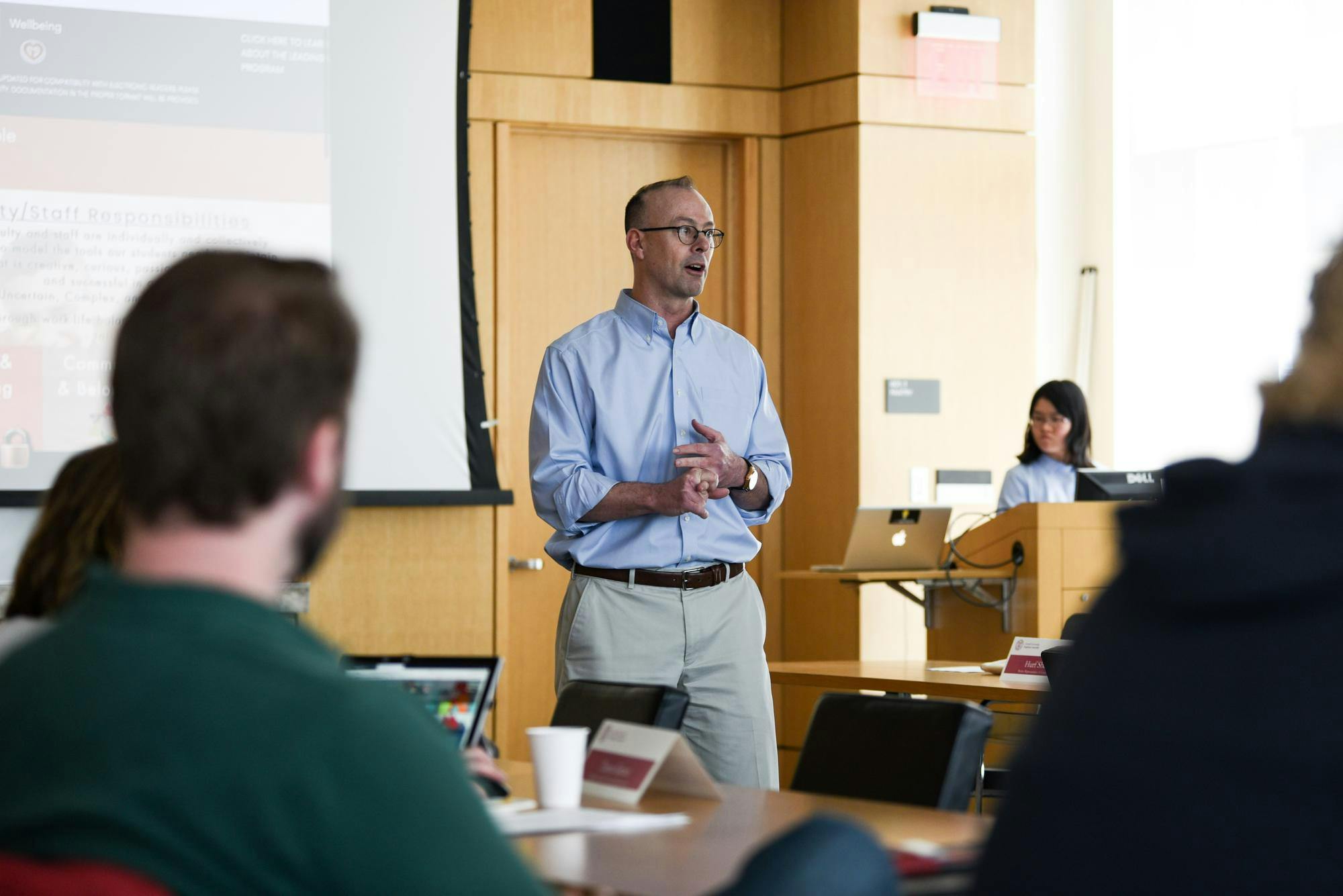
The Employee Assembly responded to a presentation by Cornell’s Committee on the Future of the American University and voiced concerns for staff welfare amid the University’s ongoing financial austerity measures in a meeting on Wednesday.
“Urgent action is necessary, both to reduce costs immediately and to correct our course over time — achieving an institutional structure that enables us to balance our budgets over the long term,” wrote top administrators in an August statement, describing financial austerity measures, following a June statement that anticipated staff cuts and hiring restrictions as the University faces “profound financial challenges.”
The Cornell Contingent Academic Workers published a response to the austerity measures last fall: “[a] new wave of austerity will negatively impact all of Cornell, resulting in even more over-burdened workers, intimidated to speak out over working conditions for fear of seeming ‘inefficient.’” The piece cited rising student enrollment and lack of financial transparency among the CCAW’s concerns. Former associate dean of the College of Arts and Sciences David DeVries also published a piece arguing that austerity disproportionately targeted university staff “who have dutifully worked to keep the lights on, the water running, the students fed, the grounds and hallways clean.”
During the Wednesday meeting, several professors on the FAU, launched by Provost Kavita Bala last September, presented on the committee’s objectives. The committee discussed goals to enhance the University’s undergraduate and graduate education, research and public outreach.
The FAU formed in October amid the freezing of over $1 billion in federal funding, including $250 million in the form of stop-work orders, by the Trump administration that spring., Its goal was to address “[a] loss of public trust in higher education, the erosion of the longtime compact between universities and the federal government and rapid technological change — especially artificial intelligence,” Bala wrote in an October statement to the Cornell community.
The FAU’s presentation at the E.A. meeting was one of “more than 100” stakeholder meetings the FAU has held since November to inform its recommendations for Cornell leadership, according to FAU member Prof. Phoebe Sengers, information science. The discussions have included debates, talks, workshops and stakeholder meetings, said Senger.
“Our goal is to produce some draft recommendations by late spring, [and] we'll bring those back to the community,” Senger told the E.A. during the meeting. “We'll hold a series of town halls to get feedback on those, and [release] a final report over the summer.”
FAU members presented on the committee’s core missions of undergraduate education, graduate and professional education, research, scholarship and public impact. Proposed initiatives included promoting “ideological diversity” among students and faculty as well as bolstering public trust in higher education through community outreach and research communication.
“One of the reasons public trust is eroding is [due to] the ways in which we engage with the broader public around scientific advances that come out of universities,” said Prof. Ariel Avgar, industrial and labor relations told the E.A.
The presentation then opened to comments from the E.A. Jeramy Kruser, E.A. Veterans Representative At-Large, voiced concern about insufficient employee representation in the FAU’s proposals.
“Your presentation [is] almost entirely focused on faculty and students,” Kruser said to the FAU committee members. “Staff are kind of tacked on as a ‘we need staff to make this happen,’ rather than really addressing the full measure that staff bring to the student experience … This is a long cultural thing that has been in higher education forever, but I think we need to lead the way in improving it.”
Several EA members concurred, with Erika Crawley, Women’s Representative At-Large, emphasizing that staff research should be considered in the FAU’s proposals to support the University’s research, in addition to faculty research.
“A lot of us are in pursuit of Ph.Ds,” Crawley said. “We present nationally. We have papers written [by] ourselves about best practices in our field, yet we get overlooked a lot of the time. And so thinking about the future of the American university, how do we fit into that narrative?”
Kruser also raised concerns about staff welfare in Cornell’s Cooperative Extension program. CCE partners with government agencies, extension associates, agriculture specialists, educators and staff and volunteers across New York state to support local agriculture, education and other programming.
“We absolutely love to talk about our successes in the CCE in every county in the state, yet we do not consider [CCE workers] our employees,” Kruser said. “We do not give them the benefits of Cornell employees, but we take the credit for all of the work they do executing our land grant mission. … We only treat them as ours when they're benefiting us.”
While the FAU committee did not immediately respond to the comments due to time constraints, they noted that the concerns will be taken into consideration for their draft proposals. The FAU has published several op-eds in The Sun communicating its objectives to the Cornell community.
During the meeting’s open discussion period, EA representatives shared ongoing concern for staff welfare amidst the University’s financial austerity measures in response to federal funding cuts, announced in a series of communications from President Michael Kotlikoff last summer. The cuts included an $11 million reduction to the College of Arts and Sciences budget. Cornell employees have previously voiced concerns about the measures’ impact on staff welfare.
“I think everybody's being asked to do more with less as part of the whole austerity and all of the attrition going on [with] early retirements,” said Marcella Benda, a representative for the College of Veterinary Medicine, at the meeting.
Executive Vice Chair Ivan Solis-Cruz noted that custodial staff in particular have been receiving increased assignments beyond their formal job responsibilities without wage compensation.
“People are picking up on various tasks and responsibilities … [but] … is their compensation reflected?” Solis-Cruz asked.
Although several other members voiced similar concerns, E.A. Chair Wendy Treat noted that Article IV, Section VI of the Assembly’s charter prohibits the E.A from representing University employees “in matters concerning grievances, labor disputes, wages, rates of pay, hours of employment, or terms and conditions of employment, and may not investigate the merits of individual grievances.”
“We need to be very careful with how we present issues, particularly when going to leadership,” Kruger said.
Members plan to present these and other concerns at the Assembly’s next meeting on March 4, which Kotlikoff and Sean Moeller, interim vice president and chief human resources officer, will attend. Employee representatives will have an opportunity to submit topics for discussion and ask questions at the meeting.
Iris Liang is a member of the class of 2028 in the College of Arts and Sciences. She is a Senior Writer and can be reached her at iliang@cornellsun.com.


