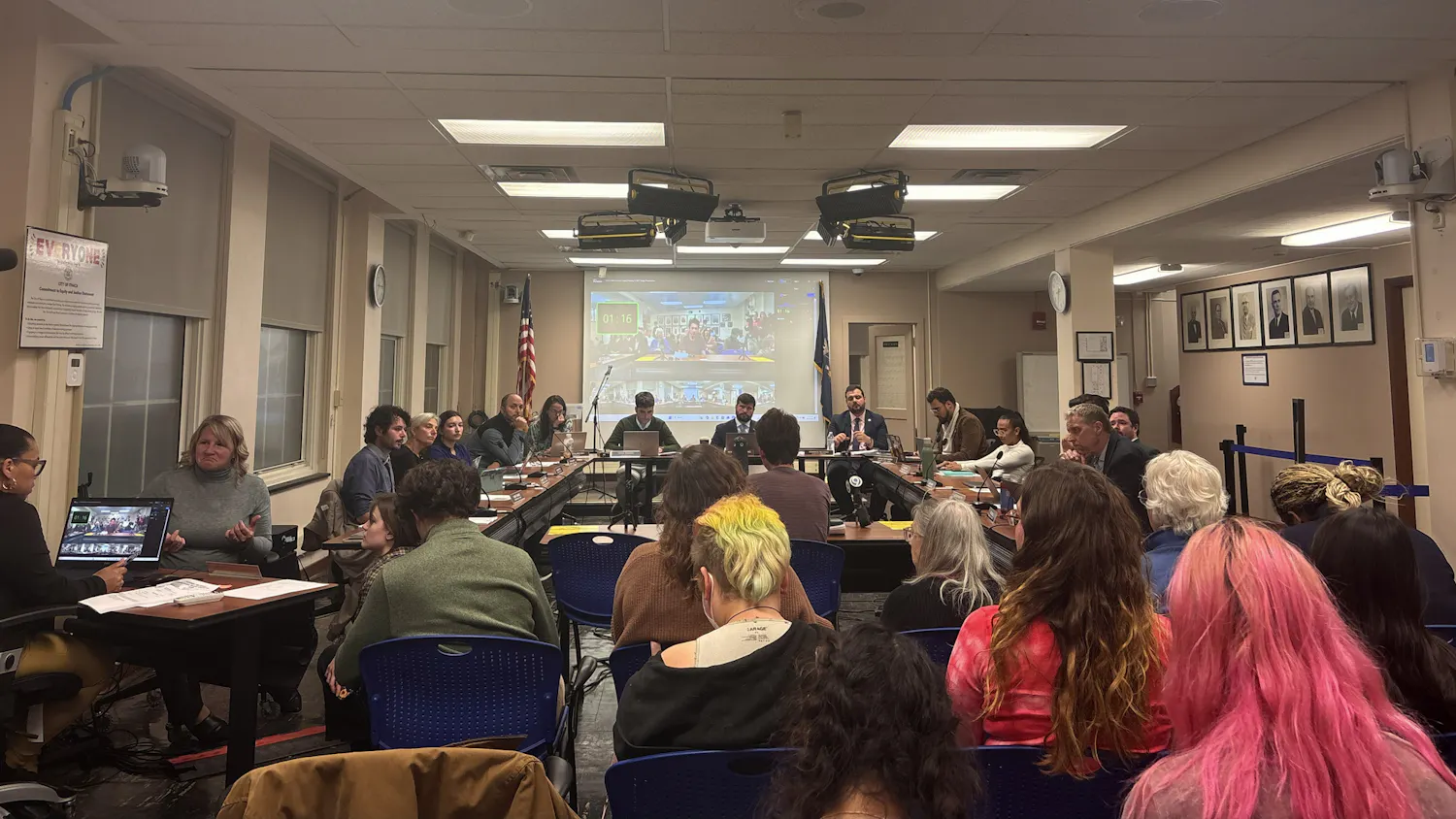
The Ithaca Common Council voted to end the city’s contract with Flock Safety and approved the design of a disputed mural on Green Street that reads “Free Gaza,” “Black Lives Matter” and “Choose Love” during the council’s meeting on March 4.
Ending Ithaca’s Contract With Flock Safety
The meeting began with public comment, which largely featured concerns around Flock Safety cameras in Ithaca.
Flock cameras are AI-powered automatic license plate readers used by law enforcement, businesses and private organizations. The security company, Flock Safety, retains access to captured data for up to 30 days after it is captured, according to its website.
In 2023, the Common Council approved funding for Flock camera installations across the city. Currently, 22 of these cameras, operated by the Ithaca Police Department, have been installed.
Reporting done under 404 media has also found that various local and state law enforcement agencies have been fulfilling requests by U.S. Immigrations and Customs Enforcement to access their Flock databases.
Tompkins County residents have previously expressed they fear the cameras could be used in similar ways, to aid ICE, track undocumented immigrants and surveil people who travel to Tompkins County to receive abortions that are illegal in their respective states.
Cornellians have also voiced fears about the usage of Flock cameras at Cornell — Flock cameras have been operating on campus since October 2024. Cornell students and faculty previously told The Sun that they worried the cameras were a “really a big threat” that could be used to target visa holders and limit their political activity.
At the March 4 meeting, Ithacans spoke about their concerns with how Flock footage could be misused and called for immediate removal of the cameras.
“Any benefits from the surveillance are offset by the fact that information is being gathered about random people,” said Ithaca resident Lynne Jackier. “There is no reliable way to ensure that the information won’t be used by bad actors and in the current political reality, it almost certainly will.”
Several community members shared their own stories about how footage has been used in the past months, urging the council to take action. Daniel Creamer, a local resident, shared a specific alleged incident from February.
“On February 19, a friend of mine who is 54 years old [and] walks with a cane … put some yarn on a telephone pole where a Flock camera was allegedly there,” Creamer said at the meeting. “Five IPD officers responded. [My friend] was tackled and pepper sprayed, and now they have two broken bones in their leg.”
IPD did not immediately respond to The Sun’s request for comment on this alleged incident.
Creamer then addressed the council directly, urging members not to enable this behavior or be complicit in these actions of surveillance.
“Please do not aid and abet the fascist [surveillence state],” Creamer said. “You are our elected officials, please don’t be a fascist.”
The council voted to end the city’s contract with Flock Safety, instructing City Attorney Victor Kessler and City Manager Dominick Recckio to terminate the contract at the “earliest possible opportunity.”
Residents also warned against replacing one security surveillance company with another, emphasizing that the core issue is surveillance itself, not just a particular company.
Approving the Green Street Mural Additions
The council also debated if they should approve the updated design of the ReAwakening the Underground Railroad mural on Green Street.
The mural was originally painted in 2010, and featured art by Jonathan Matas that commemorated Ithaca’s role in the Underground Railroad and depicted Harriet Tubman and Frederick Douglass.
In the summer of 2025, the mural was repainted with the goals of “reawakening” the “weathered” original and “bringing renewed clarity, care, and contemporary relevance,” according to the Ithaca Murals website.
The current, updated mural was painted by artists Maryam Adib and Terrance Vann in collaboration with Ithaca Murals and the Community Music Education Program, according to Ithaca Murals. The updated mural keeps the same elements as the 2010 design, including Frederick Douglass and Harriet Tubman.
However, differing from the original, the updated mural also expanded to include patterns inspired by freedom quilts and short messages, including “Free Gaza,” “Black Lives Matter” and “Choose Love,” on the sidewalls.
The “Free Gaza” message was the most disputed during the meeting, with Alderperson Pat Sewell (D-3rd Ward) raising the concern that the “highly political” message was not included in the mural’s approved proposal.
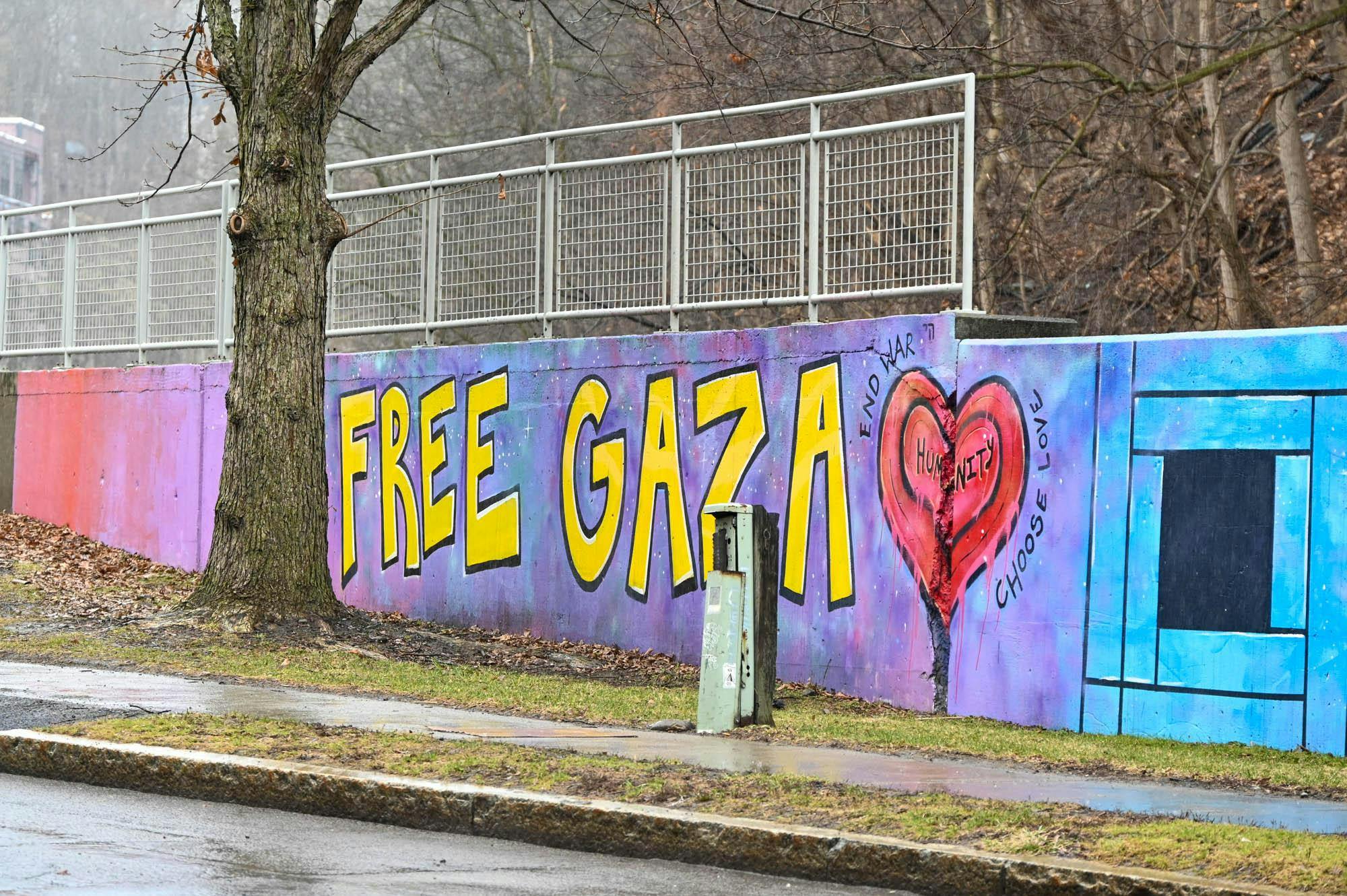
Ithaca residents, the artists of the mural and council members voiced a wide range of opinions on the mural during the meeting. Attendees discussed the validity of the added messages, specifically the phrase “Free Gaza,” the censoring of artistic expression and the city’s general procedure for approving mural designs.
“The terms in question are not separate from the theme of reawakening the Underground Railroad,” said Ithaca resident Jeremiah Craig. “I would argue the message is the same and the people who would call for the censorship of these terms would be the same people of the past to call slave catchers on runaway slaves making their journey to freedom on the underground railroad.”
Soon after, Lansing resident Richard Rosenfield contradicted this idea.
“The Gazan issue might well be relevant to what the U.S. did to deprive Native Americans of their ancestral lands, but it certainly is not relevant to African slavery and the slave trade and to the continued suppression of African Americans in this country,” Rosenfield said.
The artists of the mural also spoke at the meeting, defending their alterations to the mural’s design.
“A statement to free oppressed people should not be so controversial and I think that art is supposed to open people's eyes, open people's hearts,” Adib said. “That's exactly what me and Terrence [Vann] tried to do with this mural.”
Sam Poole ’28 voiced his support for the murals, noting how he doesn’t deem them a threat to the Ithaca’s Jewish community.
“I’m proud to be a member of the Jewish community here in Ithaca,” Poole said. “The liberation of Black Americans and Palestinians are deeply intertwined. … Our city should embrace this display of solidarity for the Black community, Palestinian community and Jews, who recognize that people cannot be safe or free until all other people are safe and free”.
Alderperson David Shapiro (D-3rd Ward) stated that to him, the nature of the issue was procedural rather than political.
“The ‘Free Gaza’ language was not part of [the] submitted application. It wasn't reviewed. It wasn't approved,” Shapiro said. “Process matters, especially when projects involve city property and carry the endorsement of this body.”
Caleb Thomas, who leads Ithaca Murals and spearheaded the creation of the original mural in 2010, defended the artists’ rights to stray from their original plans.
“With any of the murals in the city … what's put forward is a sketch,” Thomas said. After a proposal is approved by the Common Council, the artists have historically retained the right to embellish that design as they see fit, Thomas explained.
The sketch for the mural was proposed five years prior to when it was approved, Adib added.
“In those five years, we saw a lot of changes in our worlds after the shutdown, as we're seeing the results of escalations after October 7th,” Adib said. She reiterated that all aspects of the final mural, even those unrelated to Gaza, differ greatly from the initial sketch.
The main motion to approve the updated design of the mural, with the “Free Gaza,” “Black Lives Matter” and “Choose Love” messages intact, passed 9-2, with only Shapiro and Sewell voting against it.
During the meeting, Mayor Robert Cantelmo M.A. ’20 also discussed concerns regarding the Asteri building’s residential tower, stating that after an emergency review of building safety, the city had “no choice” but to order all 181 residential units to vacate the building. On Tuesday, Alan Karasin, city clerk and director of Ithaca’s department of information and community engagement, wrote in a press release that the Vecino Group — the owner and operator of the Asteri building — would fund hotel stays for displaced residents until March 20 or until the work is completed.
The council also adopted a resolution supporting statewide legislation including the REST and PASHNY Acts and established the Special Committee on Coordinated Unhoused Services Planning to create more affordable housing and help address homelessness, according to a press release by Karasin.

Giselle Redmond is a member of the Class of 2028 in the College of Agriculture and Life Sciences. She is an assistant news editor for the 144th Editorial Board and can be reached at gredmond@cornellsun.com.

Hussam Kher Bek is a member of the Class of 2028 in the College of Arts and Sciences. He is a staff writer for the News department and can be reached at hkherbek@cornellsun.com.