


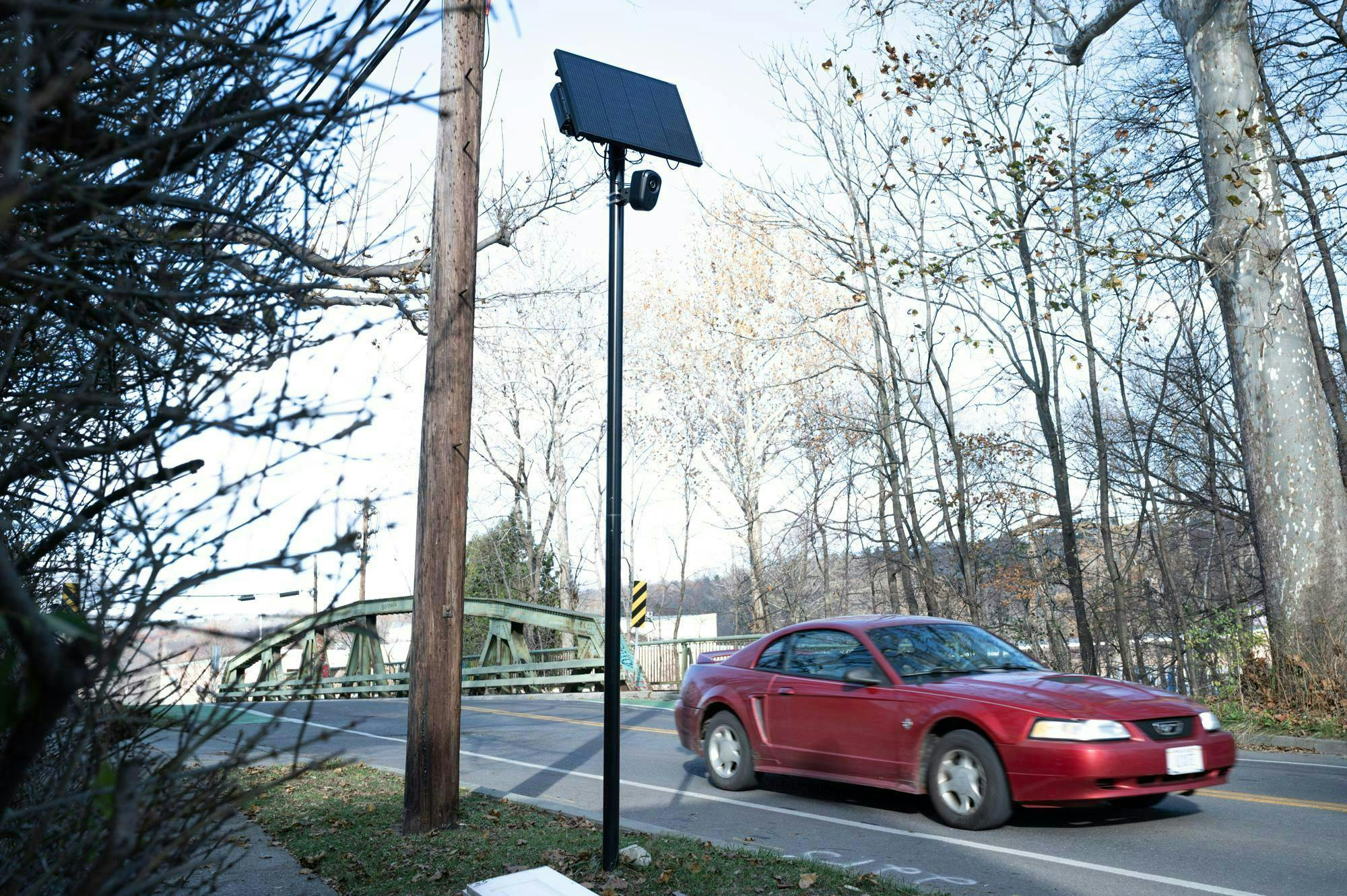
The Cornell University Police Department currently has a contract to operate seven different Flock Safety AI cameras on Cornell’s campus, according to the Ithaca Voice; these cameras have been operating on campus since October 2024, according to a University spokesperson.
The Sun spoke to students who have raised concerns that Flock camera data collected on students and faculty could be leaked to immigration enforcement agencies.
The cameras, which can be used to track license plate data for police investigations, according to Flock’s website, are all located at major entry points to central campus.
Avery Morris ’28 and Ian Palansky ’28, co-leads of the criminal justice committee for Cornell’s American Civil Liberties Union chapter, highlighted Flock’s cameras as a risk to Tompkins County and Cornell students.
“[The Flock cameras are] really a big threat at Cornell because we have a lot of people on visas, we have a lot of protesting and a lot of civil disobedience going on here,” Morris said. “We've also seen our presidential administration targeting our university, which nationally and federally, is where [Immigrations and Customs Enforcement] is looking for people.”
An “ICE Out” protest took place on campus in early February to condemn federal immigration agencies and urge the University to sever institutional ties with ICE and U.S. Customs and Border Patrol, amid Cornell’s advertisement of recruitment CBP through Cornell Career Services. The protest joined broad national demonstrations against mass ICE deportations and militarization.
Flock wrote that it does not directly partner with ICE and that all of its data is owned by its customers, according to its website.
“ICE does not have direct access to Flock cameras, systems, or data, unless the agencies that control their data expressly and deliberately allow it,” Flock’s website reads.
However, investigations from 404 Media have found that ICE has been working with local law enforcement agencies to access their Flock databases upon request.
In a statement to The Sun, a University Spokesperson stated that CUPD owns all the data in Flock’s database and can be accessed for up to 30 days before being automatically deleted.
Palansky expressed doubt that the data would not be used by Flock cameras to target students and faculty. Because the University is “politically targeted,” Palansky said, “it seems almost naive” to assume that the administration will never use Flock cameras.
The Cornell administration first discussed increased surveillance in May 2025, when they increased their administrative control over centralized surveillance systems under Policy 8.1, 1.8.5.
During a meeting with Cornell Hillel parents in October 2024, Ryan Lombardi, vice president of student and campus life, explained that the implementation of surveillance cameras in new building renovation was used to identify pro-Palestinian protesters who engaged in vandalism.
CUPD has actively requested data from routers on campus to investigate and arrest crime suspects, specifically student activists, according to the Ithaca Voice.
For instance, In January 2025, CUPD officers were able to access data from routers on campus to pinpoint a student activist who had vandalized the A.D. White Statue with pro-Palestinian graffiti.
When asked how Flock camera data is currently being used by the police department, the University spokesperson pointed toward a recent University statement on emergency preparedness and emphasized the following excerpt from it: “We value an open, accessible Ithaca campus environment and must balance that culture with tools that enhance our public safety teams’ ability to respond quickly and effectively to protect the Cornell community during emergencies."
In response to how the University administration could move forward to ensure ethical usage of Flock cameras, Palansky and Morris expressed hope that the University would acknowledge the risks that Flock posed on students and implement subsequent reforms.
Palansky ultimately hopes that the University voices concern toward Flock cameras as a risk to the privacy and security of students and Ithaca community members.
“I think that extra nudge towards that popular support would be quite helpful at this point,” Palansky said.
Morris stated that if the cameras are unable to be removed, the next best option would be to allow the student body to decide how the information on Flock cameras should be shared.
The surrounding Ithaca community protested the use of Flock cameras in the city in early February. On Feb. 4, hundreds of protesters gathered at Ithaca City Hall demanding that the city’s Flock safety cameras be turned off.
The rally, initiated by local activist group Flock Off Ithaca, called for the removal of Flock Safety cameras in Ithaca. The cameras were approved for funding by the Ithaca’s Common Council in 2023, allowing for 22 automatic license plate readers to be constructed across the city, which the Ithaca Police Department currently operates.
Ithaca’s sanctuary city status, first adopted in 2017 and renewed in February 2025, limits Ithaca Police Department officers’ cooperation with ICE and protects undocumented immigrants from being asked about their immigration status by city employees, excluding select circumstances. The order has since been updated in 2022 and 2023 to extend these protections to inquiries regarding abortion and gender-affirming care respectively.
In response to privacy and safety concerns, IPD published a Flock Safety Transparency Portal, which outlines Flock Safety’s purpose in capturing “objective evidence without compromising on individual privacy.” Additionally, IPD reports that facial recognition, gender and race are not detected by the cameras and that the cameras are prohibited from aiding in immigration enforcement.
Four members of the Tompkins County Legislature, including Amanda Champion (D-Ithaca), Michael Lane (D-Dryden), Veronica Pillar (D-Ithaca) and Shawna Black (D-Ithaca), opposed a New York State gun-involved violence elimination grant that would sponsor the continuation of Flock Safety cameras in October. In a statement to The Sun in November, Black wrote that “I did not support [funding] Flock cameras and I believe there are other ways for us to use the funding.”
Ithaca Mayor Robert Cantelmo told The Ithaca Times that he was “alarmed” by the stories about loopholes within the Flock system, and that he would like to hear from the Flock Safety administrators in the future on the implementation of new safety measures.
However, several members of Flock Off Ithaca have expressed concern about the use of the data by external sources.
“Even if Tompkins County is not sharing data with ICE, we are publishing data that others might share with ICE,” Flock Off Ithaca member Eileen Driscoll wrote in a Facebook post on Feb. 3.
Palansky argued that the police department is not sharing proper evidence behind their searches, as the IPD Flock Safety Transparency Portal only lists the number of vehicles they’ve detected in the last 30 days, but not how the cameras are specifically being used for police investigation.
“The [portal] has this section that says the recent success stories — it’s meant to say ‘here are all the ways that we’ve caught a criminal in your community in the last month’ but there's nothing there,” Palansky said. “They’ve tracked me 130,000 times, and it does not help. I think that basically speaks for itself.”
Joshua Cohen is a member of the Class of 2029 in the School of Industrial and Labor Relations. He is a contributor for the News department and can be reached at jmc746@cornell.edu.


