


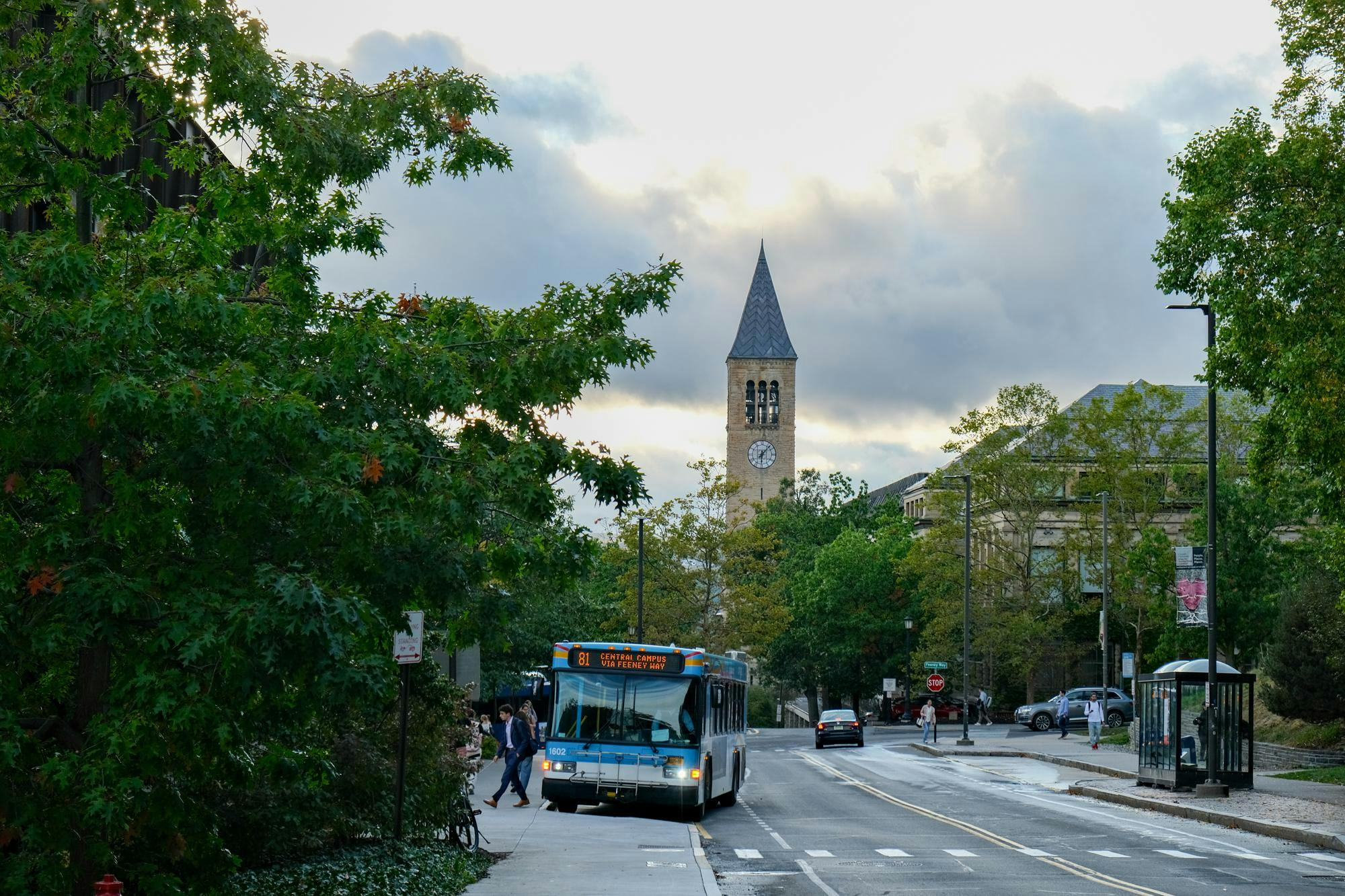
Cornell has formed a committee to reimagine “How should the American university adapt to best serve future generations?” amid a “defining” moment.
Announced in an email to the campus community on Wednesday morning by Provost Kavita Bala, the Committee on the Future of the American University includes 18 professors representing eight undergraduate colleges and five graduate colleges.
“This committee is charged with envisioning the long-term future of Cornell as an American university pursuing its core missions of education, scholarship, public impact, and community engagement,” Bala wrote. “It will explore the challenges and opportunities of this moment, engaging thoughtfully with both supporters and skeptics — within our university and beyond.”
The creation of the committee follows the freezing of at least $250 million in the form of stop-work orders and frozen grants by the Trump administration. In an August statement from administrators, Cornell shared that due to “acute fiscal pressures arising from a number of factors,” there would be immediate budget reductions.
As part of those reductions, Bala announced an internal budget cut of approximately $11 million from the College of Arts and Sciences budget at a Sept. 17 meeting.
Along with Bala, the committee is co-chaired by Prof. Ariel Avgar, labor relations and law and history; Prof. Phoebe Sengers, information science and science and technology studies; Prof. Praveen Sethupathy, biomedical sciences, who also chairs the department; and Prof. Adam Smith, anthropology, director of the Cornell Institute of Archaeology and Material Studies and associate dean and secretary of faculty.
Bala wrote that among other challenges, American universities face “a loss of public trust in higher education, the erosion of the longtime compact between universities and the federal government, and rapid technological change,” which reshape how “we teach, learn, and engage with the world.”
The committee will examine questions across four distinct areas: undergraduate education, graduate education, scholarship and public impact and community engagement.
For undergraduate education, the committee intends to discuss how a university should educate students amid diminished trust and societal change, best train students to become “responsible citizens in a polarized world” and embrace changes presented from artificial intelligence development, while retaining “retaining our commitment to the power of reading and writing, dialogue, human ingenuity, and critical thought,” according to the committee description.
The committee also intends to explore the effects of reduced federal funding for graduate education, how “American universities retain global leadership in research through new partnerships and funding models” and how to “ leverage the knowledge we generate” to help inform policy and impact community engagement.
“Envisioning the future of American higher education is a bold but necessary endeavor,” Bala wrote. “Grounded in our enduring founding principles, Cornellians are equipped to rise to this challenge. I look forward to thoughtful and inspiring conversations across campus and throughout our broader community.”
Isabella Hanson is a member of the Class of 2027 in the College of Arts and Sciences. She is a senior writer for the news department and was a news editor for the 143rd Editorial Board. She can be reached at ihanson@cornellsun.com.


