


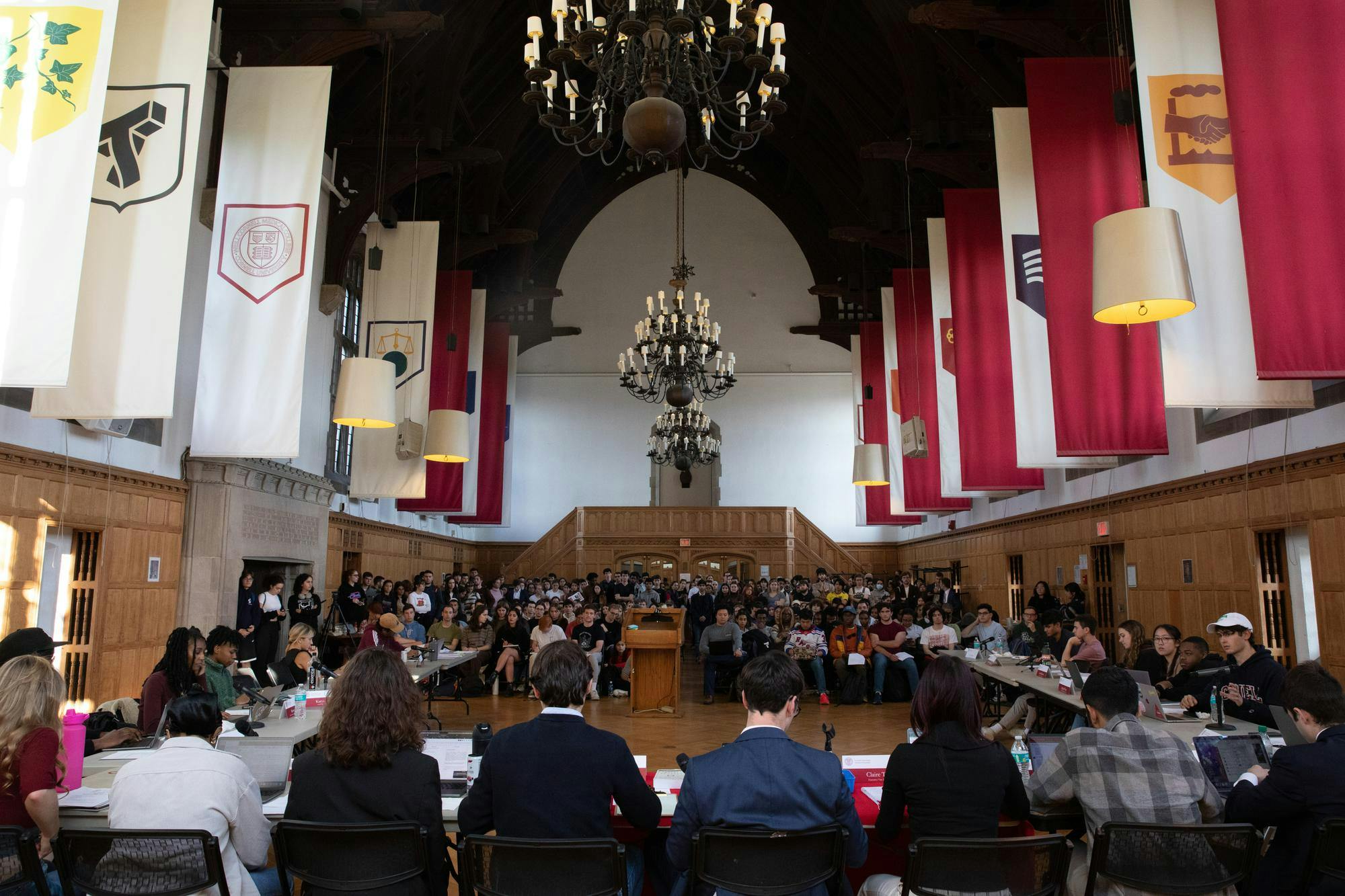
The University Assembly held its last of three public feedback sessions on Wednesday as part of the Code and Procedures Review Committee to gather community input on the Student Code of Conduct and its enforcement procedures. During the session, University affiliates raised concerns about how the Code is structured and how its accompanying procedures are implemented in practice.
The approximately 35-minute meeting brought together around 18 participants — including faculty members, Student Assembly representatives and administrators — as part of a review process launched in Fall 2025 to evaluate the clarity, fairness and structural integrity of Cornell’s Student Code of Conduct.
This session comes after the student referendum against the University’s overhaul of the disciplinary process in December passed overwhelmingly, with 93.5% and 91.7% of voters supporting ballot issues one and two, making Cornell’s judicial system independent and reestablishing the campus-wide code of conduct respectively.
The Student Assembly Charter requires Kotlikoff to approve or reject the referendum within 30 days of its passing, which he has yet to do.
Prof. Ashleigh Newman ’06, population medicine and diagnostic sciences, a member of the Code and Procedures Review Committee and the co-chair of the session, noted during the meeting, that the committee’s role is to “listen, gather input and share the input with the committee regarding proposed revisions to the code and its procedures.”
The committee serves in a non-voting, advisory capacity and is tasked with making recommendations for improvement rather than exercising disciplinary authority. The meeting began with an 11-minute informational video produced by the Office of Student Conduct and Community Standards, which detailed various complaint procedures, investigation processes and potential outcomes, largely mirroring information available on the office’s website.
After the informational video concluded, the committee opened the floor to public comment, during which two Cornell affiliates offered critiques of the existing Code.
Prof. David Bateman, government, focused his remarks on how the Code is applied in practice, particularly regarding punishment involving temporary suspensions and the degree to which proceedings are independent from central administration.
“Temporary suspensions [of students] were used in cases that quite clearly went beyond the letter and the spirit of restrictions on their use,” Bateman said during the public comment session.
Bateman argued that the severity of these suspensions enabled the “overcharging” of students, adding that “the alternative resolution process in these cases was neither restorative nor collaborative but quite clearly coercive.”
Bateman also raised concerns about what he described as “flagrant” violations of timely process, pointing to long, drawn-out investigations that remained unresolved despite repeated student requests for progress updates.
Rather than relying solely on revised language that would provide more details in the Code, Bateman called for procedural safeguards, stating that one of the “critical things” needed for the Code was “structural protections rather than just more detailed language.”
As part of these protections, Bateman recommended limiting temporary suspensions to thirty days and requiring review by a panel independent from central administration, which was the previous policy before the Code was overhauled in 2021.
Prof. Jonathan Butcher, engineering, echoed concerns about inconsistencies between how students, faculty and staff are treated under University policies.
“When we have a code that applies to students that deviates dramatically from how we might treat staff or faculty, in terms of maybe committing the same offenses … that will always create tension,” Butcher commented.
Committee chairs emphasized that the session marked an initial stage of feedback collection.
Wendy Treat, Exempt Employee Representative at-Large, noted that community members can continue submitting comments via email and that the Committee will discuss feedback further at an upcoming meeting.
The review process is expected to continue over the coming months, with recommendations to be shared with University’s leadership.
“Since the current Code went into effect in 2021, much has changed across higher education and within our own Cornell campus community,” Lombardi wrote in an August statement about the Code. “As student life and academic expectations have evolved, our approach to student learning and accountability must also evolve.”
Vivienne Cierski is a freshman in the College of Agriculture and Life Sciences. She is a Sun Contributor and can be reached at vsc38@cornell.edu


