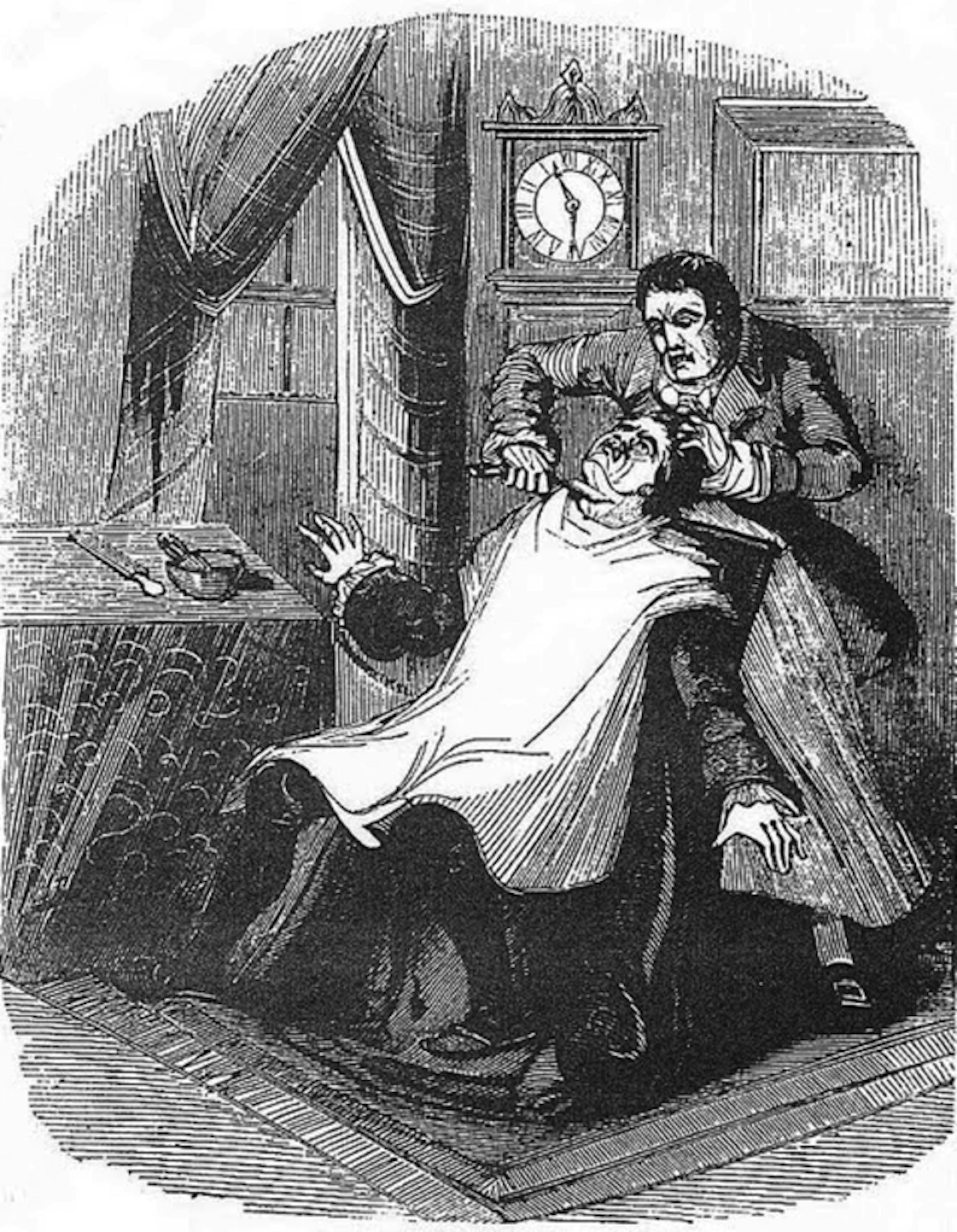
Attend the tale of Sweeney Todd — a cautionary parable detailing the destructive nature of vengeance and the lengths to which one will go for love. With Halloween just around the corner, follow along for a deep dive into the upcoming production of this chilling musical and the team behind the scenes.
The story of Sweeney Todd dates back to 1865, when the demon barber was first depicted in a penny dreadful titled The String of Pearls: A Romance. Since then, the story has undergone numerous adaptations, including melodramas and silent films, before Stephen Sondheim took the reins in 1979 to develop the stage musical that we know and love today.
For those unfamiliar with the Tony Award-winning show, let me set the scene. The story takes place in Victorian London and features characters hailing from every walk of life. One important concept to understand here is the social hierarchy of British society and where each of the characters exist in that beehive. From the Beggar Woman, scraping scraps out of alley trash cans, to high and mighty Judge Turpin, the cruel monarch who oversees the ins and outs of London, each character exists on a ladder where they always have a foot in their face while trampling someone else beneath them.
With that in mind, the curtains open as Todd is returning to London after spending 15 years imprisoned in Australia. And the reason for his imprisonment? Nothing more than Judge Turpin shipping him off so that he might pursue Lucy, Todd’s wife. Now, vengeance on his mind, Todd can only satisfy his thirst for revenge with bloodshed, slitting less honorable throats in his barbershop while he patiently awaits the day that Judge Turpin sits in his chair.
Yet, something about Todd’s desire to avenge his family doesn’t exactly scream, “villain!” Jordan White ’29, who understudies Todd, spoke on this phenomenon, saying, “He is a villain, he’s an objectively evil individual, but he’s been wronged so much that he’s being framed as the protagonist.” Similarly, Justin Lee ’26, who plays Todd, remarked, “He is a three-dimensional character, and the audience should sympathize with him.” Sondheim certainly blurs the line between good and evil with this show, leading the audience to question where the evil really lies and whether that truly validates Todd’s actions in any way. “I don’t think it’s a story about one man,” Lee said, “I think Sweeney is a victim of this cycle … as is literally everybody in this story.”
Now, the Melodramatics don’t encourage murder as a means of revenge, but that doesn’t mean that there isn’t a sense of relatability in these characters’ experiences. Student director Avery Wrobel ’28 commented, “Everyone can really see one of the characters and be like, ‘someone has made me feel this way, and I’m angry.’” Wrobel harnesses that anger, directing it towards elements of our day-to-day life that are reflected in Sweeney Todd. “The class imbalance and the way that this society is structured is something that we can all relate to and get angry about,” she said, “the ensemble is telling this story throughout time, almost bringing it to audiences who need to see it, and that’s why they are here in 2025.” Early on in the rehearsal process, Wrobel spoke with the cast about her plans for the ensemble to break the fourth wall with the audience, assuming an identity like that of a Greek chorus: “We’re keeping the set very vague and having the ensemble interact so much with the audience because we want to communicate that Sweeney is as applicable now as it was in the Victorian era.”
That being said, the social impact of this musical is just as important as the cast and crew working behind it. Music director Isaac Dorio ’26, who chose to work on Sweeney Todd for his honors thesis in music, is exploring how music creates community and the individual impact of a project of this substantiality. For the Melodramatics, an entirely student-run, community musical theater group, this sense of community is vital. There are almost 100 people working on Sweeney Todd alone — from Cornell, Ithaca College and across the greater Ithaca community. “I want [the audience] to notice how collaborative it is,” Dorio said, “I think that’s powerful.” He pointed out that working with a wider community “says a lot about people’s need to work together and connect genuinely, and I think theater creates a space to do that.” Bella Beaux ’26, a senior voice major at Ithaca College who plays Todd’s daughter Johanna, also emphasized the value in having this unbounded community group: “There’s different theater culture between Cornell and Ithaca.” Indeed, Cornell doesn’t have the same pre-professional theater focus as Ithaca College’s BM or BFA program, but as Beaux pointed out, this collaboration allows actors to come together “more for the love of the art rather than the want of the final product.”
The team behind Sweeney Todd contains the greatest number of non-Cornell members in the Melodramatics since before the pandemic and were recently granted access to the Schwartz Center’s Kiplinger Theater, a proscenium theater that seats nearly 500. Justin Lee remarked that Sweeney Todd is “a culmination of the Melos as an organization,” as it truly showcases the growth of the group since its founding in 2004. So, while Sweeney Todd conveys a tale of vengeance and hate, it also speaks towards the value of community bonds, whether that be through shared experiences or a shared love of creating art.
Sweeney Todd will run from Nov. 14 to Nov. 16, and you can purchase tickets here.
Gia Lish is a freshman in the College of Arts and Sciences. She can be reached at gml223@cornell.edu.

Gia Lish is a member of the Class of 2029 in the College of Arts and Sciences. She is a staff writer for the Arts & Culture department and can be reached at glish@cornellsun.com.