There are many things we are grateful for when it comes to ABBA: the undying hit “Dancing Queen,” still soundtracking birthdays across the world; the cult-classic Mamma Mia!; the vague awareness of the Eurovision Song Contest extending beyond Europe; and, of course, the crown jewel of Benny Andersson and Björn Ulvaeus’s careers — a musical about the Cold War and an 800-year-old board game.
When thinking about the Swedish pop scene or Broadway, one rarely conjures Chess. “One Night in Bangkok,” a hit track firmly lodged in the subconscious of many, has largely been divorced from its original home as the show’s second-act opener. Beyond that, Chess can hardly be described as a pillar of musical theater. Did the Broadway revival manage to redirect the spotlight onto the overlooked gem, finally bringing it the fame and acknowledgement it deserves? Yes, and no.
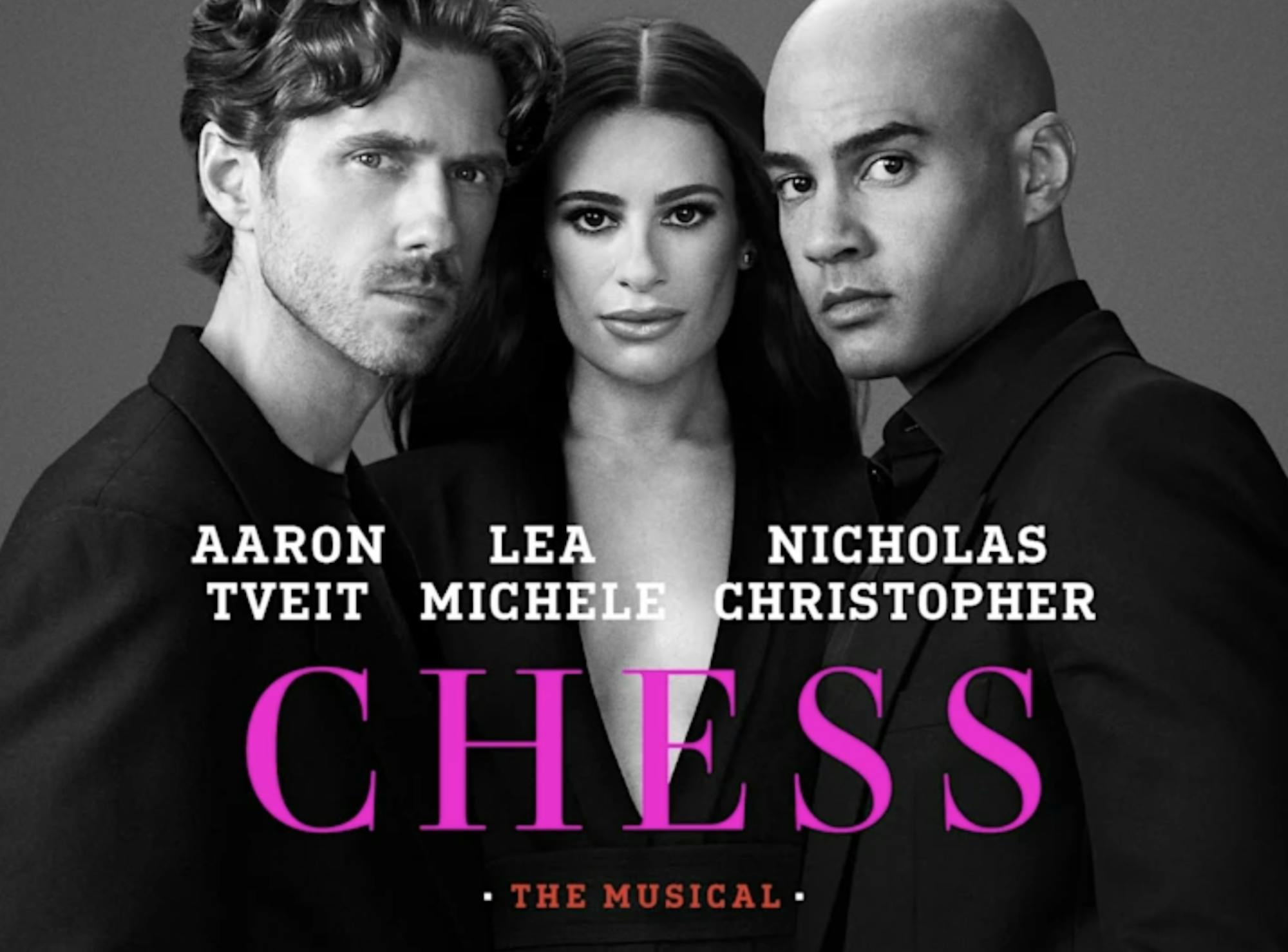
In New York City, it is currently hard to forget that Chess is on. The city billboards not occupied by Zohran Mamdani’s friendly smile are mostly selling passersby on the power trio of Aaron Tveit, Lea Michele and Nicholas Christopher. Despite the hype, there are only a few sanctioned snippets of the show circulating online, and the media policy surrounding it is notably strict: if you want to know what it’s about, you have to come and see. And if, charmed by the omnipresent engineered scarcity and a singular Youtube Shorts preview insistently popping up on your feed, you manage to score a ticket for one of the less busy nights, you’re bound to have a time best described as moderately good.
The script has been updated to reflect modern American horrors. The narrator, unconcerned with the fourth wall, speaks directly to the middle-class New York audience the jokes are written for, punctuating the unfolding personal and political crises with knowing asides. The audience laughs, sometimes genuinely and sometimes wearily. The references oscillate between incisive and gimmicky, continuously nudging the viewer: isn’t it crazy that we’re basically living through the Cold War again? Some of the questions raised by the show are chillingly relevant to the modern-day United States, from international politics to immigration and the devastating realities of refugee life. Whether the production fully trusts its viewer to draw parallels on their own, without placing a carefully pre-digested conclusion right in front of them, is another matter.
While politics are important for Chess, they’re not the only gravitational center of the show. It is, in fact, concerned with anything but chess itself. The characters are delightfully messy, driven by bruised egos and interpersonal tension more than ideology. Aaron Tveit delivers a quintessential Aaron Tveit performance, truly shining in the second act. “Pity the Child” is arguably the show’s strongest moment, both emotionally and vocally, with a high note that calls back to the final crescendo of Moulin Rouge’s “Roxanne.” Nicholas Christopher gets to remind Broadway audiences that he is more than the sum of two successful Hamilton roles. He portrays a character both stoic and nuanced, and manages to make it genuinely touching. Despite intermittently losing his Russian accent in ways that feel careless for a production of this scale, he appears deeply invested in the forces driving his onstage alter ego, leaving the viewer with the aftertaste of a breakdown witnessed in real time. Hannah Cruz, playing a secondary part as the estranged wife of one of the main characters, emerges as the surprising powerhouse of the show’s second act, almost making one wonder if Chess could have been something else if it decided to step aside from the all-star headline and simply let itself implode.
Lea Michele is … in the show. Her vocals, while technically fine, seem to lack the elusive ingredient that would make them outstanding. Much of her acting gives a similar impression: wide-eyed and passable, yet simply not quite there for reasons nearly impossible to pinpoint. This feeling seems to be the throughline for this iteration of Chess: well-built on paper, yet missing the mark by mere inches in practice. Like most Broadway shows, it is, undoubtedly, an evening well-spent, but, after all the choreography and costume work, it stops just short of transcendence.
This version of Chess works as a revival, as well as a fun new detour for the Broadway faithful who have already seen it all. It does not, however, yield the power necessary to call in The Queen’s Gambit-esque craze. For a show so concerned with power and strategy, it ultimately plays it a little too safe where a bold sacrifice might have made it unforgettable.
Arina Zadvornaya is a graduate student in the College of Engineering. She can be reached at az499@cornell.edu.

Arina Zadvornaya is a graduate student in the Duffield College of Engineering. She is a columnist for the Arts & Culture department and can be reached at az499@cornell.edu.