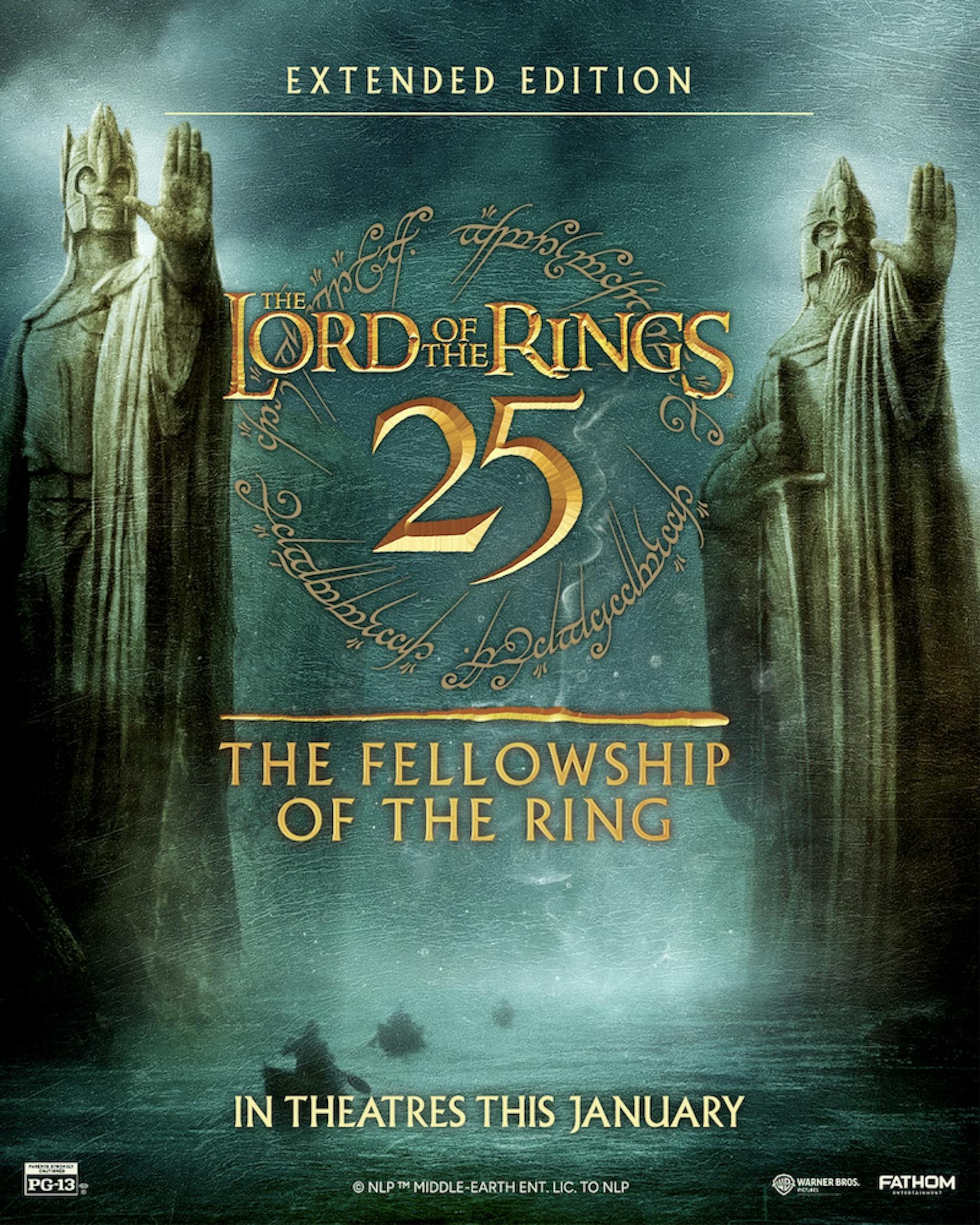
On Dec. 19, 2001, Peter Jackson’s The Lord of the Rings: The Fellowship of the Ring was released in theaters. And just this past January, it was re-released in theaters across the world to celebrate its 25th anniversary, taking in $11 million according to Deadline. As one of the highest grossing franchises in film history, its anniversary presents the opportunity to both dig into the story of its production and to break down the franchise film as a historical phenomenon.
The development history of The Lord of the Rings trilogy, perhaps opposed to the popular conception of a franchise film, was something more of an indie affair. The J.R.R. Tolkien property had attempted adaptations before the 2000s films, but the preproduction process that would lead into the final films began with Miramax, producer Saul Zaentz and Peter Jackson around 1995. At this time, Miramax was the kingpin of independent film. After they distributed Jackson’s Heavenly Creatures, Jackson followed contractual obligations to produce more films under the Miramax banner. The Lord of the Rings had been a dream project of Jackson’s since he was 18, and when Harvey Weinstein obtained the film rights from Saul Zaentz, they began preproduction work together. But Weinstein wanted only one movie, not a trilogy. The project was then put in turnaround and picked up by New Line Cinema, another independent, whose logo many audiences will recognize at the beginning of the film. New Line poured a massive $130 million commitment to the film in what a 1998 article termed a “huge gamble” with “enormous financial risk.” Today, we often take the result for granted; this appears laughably myopic.
This preproduction history is even more interesting when it is studied as a pattern. There are certain recurrent features that answer such questions as, ‘Where might we expect the franchise film to come from,’ or, ‘How is the prestige production chosen and established?’
A modern example of a franchise film — and very often compared to LOTR — is Dune. In 2016, large independent production company Legendary Pictures acquired rights to the Dune novels, the first of which was written in 1965. Denis Villeneuve, who had nurtured dreams of adapting it from an early age, was chosen to direct. Another example are the Twilight films, adapted from the Stephanie Meyer novels and produced by Summit Entertainment, a hungry independent that would later be purchased and absorbed by Lionsgate. When Iron Man came out, Marvel was in a similar space.
A very recurrent theme is the franchise film as novel adaptation; others include the Jurassic Park films, the James Bond movies, Harry Potter and almost everything in the superhero genre. There are outliers like Star Wars or Avatar, but they appear the exception. There are many arguments regarding the why, such as the pre-established audience one attracts from popular novels and the fact the material is already tested. But it appears a plain fact that adaptations make up the majority.
Another frequent element is the role of the independent. One would expect the biggest studios to lead these franchise films, and in many cases they do, but some of the most successful of all time have come from independents. To me, this is a note of optimism. It is a paean to the hungry. It makes sense that in the case of LOTR it would take an independent to produce what was a revolutionary vision — a realistic take on high fantasy, which really had not been done beforehand in the genre.
Finally there is the role of the auteur. The trilogy is characteristically Peter Jackson’s conception of the material and retains its unity through him. The same can be said of George Lucas for Star Wars or Gore Verbinski with the Pirates of the Caribbean movies. In place of the uncoordinated dictatorship of a producer, placing the creative seat of power firmly in the hands of the writer or director allows for a complete vision.
25 years later, we can not only enjoy The Lord of the Rings trilogy, but also expect new cinema to follow in its tradition, which — if this analysis holds any merit — we might have the foresight to trace the origins of.
Tommy Welch is a senior in the College of Arts and Sciences. He can be reached at tsw62@cornell.edu.
Tommy Welch is a member of the Class of 2026 in the College of Arts and Sciences. He is a staff writer for the Arts & Culture department and can be reached at twelch@cornellsun.com.