

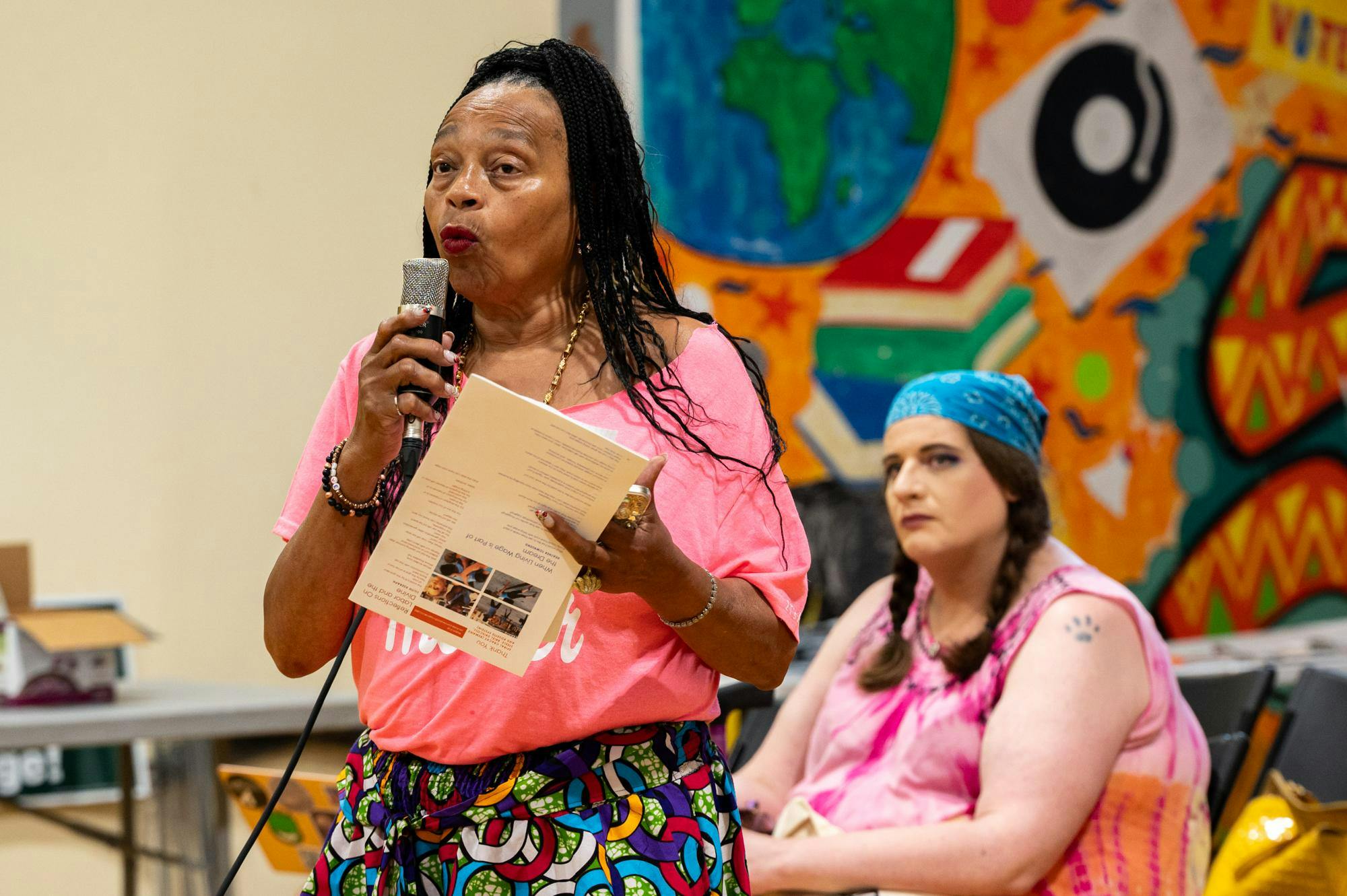
Around 20 local officials, educators, students and activists shared their thoughts on what reparations for those of African descent should look like in New York at Thursday’s New York State Community Commission on Reparations Remedies public hearing.
As part of its statewide public hearing series, the NYSCCRR invited community members to give public comments on reparations at the Thursday evening Ithaca Downtown Conference Center. The hearing highlighted Black New Yorkers in education, featuring a presentation by Ithaca College professor of education, Sean Bradwell Ph.D. ’09, on the history of racial discrimination in Tompkins County. Executive Chair Dr. Seanelle Hawkins and Commissioners Timothy Hogues and Linda Brown-Robinson hosted the hearing.
Senate Bill S1163A established the NYSCCRR in 2023 with the goal of making recommendations for reparations after examining the legacy of slavery and subsequent racial and economic discrimination against Black Americans. The reparations movement calls for monetary, systemic and structural amends to be made to address the history of chattel slavery in the U.S.
Bradwell said that Tompkins County has a “long history of oppression,” including the enslavement of Black Americans until 1827 and “genocide of indigenous folks.” Marginalized communities do not carry the responsibility of solving the oppression they face, Bradwell said, suggesting that instead, community members must cooperate to make reparations for historical injustices.
In Ithaca, racism against the Black community does not only manifest in racial discrimination but also in wealth disparities, Bradwell said. The city has an overall economic segregation index, or geographical segregation by economic status, of around 0.72. An index of 1.0 would indicate complete economic segregation. According to Bradwell, Ithaca’s economic segregation index value shows that the city is “not only segregated by race — [but is] significantly segregated by economics.”
“For a city of our size, to have this level of economic segregation should be jarring,” Bradwell said. “And for me, there's an interconnection between the history of indigenous theft of land, of racial chattel slavery and of practices that make our community a segregated place.”
Through input from New Yorkers via public hearings, consultations with experts and additional research, the NYSCCRR aims to create a report with recommendations for reparation measures in New York. While the commission does not have the authority to enact measures itself, the report must be passed by the state legislature to take effect.
In an interview with The Sun, Hawkins said that the commission takes into consideration all community input during their preliminary research process. She said NYSCCRR plans to host a final public hearing in Brooklyn before embarking on the second phase of their plan, which is to develop a comprehensive reparations report. Since the commission has no power to instate the recommendations they formulate, Hawkins said it is up to the New York community to champion their amendments to the state legislature.
While others expressed support for reparation efforts and offered suggestions on where the commission’s attention should be focused, Zach Winn, candidate for Ithaca’s First Ward Common Council, stated that public funds would be better spent elsewhere when “people are leaving New York State because of the crushing tax burden.”
Alderperson Phoebe Brown (D-1st Ward), alongside alderperson Kayla Matos (D-1st Ward), co-sponsored the approved proposal to allocate $50,000 of the city’s 2025 budget to fund a study on reparations.
Although Brown supports reparation efforts, she disagreed that they must be studied before being enacted when it is evident that Black Americans have suffered throughout history.
“Why are we researching what we know Black people deserve? They worked for free,” Brown said.
Several members of the Afrodescendant Nation — who believe in self-determination, human rights and reparations for descendants of those who were enslaved — expressed support for reparations but not in the manner in which NYSCCRR was carrying them out.
One member said “Reparations in the form of education, healthcare or public apology will not remedy the 400-plus years of slavery that our ancestors went through.”
Other speakers echoed the sentiment. Kenneth Glover, teaching assistant in the Ithaca City School District, said that despite racial discrimination being outlawed, it has still been historically perpetuated through policies.
“There is progress being made in the contemporary [world], but the commission has to look at the subordination and marginalization [of Black Americans],” Glover said. “For instance, who could become a teacher? Who could go to school to get an education? Who could work in a building trade? Who could build a house? Could you get a mortgage? That has to be elaborated upon within the report, as well as looking at it on a community basis.”
Bradwell concluded his presentation with a call for community members to work together to address Tompkins County’s history of injustices against minority groups.
“None of us in this room are responsible for the racial chattel slavery that took place in Ithaca or Tompkins County,” Bradwell said. “However, whether we like it or not, all of us must reconcile our community's legacy of racial chattel slavery, especially if our goal is to work for justice and a collective understanding of humanity.”

Shubha Gautam is a member of the Class of 2028 in the College of Arts and Sciences. She is an assistant news editor for the 144th Editorial Board and can be reached at sgautam@cornellsun.com.


