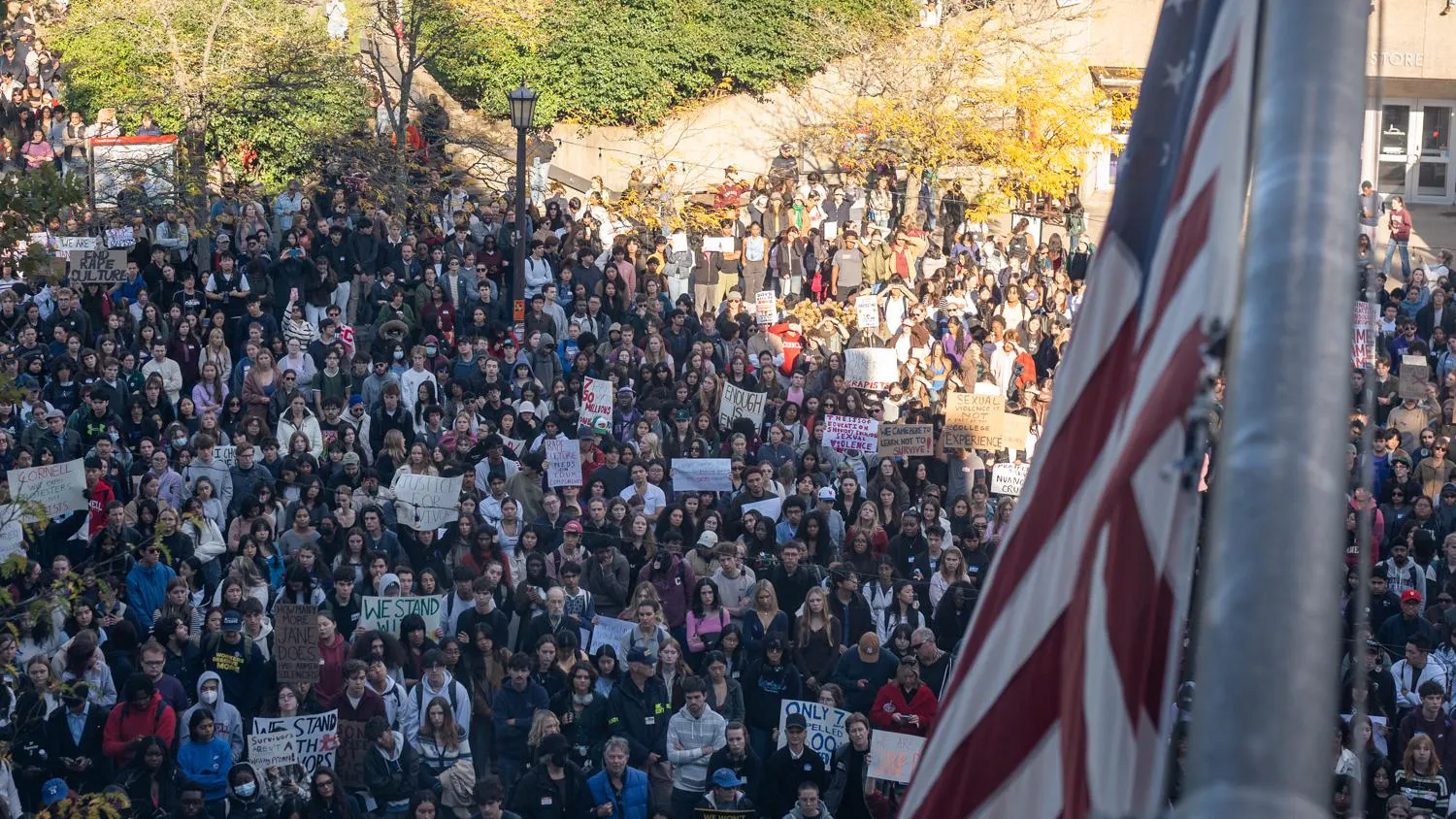
23 cases of on-campus rape were reported in 2024, according to the 2025 Annual Security Report released by the Cornell Division of Public Safety Clery Compliance Office on Sept. 4.
Compared to 2023, all categories of sexual and Violence Against Women Act offenses decreased. However, some crimes — including rape and fondling — did so at a lesser rate. Hate crimes, burglary and arson were also reported at lower rates in the security report than in previous years.
Under the Jeanne Clery Campus Safety Act, all institutions of higher education across the country are required to prepare, publish and distribute campus crime statistics on a narrowly defined set of offenses. Each year, Cornell prepares a report based on Clery reportable crimes reported to Campus Security Authorities, including CUPD as well as local law enforcement agencies with jurisdiction over the campus.
Statistics on hazing, which are now a Clery-reportable crime, will begin to be included in 2026 following the passage of the 2024 Stop Campus Hazing Act.
The 23 cases of reported on-campus rape in 2024 show a decrease from the 28 reported cases in 2023 and 25 reported cases in 2022. Fondling cases on campus decreased only slightly, with 21 reports in 2024, 22 reports in 2023 and 24 reports in 2022.
By comparison, VAWA offenses — which include dating violence, domestic violence, and stalking — decreased significantly from 2023 to 2024, with cases of stalking reducing nearly by half. The VAWA is a 1994 congressional act that addresses violent crime, especially that against women, but also against all victims of domestic and dating violence.
The statistics contained within the Annual Security Report only exhibit crimes officially reported to CUPD or to designated campus officials. Survey data from the 2023 Cornell Survey of Sexual Assault and Related Misconduct show much higher rates of experienced sexual assault and non-consensual sexual contact.
According to the survey of 6,000 students, 23 percent of undergraduate women and 9 percent of undergraduate men reported experiencing sexual assault of some form during their time at Cornell. That year, 16,071 undergraduates were enrolled according to Cornell Institutional Research and Planning, with 8,763 identified as women and 7,308 identified as men.
Only 38 percent of the survey respondents stated they knew how to file an official complaint of sexual assault.
The 2025 SARM survey is currently underway, and students can access the report once it is published on Cornell’s Sexual Harassment and Assault Response and Education website.
On Oct. 25 of last year, an individual reported being drugged and sexually assaulted by multiple males at the Chi Phi fraternity house — leading to the temporary suspension of the fraternity and a number of students amid investigation. Students on campus felt jarred following these events, with many calling for a mental-health day and an in-depth response from the University.
Around the same time, Cornell student Noah Rebei ’25 was arrested by CUPD after being discovered hiding under a female resident’s bed in William Keeton House on Oct. 30. He faced charges of second-degree criminal trespassing and third-degree assault.
In response to these incidents, the University launched the Presidential Task Force on Campus Sexual Assault, which was announced on Feb. 6 in a statement from Kotlikoff and Provost Kavita Bala.
Hate crime data from the 2025 Security Report revealed a steep drop in hate crimes on campus compared to the previous year. In 2024, one hate crime was reported on campus, characterized by ethnicity. In contrast, 2023 data revealed seven total reports of hate crimes on campus: one characterized by race, five characterized by ethnicity and one vandalization characterized by ethnicity.
2023 was a year of heightened tensions on campus, with protests and contention over the Israel-Palestine conflict.
In late October of 2023, Patrick Dai ’24 made several antisemitic threats against Jewish institutions on campus via the anonymous discussion forum Greekrank. Several derogatory messages toward Muslim students were also posted on Greekrank at the same time.
That same year, the U.S Department of Education opened an investigation into seven universities, including Cornell, over alleged antisemitism and Islamophobia. Five universities were being investigated for antisemitic harassment, and two for islamophobic harassment. At the time, a spokesperson for the ED said they could not specify which subject the Cornell investigation covered.
In 2024, a Muslim student was spat on while walking in Collegetown during Ramadan.
Murder and non-negligent manslaughter data reveal that no cases have been reported to CUPD or other campus authorities. Data for manslaughter by negligence also has remained at zero reports. Reports for incest and statutory rape are also zero, both on-campus and other locations within Cornell’s Clery Geography.
Correction, Sept. 15, 8:20 a.m.: This article has been updated to clarify that the report was released by the Division of Public Safety Clery Compliance Office, that the security report includes Clery reports sent to Campus Security Authorities, local law enforcement and CUPD, clarify the statistics on hazing and that on-campus locations are within Cornell’s Clery Geography.
Ariana Sanchez is a member of the Class of 2028 in the Dyson School of Applied Economics. She is a Sun Contributor for the News Department and can be reached at acs327@cornell.edu.