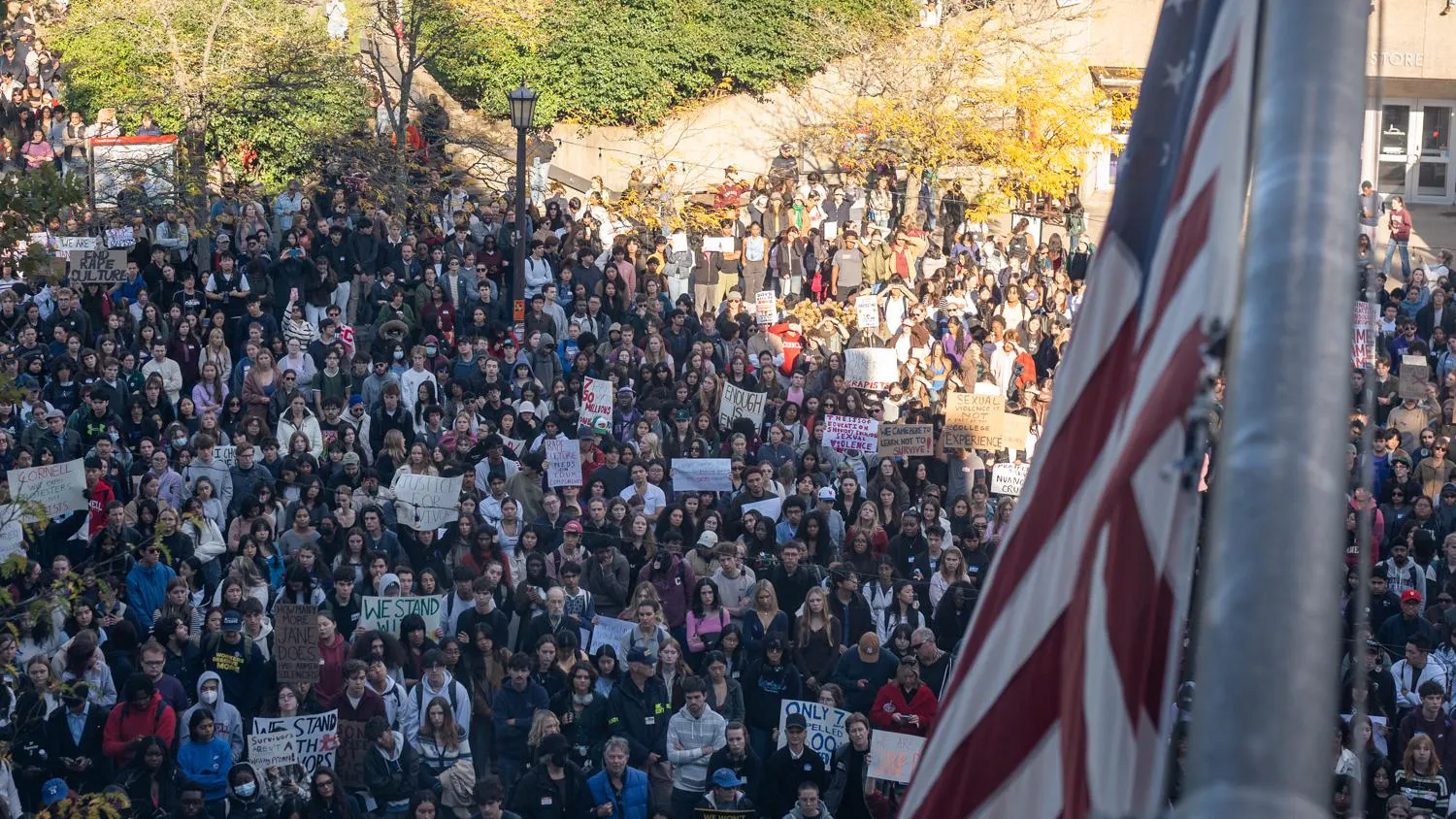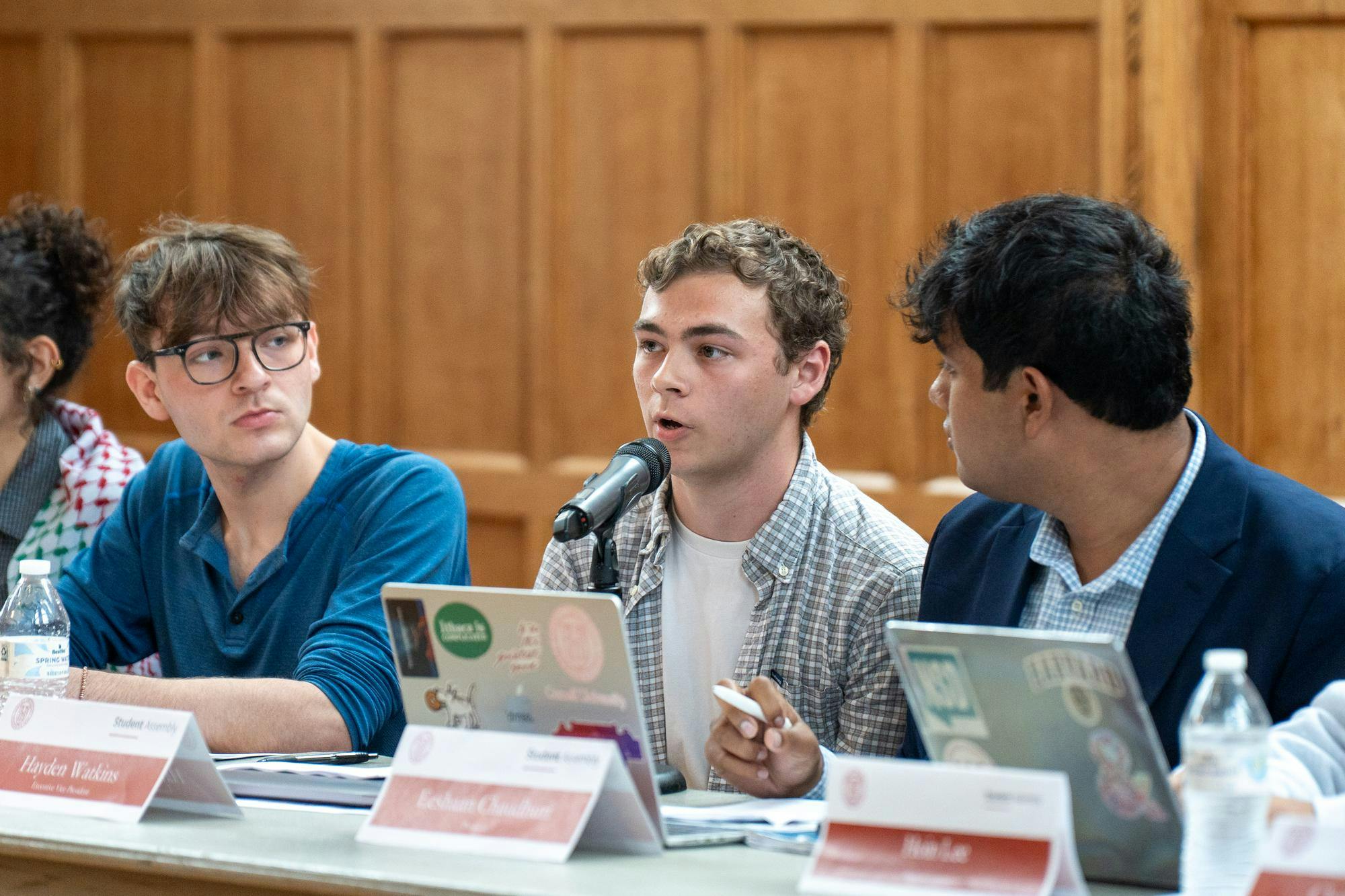
Following a public hearing on sexual violence that drew over 100 students, parents, alumni, faculty and staff, the Student Assembly turned to a packed legislative agenda Thursday, unanimously passing resolutions addressing transparency around additional course costs, ROTC representation and internal Assembly policy.
The hearing and the passage of three resolutions related to sexual violence came in response to the alleged 2024 Chi Phi gang rape case. Read The Sun’s coverage here.
Prolonged Risley Shop Closures
The Assembly introduced Resolution 18: Addressing the Delays and Lack of Transparency Surrounding the Risley Shops and Theater Repair Timeline, which will advance to a final vote at the next meeting.
The resolution focuses on the prolonged closure of shops and theater spaces in Risley Residential College, a program house for the arts. It seeks greater transparency from the administration about the repairs and calls for students to regain access, when feasible, to materials currently inaccessible inside the shops.
The Risley shops and theater have been closed since August 2025, when Cornell Environmental and Safety began a health and safety evaluation of the spaces. The shops –– 11 fine arts workshops including pottery, sewing and darkroom facilities –– and the theater were initially expected to remain closed through the Fall 2025 semester. In March, Housing and Residential Life announced that the spaces would remain closed throughout the 2026-27 academic year, citing “previously unknown infrastructure challenges.”
Presenting the resolution, Chief of Staff Ellie Porter ’29 described a lengthy history of issues surrounding the closures and said the lack of access has restricted what members of Risley’s artistic community can do.
“[Students] don’t have access to the supplies in the shops. So effectively, they cannot do anything,” Porter said.
Abisola Ayoola ’28, College of Human Ecology representative, who studies fashion and lived in Risley during her first year, commended Porter for her work on the resolution.
“I expected to use the sewing shop,” she said. “I think it’s important work.”
The Assembly will hold a final vote on Resolution 18 at its next meeting.
Transparency in Course Fees
The Assembly unanimously passed Resolution 14: Promoting Transparency in Additional Course Material Costs, which recommended syllabi and course descriptions to include the cost of course materials not included in CAMP or course fees.
Saphira Augustin ’29, first-generation students representative, who wrote and presented the resolution, said she had revised the motion since its initial presentation to include film viewings and field trips.
The Cornell Academic Materials Program, or CAMP, provides undergraduate students with required textbooks and course materials for a flat fee of $275 per semester. Financial aid packages automatically cover CAMP as part of the estimated cost of attendance –– which excludes any costs students may encounter to acquire supplementary or particular instructor-preferred materials.
Chaudhuri singled out the resolution in a written statement to The Sun after the meeting.
He wrote that, in addition to Resolutions 15-17, he is “equally excited about the resolution calling for transparency about course fees.”
“Professors should do better,” he added.
Resolution 14 passed unanimously and without debate.
Internal Resolutions
The Assembly also unanimously passed four resolutions changing its internal policies and increasing financial transparency for organizations receiving money through the Student Activity Fee.
Resolution 9: Expanding the Office of Ethics and the Office of Elections, Requiring Continuity of Membership, and Establishing an ROTC Liaison expands participation in the Office of Ethics and Office of Elections to allow current members to remain active while passing on their roles to new members, and additionally establishes a non-voting ROTC representative for the Assembly.
Resolution 9 passed quickly and without debate.
Chaudhuri described the resolution as “very straightforward” during the meeting, and highlighted the ROTC provision in comments to The Sun.
“ROTC representation is super important,” Chaudhuri wrote to The Sun, adding that he was “very happy that it passed unanimously.”
Resolution 11: Modernizing the Student Assembly Charter by Removing Organizations Not Funded Directly by the Student Activity Fee updates the Assembly charter to remove organizations that are no longer funded through the fee.
Executive Vice President Hayden Watkins ’28 stressed that the resolution does not eliminate the organizations themselves or strip them of funding.
“This is not cutting the organizations,” Watkins said, explaining that the affected organizations will instead receive funding through umbrella organizations and other sources. Additionally, the amount of money given to cut organizations is not impacted by the resolution.
Resolution 12: Enforcing Transparency for Student Activity Fee Spending generated discussion after the meeting ended. The measure recommends organizations funded through the Student Activity Fee –– including their suborganizations –– publicly document their finances through a template available on CampusGroups.
Watkins, who previously served as the Assembly’s vice president for finance, connected the resolution to his experience with the byline funding process last year.
“One of the main … critiques of the byline funding process last year is the lack of transparency,” Watkins said. “It became very difficult to articulate decisions when I could not point to the financial documents that were not readily accessible to students.”
Watkins argued that inaccessible financial information also leaves students without the context needed to evaluate how their Student Activity Fee, $424 a year for undergraduates, is allocated.
Watkins said making spending records public would allow students to better understand the fee-setting process, while also encouraging organizations to scrutinize their own spending, knowing “there’s going to be eyes on how specific activity fee dollars are being spent.”
Resolution 13: Reframing Policy Committee, which eliminates the committee in favor of a single position held by Vice President for Policy Lydia Blum ’27, also passed unanimously and without any debate.

Emma Spindler is a member of the Class of 2028 in the College of Arts and Sciences. She is a senior writer for the news department and can be reached at espindler@cornellsun.com.