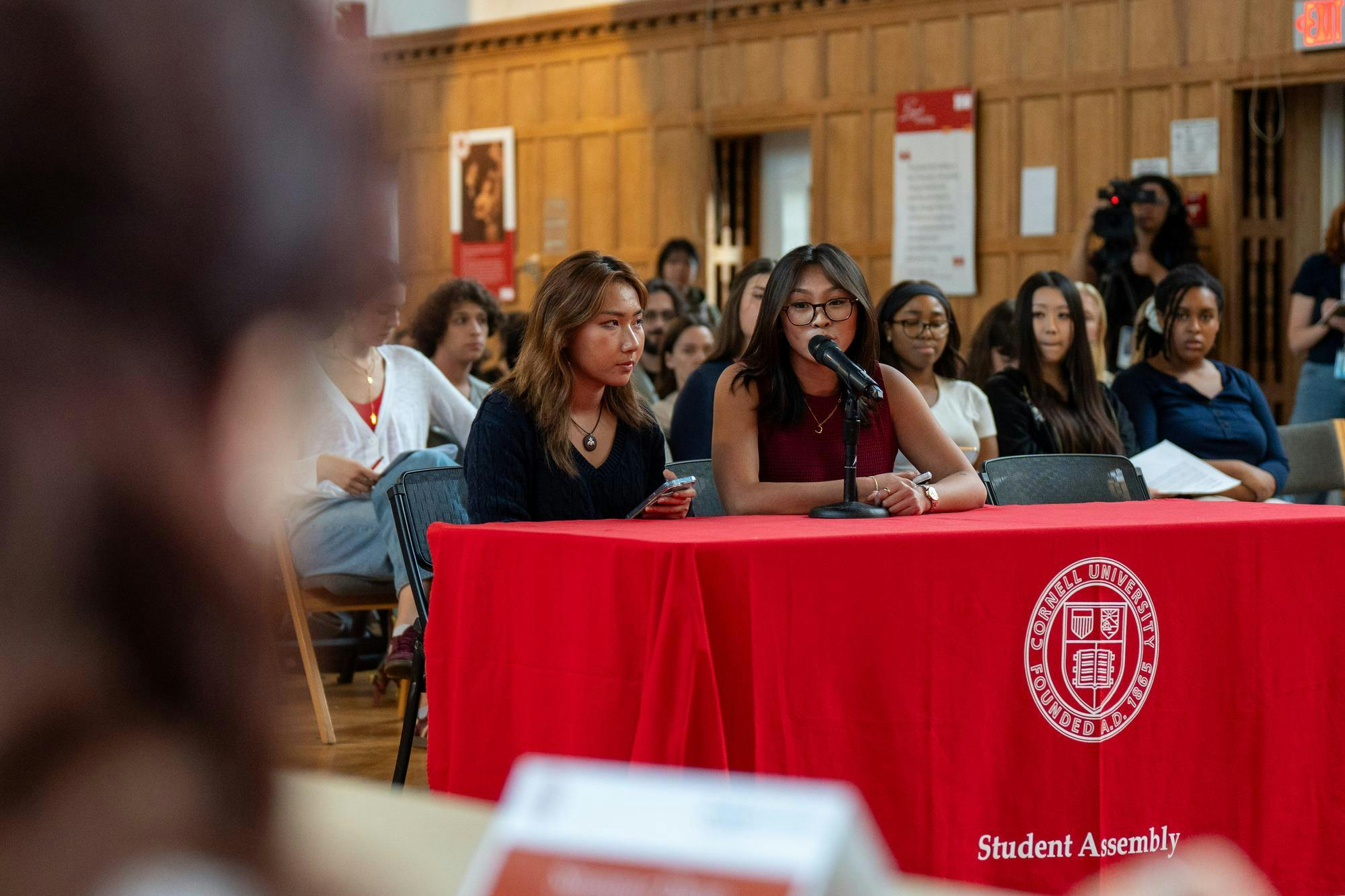
The Student Assembly hosted a public hearing on sexual violence and unanimously passed three resolutions related to the alleged 2024 Chi Phi gang rape and sexual assault on campus at its Thursday meeting.
Throughout the event — which drew approximately 100 students, faculty, parents, alumni and some administrators — attendees and Student Assembly members expressed frustration regarding a lack of transparency and accountability by the Cornell administration about the alleged Chi Phi gang rape.
The meeting comes after a former Cornell student, identified as Jane Doe, filed a Sept. 14 lawsuit, alleging that she was sexually assaulted and gang raped after being coerced into consuming drugs at Cornell’s Chi Phi fraternity house in 2024. The case, and conversations of how it was handled, have led to national uproar.
Reporters from news organizations from around the world, including The New York Times, CNN and BBC, attended the meeting and interviewed students outside of the meeting room.
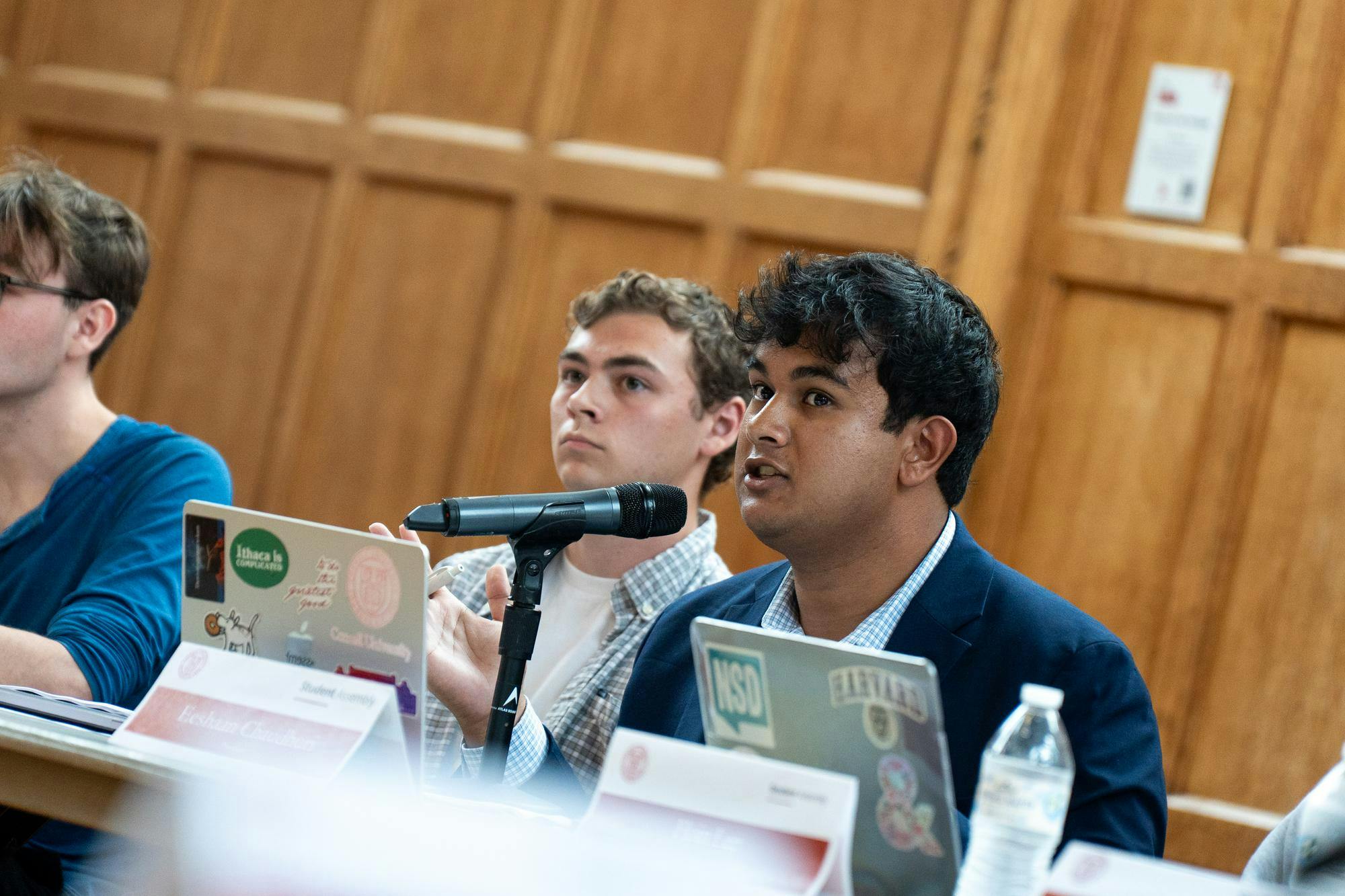
“I think we’ve made it abundantly clear over the past couple of days that we, as a campus community, stand with victims of sexual violence,” said Student Assembly President Eeshaan Chaudhuri ’27 at the start of the meeting. “I’m incredibly ashamed by the actions that happened, but I’m also incredibly proud of the work that students have been doing here on campus to stand up against these actions as well.”
Public Comment
Students raised concerns about Cornell’s lack of transparency and communication and shared personal experiences with sexual assault during the public comment period.
Sophia Riley Sim ’28, a Sun senior writer in the news department, and Jane Wang ’29 spoke on behalf of the American Civil Liberties Union Chapter at Cornell.
“The greatest failure was Cornell not protecting Jane Doe and allowing perpetrators to remain on our campus, but Cornell has also failed our community through its lack of accountability, transparency and failure to address the state of the Cornell student body at this time,” Riley Sim said.
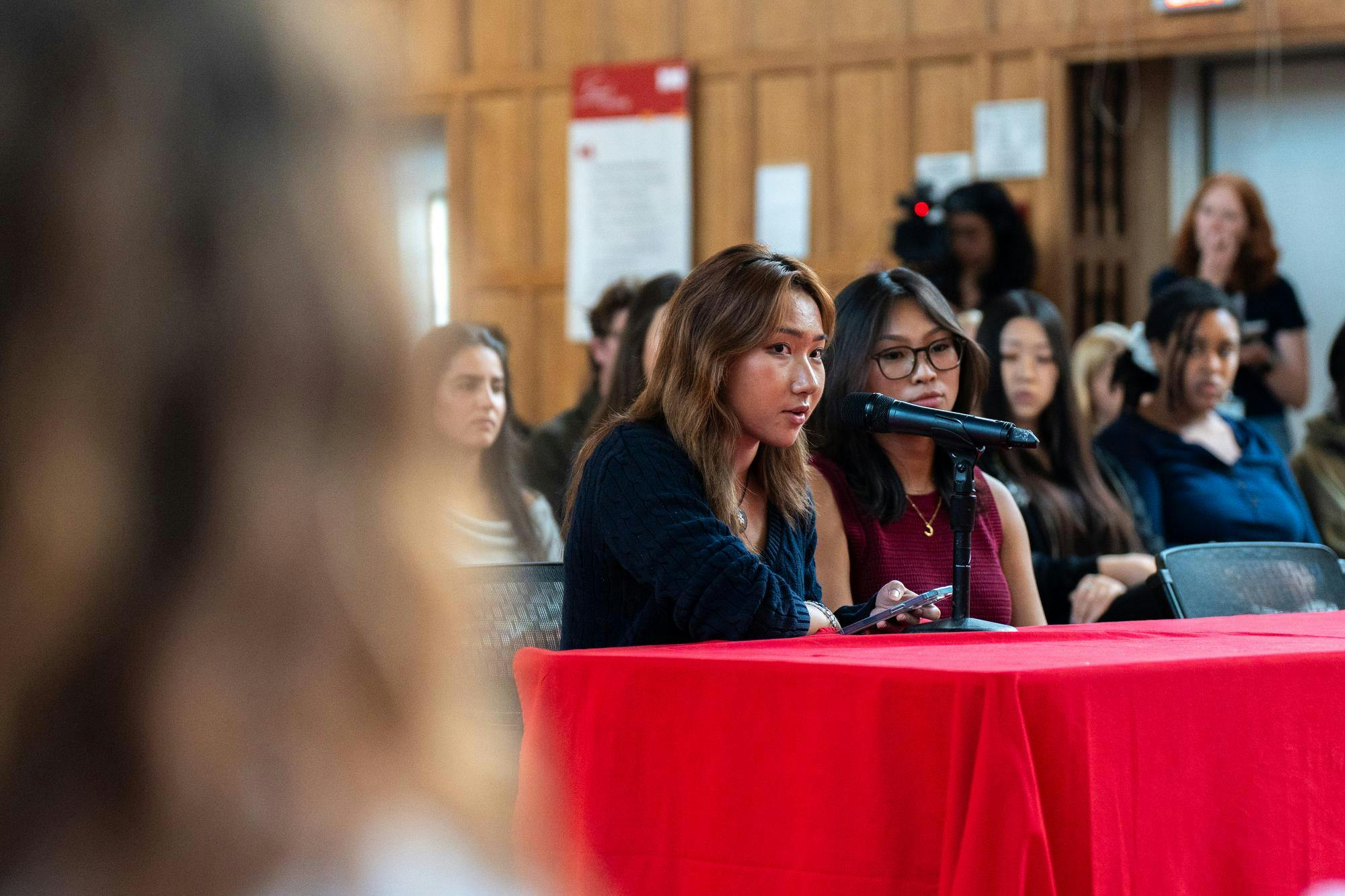
Jane Wang '29 spoke on behalf of the American Civil Liberties Union Chapter at Cornell at the event.
When asked about sentiments expressed at the meeting and the resolutions passed by the Student Assembly, a University spokesperson pointed to a video statement shared by President Michael Kotlikoff on Saturday.
“I also hear the frustration that Cornell has not communicated enough about what the university did after the assault was reported, which has led to distrust,” Kotlikoff said in the video. “There are real legal and privacy limits on what we can say. But we will make a greater effort to explain what we can, to provide context about the actions Cornell has taken and to be more transparent.”
Riley Sim advocated for accommodations for students struggling with academics in the light of the alleged Chi Phi gang rape and heightened media attention.
“This past week, I have skipped classes because I am trying to navigate something that does not feel possible to compartmentalize,” Riley Sim said. “I cannot pretend this is a normal Thursday when I am passing camera crews on my way to class. … The Cornell student body is facing a mental health crisis.”
Wang, who spoke alongside Riley Sim during the public comment period, described her experience as a survivor of sexual assault.
“I’m also speaking as a fellow Jane Doe,” Wang said. “One of the biggest factors in my healing and our healing as a whole is knowing that a broader system is in place for us to be able to find support and seek justice.”
Wang went on to discuss what she described as a “total lack of agency and accountability” in the Cornell Title IX Office’s response to sexual assault allegations. The office, housed under the Cornell Office of Civil Rights, handles cases of sexual violence, harassment and discrimination.
“I was also met with an abundance of paperwork, very little instruction on how to navigate it and no follow-up from our Title IX Office of an outcome,” Wang said. “Clearly, this is a historical and an institutional problem where Cornell has not built a culture within our leadership or within the offices that handle misconduct.”
Kotlikoff said in his video statement that the University will act on “opportunities to strengthen prevention and education, student support, mental health and substance-use resources, investigative processes or coordination among our university offices.”
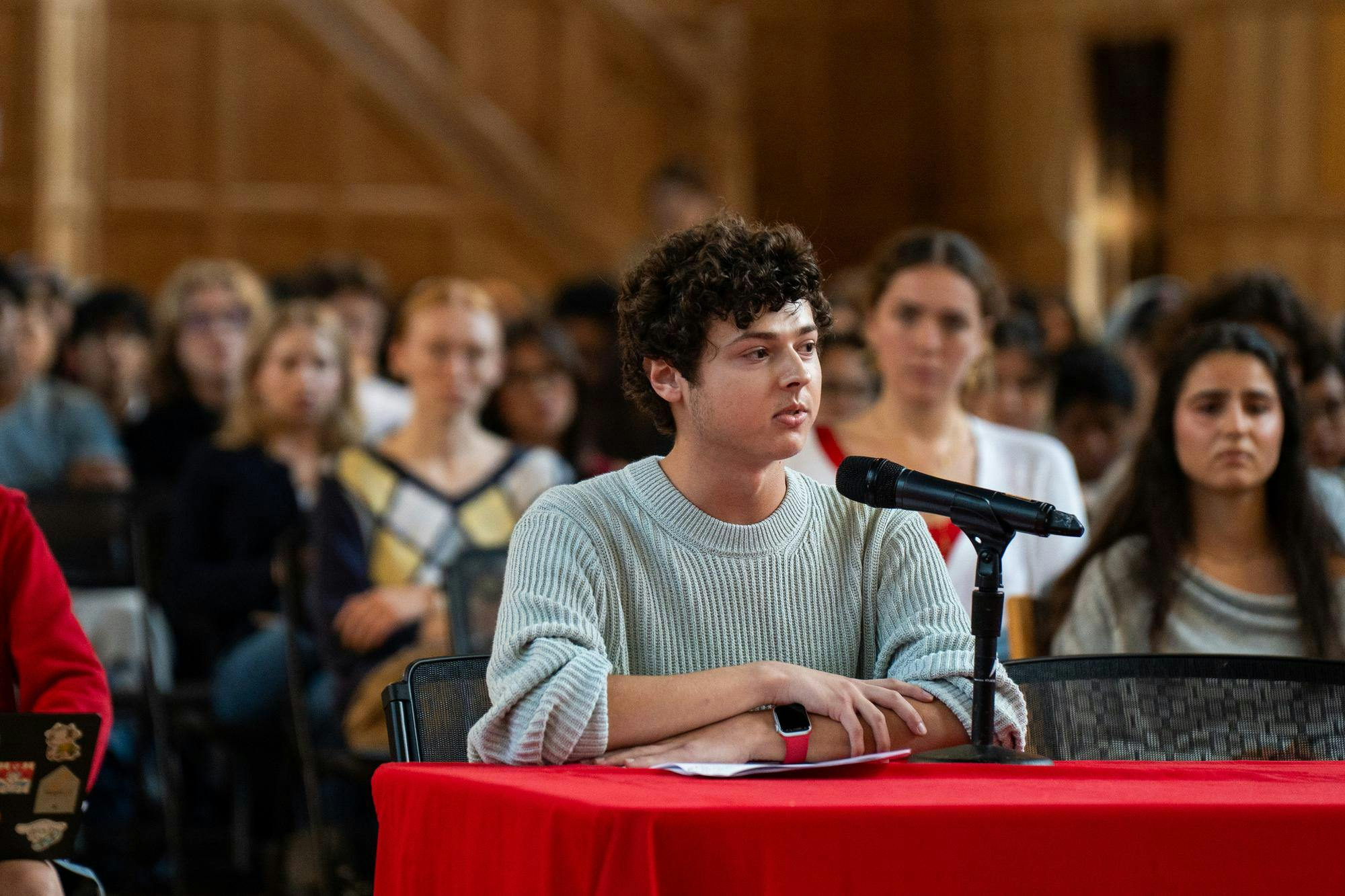
Another student who spoke during public comment, Mason Tavares ’30, recounted a conversation between him and one of his teachers when deciding whether to commit to Cornell.
“The teacher I was closest to told me, ‘Any institution you decide to go to is lucky to have you, not the other way around,’” Tavares said. “It is the students that show up every day, work hard and fight for our community that makes Cornell so exceptional.”
Following a public comment period in which attendees raised concerns regarding the Chi Phi incident, the Assembly held a hearing on sexual violence that was entirely off-the-record, meaning anything shared in the hearing was confidential and could not be recorded or photographed, Chaudhuri said.
The Student Assembly decided to split the public comment period into two parts, one on-the-record and one off-the-record, as a compromise between recognizing that “this is a public event” and that it “feel[s] like a Cornell space,” Hayden Watkins ’28, executive vice president of the Student Assembly, told The Sun after the meeting.
A reporter with The New York Times took a photograph during the off-the-record portion of the meeting. After the photograph was taken, Chaudhuri reminded members of the press that the public hearing was off-the-record and that the reporter who took the photo should delete it.
Chaudhuri wrote in a statement to The Sun that, after the meeting, an assemblymember went up to the reporter to confirm that the photograph was deleted.
“While we appreciate the press for covering this issue, we are appalled by the lack of decorum some of them displayed during the hearing, and will not stand for it,” Chaudhuri wrote to The Sun.
A spokesperson for The Times wrote in a statement to The Sun that the photo was not intended to be published.
“A Times reporter was present at an off-the-record event,” the spokesperson wrote. “She briefly took a photo as a visual reference. The photo was never shared or published; it was deleted to adhere to the event guidelines.”
Chaudhuri described the public hearing portion of the meeting as a success in an interview with The Sun.
“I’m really proud of the turnout that we got,” Chaudhuri told The Sun. “I’m proud of the fact that it started really slow — because I think people were really scared — but once people started speaking up, then it was like a floodgates. It literally just didn’t stop going, and that was amazing.”
Resolutions Related to Sexual Violence
Following the public hearing portion of the meeting, the Student Assembly transitioned to addressing resolutions. The representatives passed three resolutions — Resolutions 15, 16 and 17 — related to the alleged Chi Phi gang rape and sexual violence in unanimous deicisons of 24-0-0. The resolutions will head to the Office of the President for approval.
Resolution 15: Institutional Transparency and Accountability in the University’s Response to Sexual Assault
Resolution 15, drafted by the entire Student Assembly, was proposed to the Assembly in the Thursday meeting by Chaudhuri and Women’s Issues Representative Saanya Agarwal ’27.
“We’re asking for three very clear things,” Chaudhuri said. “Number one is transparency. Number two is accountability, [and] … third and finally, we’re asking for institutional reform.”
The resolution features 15 recommendations directed at the University administration, largely focusing on access to information regarding the alleged Chi Phi gang rape and sexual assault policies.
The provisions include the disclosure of violations and sanctions given to the defendants during the alleged Chi Phi gang rape case and the status of their degrees, a report of how Title IX handled the initial report of the alleged Chi Phi gang rape and general explainations of what the University can and cannot comment on in regards to sexual assault investigations.
The resolution pointed to federal privacy law allowing postsecondary institutions to disclose results of disciplinary proceedings where “the student is an alleged perpetrator of a crime of violence or non-forcible sex offense” and “has committed a violation of the institution’s rules or policies” with respect to the allegation.
The resolution also calls for the enforcement of drug and alcohol policy, especially in Greek life, and for the creation of an undergraduate task force on sexual assault prevention, comprising members of the Assembly and Greek life representatives.
“We have an opportunity to make some really big changes and we’re going to do that,” Agarwal said about the resolution.
Resolution 16: Requesting Consent and Substance Use Training Materials from Orientation
Resolution 16, authored by Watkins, requests that the Tatkon Center for New Students and other programs involved in orientation provide the Assembly with the training materials they use in regards to consent and substance use in order for the Assembly to suggest revisions.
The provided materials would be revised by the Assembly’s Campus Pulse Committee, chaired by Watkins, which serves to address “pressing needs of the Student Body” including biases such as sexism, according to the Assembly’s website.
During the announcement of the resolution, Watkins criticized an orientation training activity that a freshman on the Pulse Committee experienced.
“Consent was talked about in person with a metaphor of ice cream, which I didn’t think really gave the seriousness that was necessary for the topic,” Waktins said at the meeting.

Resolution 17: Granting Free Cornell Health Counseling for Survivors of Sexual Assault
The third resolution passed related to the alleged Chi Phi gang rape addresses access to resources for survivors of sexual assault.
Resolution 17, authored by Watkins and Director of Elections Sophia Trapani ’27, would provide a fee waiver for Cornell Health Counseling and Psychological Services to survivors of sexual assault. The resolution also asks that Cornell Health denote which counselors have specialized skills related to working with survivors of sexual assault.
“If a survivor has just gone through the worst nights, the worst days, the worst weeks of their life, they should be able to easily access information to help them start that path towards healing,” Trapani said at the meeting.
Chaudhuri described the three resolutions as “the first steps, not the last” in regards to the issue of sexual assault.
“This is a huge issue that is plaguing our entire generation and 3 resolutions, even if enacted in their entirety, is not enough,” Chaudhuri wrote in a statement to The Sun. “We’re calling on the entire Cornell community, and even beyond to help us craft policy solutions to change the culture on campus, and we’re hoping that a lot of the testimonies from the public hearing will serve as a groundwork for where to make the first steps.”

Coral Platt is a member of the Class of 2029 in the College of Arts and Sciences. She is a news editor for the 144th Editorial Board and can be reached at cplatt@cornellsun.com.