Editor’s note: This article references sexual violence.
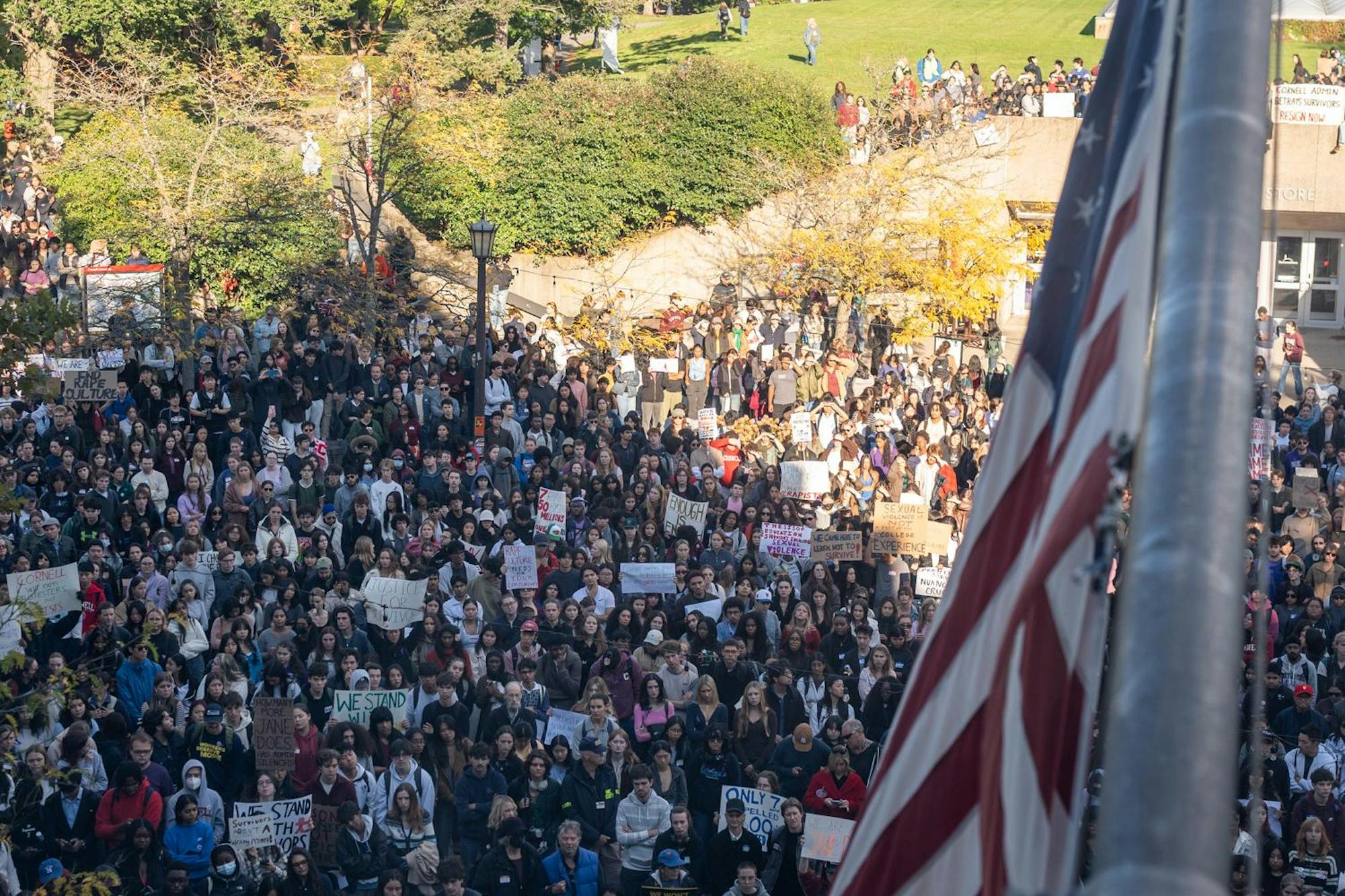
Thousands of students, faculty and Ithaca community members flooded Ho Plaza on Monday evening for a “Justice for Survivors” rally held in response to the alleged 2024 Chi Phi gang rape case.
Speakers representing a variety of backgrounds — from undergraduates in multicultural groups to Cornell Graduate Students United to individual professors — spoke on the steps of Willard Straight Hall. Speakers expressed frustration with the University’s handling of the alleged Chi Phi gang rape, discussed the intersectional nature of sexual violence and voiced the organizers’ demands of the University — including CGSU’s call for President Michael Kotlikoff to resign.
Approximately 40 student organizations, including Students for a Democratic Cornell, Planned Parenthood Generation Action at Cornell, Cornell NAACP and Movimiento Estudiantil Progressive Action, took part in organizing the rally, which started on Ho Plaza and ended in front of Day Hall.
The protest comes after a former Cornell student, identifying as Jane Doe, filed a Sept. 14 lawsuit alleging that she was sexually assaulted and gang raped after being coerced into consuming drugs at Cornell’s Chi Phi fraternity house in 2024. The case and details about the University’s response have since sparked national outrage.
Saya Taylor ’29, a member of SDC, opened the rally by criticizing Cornell for enabling “sexual assault culture.”
“For everybody here, for all of the news outlets watching us, I just want to say one thing: Stop calling it the Cornell Seven. It’s Cornell,” said Taylor. “The systems placed by this University and the state of New York have allowed sexual assault culture to thrive and for rape to go unpunished.”
Taylor then encouraged the attendees to be the change they want to see.
“Cornellians, if you want to be proud to call yourself that again, then fight,” Taylor said.
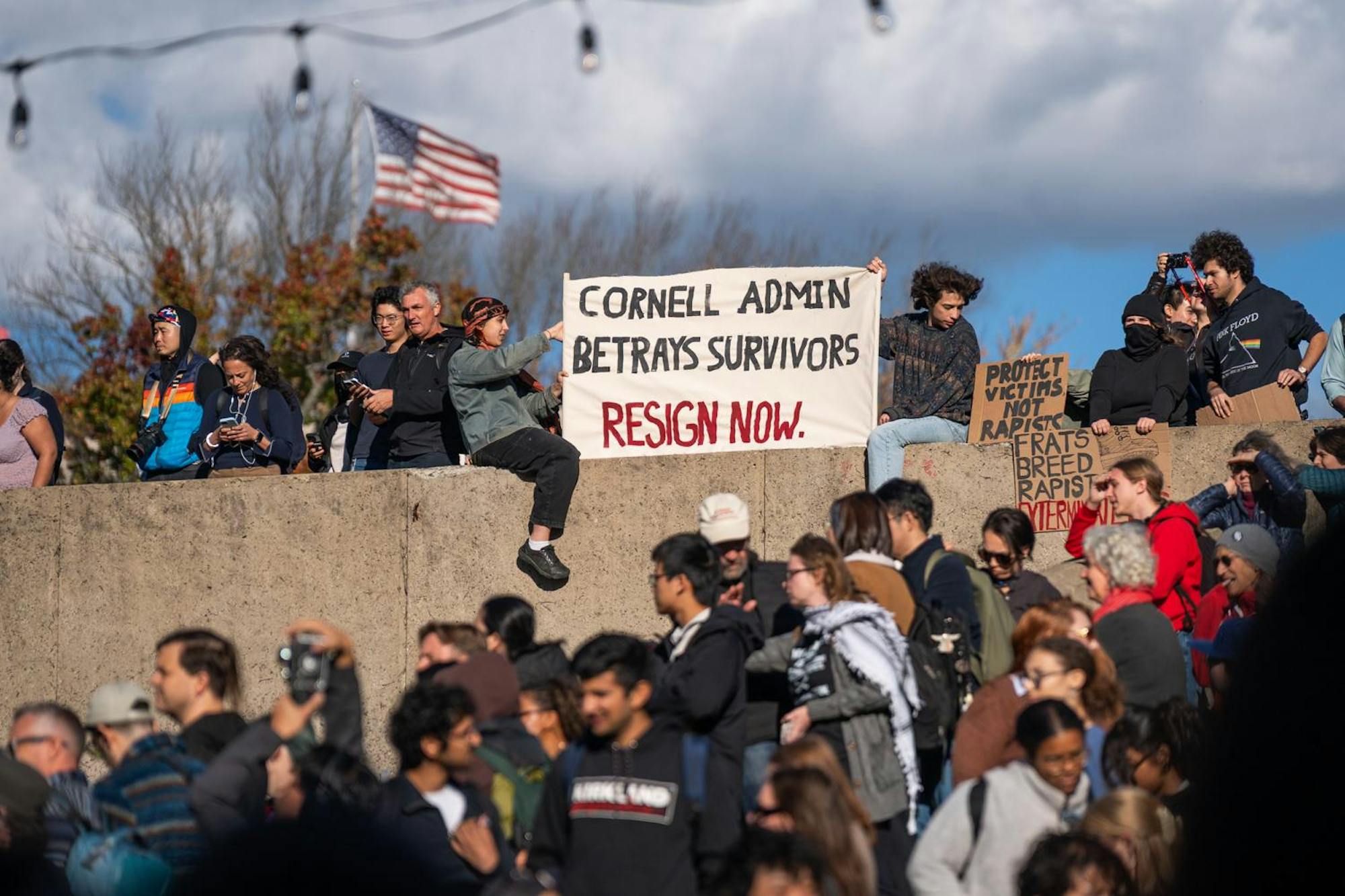
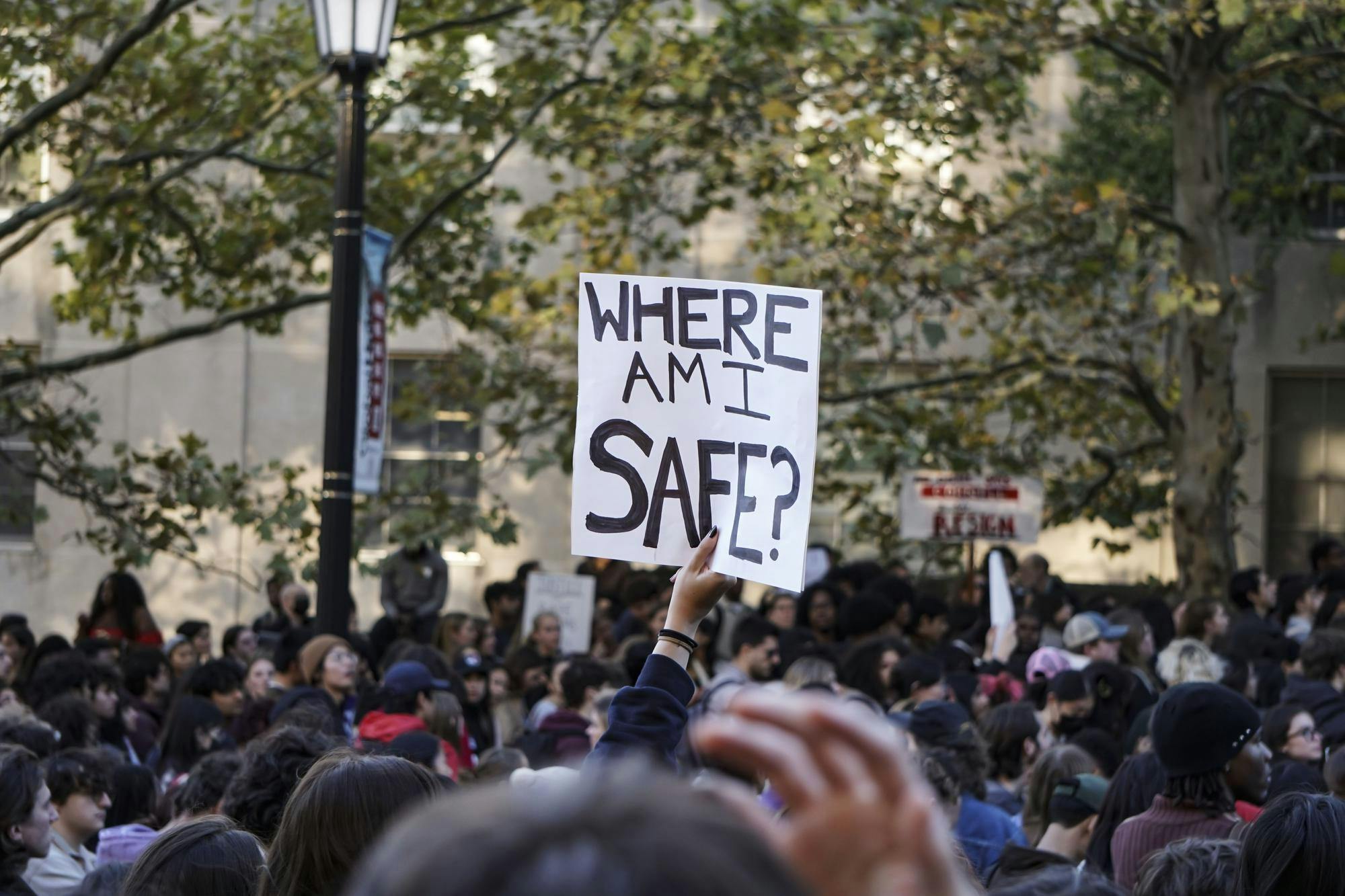
The crowd, scattered with signs voicing frustration with the University administration and support for Jane Doe, stretched above The Cornell Store and across Ho Plaza. The signs had phrases such as “We are Jane Doe,” “Prison Sentences Not Essays,” and “Cornell Protects Rapists.”
Taylor’s speech was followed by statements from seven students and professors representing organizations including Cornell NAACP, Cornell Asian Pacific Student Union and Native American and Indigenous Students at Cornell before protesters marched to Day Hall to continue the rally in front of the University’s administrative offices.
‘Speaking Out Comes With a Price’
Athena Holloway ’27, former president of Black Students United and president of Cornell NAACP, spoke next, discussing free speech on campus and Cornell’s history of protest.
“When I first came to Cornell, I was excited … I heard ‘any person, any study,’ and I believed it,” Holloway said. “So, imagine the disappointment of discovering what can happen when that ‘any person’ needs help, when that ‘any person’ speaks out, when that ‘any person’ demands accountability.”
Holloway pointed to the Afro-American Society Willard Straight Hall Takeover of 1969 and Latino Cornellians’ Day Hall Takeover of 1993 as times students successfully organized to demand change of the University.
“Cornell has changed before, and we can change it again,” Holloway said.
Jocelyn Jao ’28, a member of Cornell Asian Pacific Student Union, shared a story about one of her friends, a Korean international student, who didn’t attend the protest out of a fear of retribution, connecting her friend’s experience with broader concerns about activism on campus.
“Across this campus, students are afraid that speaking out could mean being disciplined, suspended or losing their place here,” Jao said. “International students worry about losing their visas. Students on financial aid worry about their scholarships. All of us have been taught that speaking out comes with a price.”
Other speakers drew connections between activism on campus and the alleged Chi Phi gang rape.
Andrea Cicirello, a fourth year Ph.D. student and CGSU financial secretary, compared the University’s response to the alleged Chi Phi gang rape with its response to a September 2024 pro-Palestinian protest at the Statler Hall career fair. The two incidents took place approximately two months apart.
At least 15 students were suspended for shutting down the career fair — with some banned from campus for up to three years.
“Cornell administration responded [to the career fair shutdown] swiftly and aggressively, suspending students and threatening grads with deportations,” Cicirello said. “Their reasoning was that immediate action was necessary to protect the University community. At the exact same time, the seven men who raped Jane Doe were being protected by this University. For them, there apparently was no immediate action necessary to protect the University community.”
The punishments of the seven defendants listed in Jane Doe’s lawsuit ranged from educational sanctions and no-contact orders to suspensions and expulsions, according to documents obtained by The New York Times.
Three professors, Prof. Sabrina Karim, government, Prof. Julia Chang, romance studies, and Prof. Dan Hirschman, sociology, concluded the speeches at Ho Plaza.
“They call it the ‘Cornell Seven,’ but we are Cornell too,” Chang said. “The decades of Jane Does are Cornell. The 58,000-plus alumni who signed the petition in support of Jane Doe, they too are Cornell. The dozens of student organizations that make this protest happen today, you are Cornell.”
A petition of Cornell alumni pledging to withhold donations to the University in support of Jane Doe has surpassed over 60,000 signatures.
‘Do Not Let This Fight End Today’
The protesters then marched from Ho Plaza to Day Hall, which serves as the main administrative building on campus.
Once at Day Hall, several students led a protest song called “The rapist is you,” which was created by the Chilean feminist movement Las Tesis. The call-and-response song featured lyrics in both English and Spanish connecting rape to the patriarchy.
Following the song, three organizers of the protest, Marianne Levitova ’29, Izzy Margolin ’29 and Emely Gutierrez ’28, listed the organizers’ demands of the University regarding sexual assault and the handling of the alleged Chi Phi gang rape.
The organizers demanded that Cornell expel or revoke the degrees of all of the alleged assaulters, implement mandatory sexual assault trainings for all students and trauma-informed trainings for the Cornell University Police Department, initiate an external investigation into its handling of the case and return to a University-wide judicial system independent of the administration.
The organizers’ demands for an external investigation were echoed by Gov. Kathy Hochul (D-N.Y.), who called for a “transparent, independent review” of the University’s response to the alleged 2024 gang rape on Sept. 29. New York State Attorney General Letitia James (D-N.Y.) launched an investigation the same day.
The demands also ask Cornell to revise Policy 6.4 — which addresses sexual misconduct — to require independent hearings and minimum sanctions for sexual assault violations, and to comply with New York State’s “Enough is Enough” law, requiring universities to adopt “a set of comprehensive procedures and guidelines” regarding sexual misconduct.
A view from Day Hall during the Monday demonstration.
Some speakers at the protest announced individual demands related to the alleged Chi Phi gang rape. Cicirello called for the resignation of several top administrators, including Kotlikoff, Provost Kavita Bala, Ryan Lombardi, vice president for student and campus life, and Chirstina Liang, director of the Office of Student Conduct and Community Standards.
Hirschman called for the banning of fraternities on campus in his speech, saying that fraternities are “the places where the most horrific events happen over and over again.”
Several students involved in organizing and attending the protest expressed frustration with the handling of the alleged Chi Phi gang rape and shared that they attended the protest to show solidarity and create change regarding sexual violence on campus.
El Claver ’28, a safety marshall for the rally, told The Sun they chose to participate because the case has been “depressing” and left them feeling “helpless.”
“When the administration that’s supposed to protect you doesn’t, you feel the need to take it into your own hands,” Claver said.
Josefina Rodriguez, a graduate student at Cornell, explained that she attended the protest both to create change and engage with the community.
“I chose to be here today because I’m f*cking angry,” Rodriguez said. “I need to see change and we are furious and I also cannot stand processing these types of situations alone. I feel like it’s a collective situation that we all need to face.”
For Emeka Okereke ’28, attending the protest was important to him, to “show support, especially as a male on campus.”
Madeline Gage ’27, a member of the American Civil Liberties Union Chapter at Cornell concluded the rally by thanking Jane Doe.
“In standing up for yourself, you have inspired others to stand up for all survivors,” Gage said. “We cannot take away the failures of the past, but we can commit to preventing them in the future.… Do not let this fight end today or with Jane Doe. Dare to envision a future free from sexual violence, and continue to fight for it.”
The University declined to comment.

Mary Caitlin Cronin is a member of the Class of 2028 in the College of Agriculture and Life Sciences. She is a news editor for the 144th Editorial Board and can be reached at mcronin@cornellsun.com.

Coral Platt is a member of the Class of 2029 in the College of Arts and Sciences. She is a news editor for the 144th Editorial Board and can be reached at cplatt@cornellsun.com.