


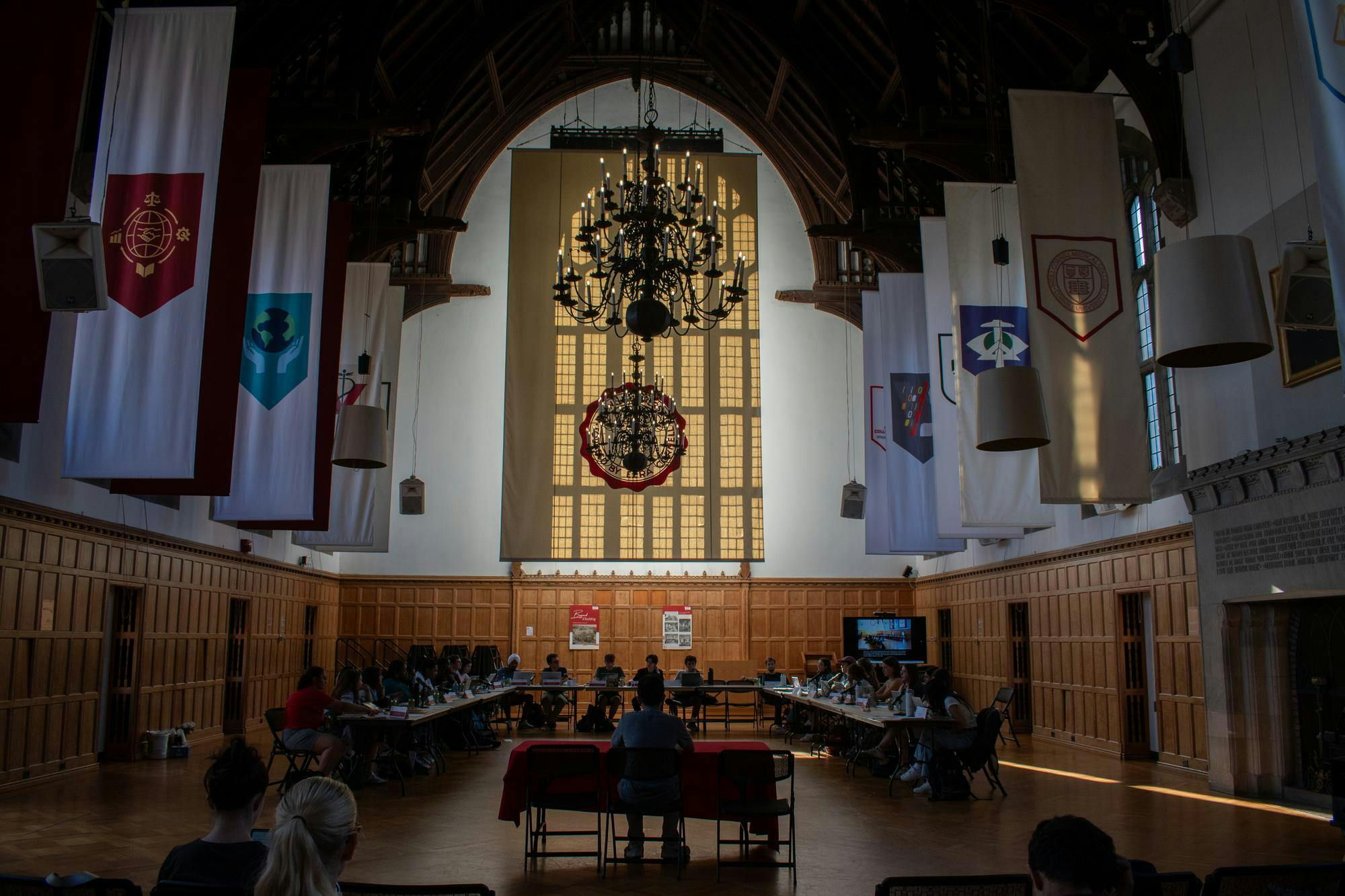
A hot topic at Thursday’s Student Assembly meeting surrounded a proposed change to the add-drop period that would substantially shorten the period in which students can drop courses without receiving a withdrawal –– or “W” –– notation.
The change, proposed by the Faculty Senate in March 2026, would require students to drop classes by the 11th day of class, one day after the add deadline, rather than the current course drop deadline where students have up until the end of the ninth week of the semester. The proposal would also move the deadline for changing a course’s grading option.
“I think there’s a large disconnect between students and faculty about what should happen,” Christian Tarala ’27 said.
Alexander Walters ’28, vice president for communications, introduced the issue.
The resolution “does a lot of things, and mostly under the umbrella of restricting students’ autonomy in deciding their educational path,” Walters said.
Walters pointed specifically to students pursuing research, who may enroll in a heavier course load while waiting to hear back from research opportunities, and later drop a course to make room for a lab. Under the proposed deadline, he said, students who receive those decisions after the first 11 days of classes would have to decide between passing up an opportunity or receiving a “W” on their transcript.
Walters also said that the proposed drop deadline could “affect the ability for students to prioritize their mental health.”
Ellie Porter ’29, undergraduate representative to the University Assembly, also raised concerns that shortening the drop period could discourage students from exploring unfamiliar subjects.
“I think another important thing to note is the fact that we are a liberal arts institution that emphasizes the exploration of people coming in here,” Porter said. “If … someone drops [a course on] the 12th day and they get a ‘W,’ that decreases the amount of students who’d be willing to try out courses.”
Porter said that she had asked faculty members during a University Assembly meeting whether first-year students could receive a more flexible deadline. She said the idea was received positively, but that no such provision was currently being developed.
Chaudhuri emphasized that because the proposal originated in the Faculty Senate rather than the Student Assembly, Student Assembly did not have the power to amend the resolution on their own.
The Faculty Senate published in its resolution a report outlining its reasoning, which Chaudhuri explained he believed was in “the spirit of collaboration and goodwill.” Tarala said faculty members expressed concerns about students dropping courses due to poor academic performance.
The Faculty Senate does not plan to vote on the proposal until November, Chaudhuri said, leaving several weeks for discussion with other shared governance bodies. He explained the proposal had already received “pretty strong pushback” from student, graduate student and employee perspectives during the Sept. 15 University Assembly meeting.
Resolution 10 Reiterates University’s Medical Excuse Policy
The Student Assembly also unanimously passed Resolution 10 on Thursday, calling on faculty leadership to enforce the existing health excuse policy and discourage instructors from requiring medical documentation for short-term illnesses.
The resolution targets instances when students are required by their instructors to provide doctor’s notes for short-term illnesses that lead to missed classes or assignments, and asks the University to remind faculty of existing University guidance which prohibits this.
“Faculty should not be asking for medical information, nor do you have to provide it to them,” according to Student Disability Services’s website on temporary health conditions.
The Faculty Handbook explains that Cornell Health “does not provide excuses for routine illnesses, injuries, and mental health problems” and suggests that professors work with students on these issues.
Resolution 10 highlights how this policy can pose issues for students.
“A student who is asked for a note (that Cornell Health will not write) is left with two choices: accept a zero or an unexcused absence, or seek care from an off-campus urgent care, telehealth service or private provider for the sole purpose of getting documentation,” the resolution reads.
The resolution’s authors, Women’s Issues Representative Saanya Agarwal ’27, Lydia Blum ’27, College of Agriculture and Life Sciences representative, and Assembly President Eeshan Chaudhuri ’27, argue that requiring medical documentation creates disparities for students who are unable to seek care outside Cornell Health — particularly first-generation and low-income students, international students and those with high-deductible or out-of-state insurance plans.
The resolution calls on the Office of the Dean of Faculty and the Office of the Vice Provost for Undergraduate Education to remind instructors of the policy and enforce it.
The resolution also encourages instructors to build flexibility into their courses for short-term illnesses, including options such as dropping the lowest exam score, offering make-up prelims or reweighing missed exams.
Resolutions for Next Week
- Resolution 9: Expanding the Office of Ethics and the Office of Elections, Requiring Continuity of Membership, and Establishing an ROTC Liaison, would allow the Office of Ethics and the Office of Elections to bring in additional members while retaining some returning members in an effort to maintain and pass down institutional knowledge. It would also create a non-voting seat for an ROTC representative.
- Resolution 11: Modernizing the Student Assembly Charter by Removing Organizations Not Funded Directly by the Student Activity Fee makes “small updates to the Student Assembly Charter” by removing organizations “no longer funded” by the fee, following previous resolutions passed this term clarifying the relationship between clubs, the Assembly and the Student Activity Fee.
- Resolution 12: Enforcing Transparency for Student Activity Fee Spending requires that “all registered student organizations to publicly disclose how Student Activity Fee money is used.”
- Resolution 13: Reframing Policy Committee dissolves the internal Policy Committee in favor of “weekly office hours” held by the Vice President for Policy to “support community policy development and committee leadership.” Students interested in the Policy Committee will be redirected “into a subcommittee where their interests are more applicable.”
- Resolution 14: Promoting Transparency in Additional Course Costs, urges the Faculty Senate to require that instructors disclose “the estimated cost of required materials” that are not covered by the Cornell Academic Materials Program. If, once passed, President Kotlikoff approves the recommendation, the resolution’s author, Saphira Augustin ’29, will have the opportunity to present the motion to the Faculty Senate.

Emma Spindler is a member of the Class of 2028 in the College of Arts and Sciences. She is a senior writer for the news department and can be reached at espindler@cornellsun.com.


