


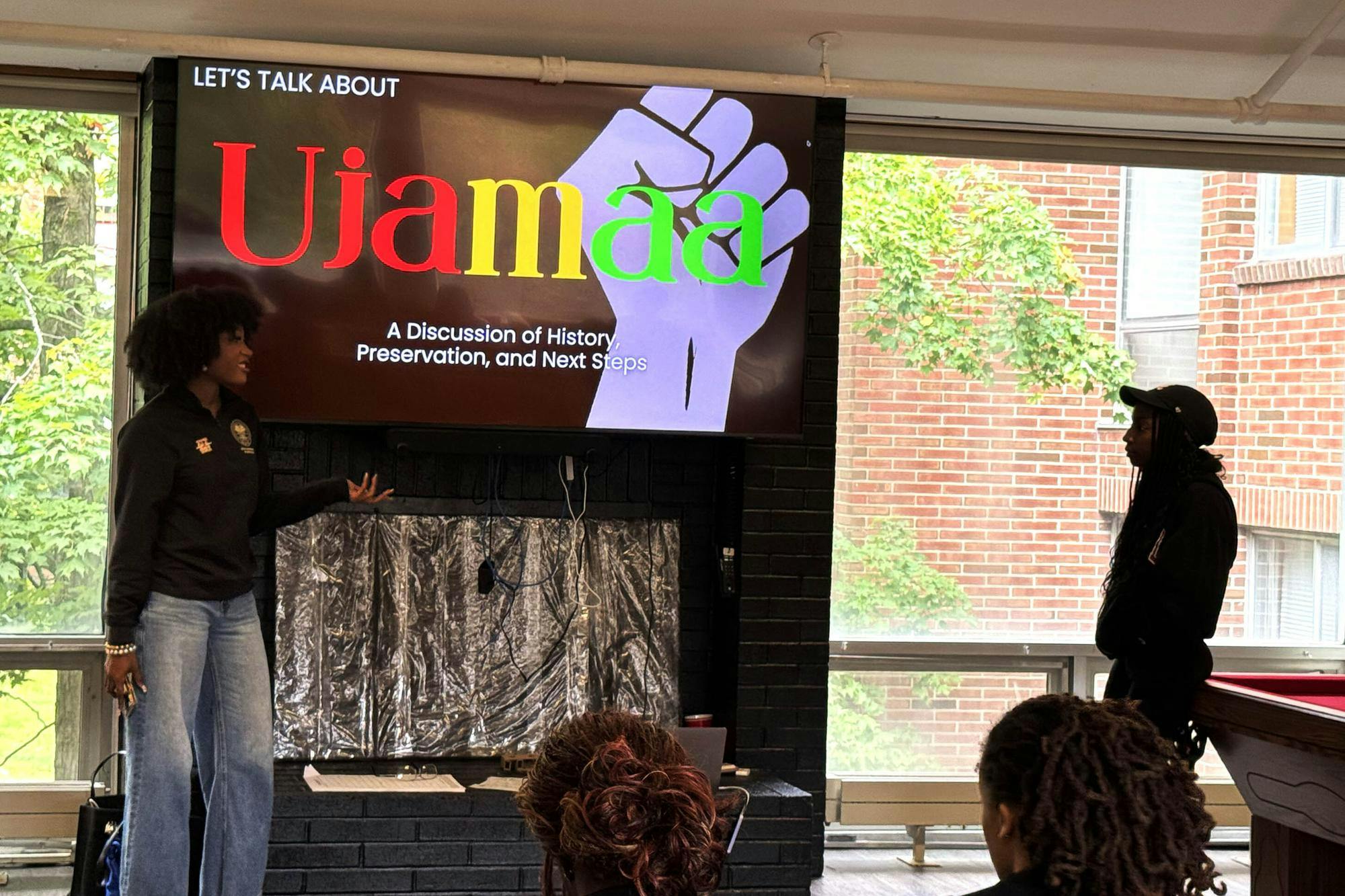
Around two dozen students gathered in Ujamaa Residential College’s main lounge on Sunday to discuss changes in the program house’s residential community and what it will take to preserve its historic role as a center of Black student life.
The discussion, hosted by Jordanne Nichols ’27 and Kennedy Young ’28, executive officers of Black Students United, comes after Ujamaa community members stated that the University removed historical and culturally-significant Black artwork from the program house in August.
Titled “Ujamaa: A Discussion of History, Preservation, and Next Steps,” the discussion explored different perspectives on why fewer Black students are living in Ujamaa, with attendees pointing to University housing practices and the building’s aging facilities and accessibility issues.
Ujamaa residents previously told The Sun that the house’s Black residential population had declined significantly. In May 2026, resident adviser Amadou Agne ’27 estimated that about 30% of Ujamaa residents were Black, down from approximately 60% during his first-year in 2023.
“Being a minority student at Cornell … there aren’t very many places to connect with other Black Cornellians,” Agne told The Sun. “If Ujamaa is not serving that purpose, that’s a major loss for Black students on the Cornell campus.”
Ujamaa’s roots go back to Black student activism in 1969, as the historical portion of the event noted.
In the presentation, Nichols emphasized the necessity of establishing Black spaces like Ujamaa “back then” due to the “very toxic environment” of “divisive racial dynamics" on campus.
In the early morning hours of April 18, 1969, a burning cross was discovered outside of Wari Cooperative, a house for Black women on campus.
The following morning, members of Cornell’s Afro-American Society occupied Willard Straight Hall for roughly 36 hours until peaceful negotiations were reached with Cornell officials. Among their demands were an Africana center, recognition of Black studies and a residential space for Black students –– demands that helped lay the groundwork for Ujamaa’s establishment in 1972.
A Shifting Residential Community
Black students make up 3.4% of first-years in the Class of 2030, while another 1.6% identify as multiracial with Black and/or Indigenous heritage, according to newly released admissions data.
Black student enrollment has remained substantially below pre-affirmative action levels following the Supreme Court’s 2023 decision restricting the consideration of race in college admissions.
Black students made up 4.7% of first-year admissions in the Class of 2029, 4.3% for the Class of 2028 and 7.3% for the Class of 2027. These numbers show a significant decline from data released for Fall 2021, when Black students made up 9% of first-years.
At Sunday’s discussion, some students blamed the University for changes at Ujamaa.
“We’ve also had issues in the past of Black students applying to be in [Ujamaa] but being placed elsewhere,” Young said during the presentation. “[The University is] actively attacking the community by not allowing us to be in this space.”
In a statement to The Sun, Housing and Residential Life stated its intention is “to always match as many students that preference program houses with their selection as possible,” except when Student Disability Services accommodations or conflicting roommate preferences cannot be met by a given Program House’s facilities.
HRL also pointed to the Priority Program House Selection process introduced in the 2025-2026 academic year, which allows rising juniors and seniors to express interest in up to three program houses and receive priority selection timeslots for those communities.
Removal of Historic Artwork
Nichols said BSU was concerned about the recent removal of artwork and murals from Ujamaa by the University. She shared that a common space painted in green, a color of the Pan-African diaspora representing the abundant, natural wealth of the African continent, had been painted white by maintenance staff over the summer in addition to dozens of art pieces being removed.
“The artwork, the murals, the paintings are something that are very deeply entrenched to the space of [Ujamaa] and why it exists as it does,” Nichols said.
In response to those claims, HRL claimed the artwork was “temporarily relocated” over the summer to allow for planned wall repairs and painting. According to their statement, Ujamaa student leadership was contacted before the work began and participated in a walkthrough of the space.
The University said the artwork was preserved so residents could help determine its placement and presentation after returning to campus, but did not disclose where the artwork was being stored or when it would return to the building.
“This was intended to give current residents a voice in shaping their community while updating displays to reflect student interests and create a more cohesive presentation through consistent framing,” HRL stated.
HRL also stated that new artwork and mural-style installations may follow a model used in Toni Morrison Hall, which allows pieces to remain movable for fire precautions or for potential changes to community spaces.
Concerns Over Aging Facilities
The condition of Ujamaa’s facilities was another concern raised at the event.
Nichols pointed to the lack of elevators, air conditioning and other accessibility issues. She said Ujamaa can be difficult for students who “need an environment that is a bit more modern.”
HRL stated that “several improvements are planned for Low Rise 10, home of Ujamaa,” including new lounge and lobby furniture, an evaluation of flooring improvements, modernized lighting in common areas and upgraded technology for residential programming.
“While some projects have already been completed or are underway, others remain in development and will be implemented as planning and resources allow,” HRL stated.
The University did not address the specific concerns about the lack of elevators and air conditioning in its response to The Sun.
“If we don’t all get together and talk about what it is that we think should change, [Ujamaa] might not exist as a space that we all used to know,” Nichols said on Sunday.
Students also discussed a lack of information on Ujamaa for prospective students.
One first-year audience member said while filling out their housing application, they struggled to find information about the residence online.
Another first-year resident said the information they found online made the building appear “scary and dark,” but that their impression changed once they arrived.
Another resident said the matter extended to a “lack of recognition" of Ujamaa on campus. The student shared that most first-year students she has met were not aware of Ujamaa.
In an interview following the event, Nichols and Young raised a similar concern about physical signage around North Campus, saying signs direct students toward numbered Low Rises without prominently identifying Ujamaa.
At a scheduled meeting following the event, Ujamaa student leadership and Residence Hall Director Trinity Hinton met with University administrators for a walkthrough of Ujamaa to discuss concerns about the program house and its facilities. The walkthrough included representatives from Facilities and Campus Services and HRL, as well as Dean of Students Marla Love.
During the walkthrough, Young said that she pointed to changes that the University “can fix right now,” like the fourth floor lounge, which she said lacks central air and has two fans, only one of which works. She said that she did not receive a response to her comment.
What Comes Next for Ujamaa
With feedback from the attendees, Nichols outlined possible short-term changes during the event, including new murals, laundry and facility improvements, additional programming, community spaces and a community garden.
Longer-term ideas included accessibility improvements, establishing a Black student resource center, securing dedicated funding and expanding community space.
In an interview after the event, Young told The Sun she sought data on how many students request and are assigned to Ujamaa but was denied access to the figures.
The University did not provide The Sun with data on how many students requested or were assigned to Ujamaa, nor did it address the reported decline in the residence’s Black population.
Nichols added that this information is important because renovating Ujamaa alone would not resolve questions about who is a part of its residential community.
For Young, what happens next “depends on if Cornell [is] able to openly commit to restoring this space.”
“If they’re not looking to restore [Ujamaa], we have to go back together and learn about what that looks like for us moving forward,” she said.
Young said administrators agreed to begin meeting with students monthly to continue discussing concerns about Ujamaa.
“I think it’s nice to meet everybody in the same room,” Young said after the walkthrough. “I feel like we had some productive conversations [during the walkthrough], but other conversations didn’t feel as productive. It had its pros and cons.”

Emma Spindler is a member of the Class of 2028 in the College of Arts and Sciences. She is a senior writer for the news department and can be reached at espindler@cornellsun.com.


