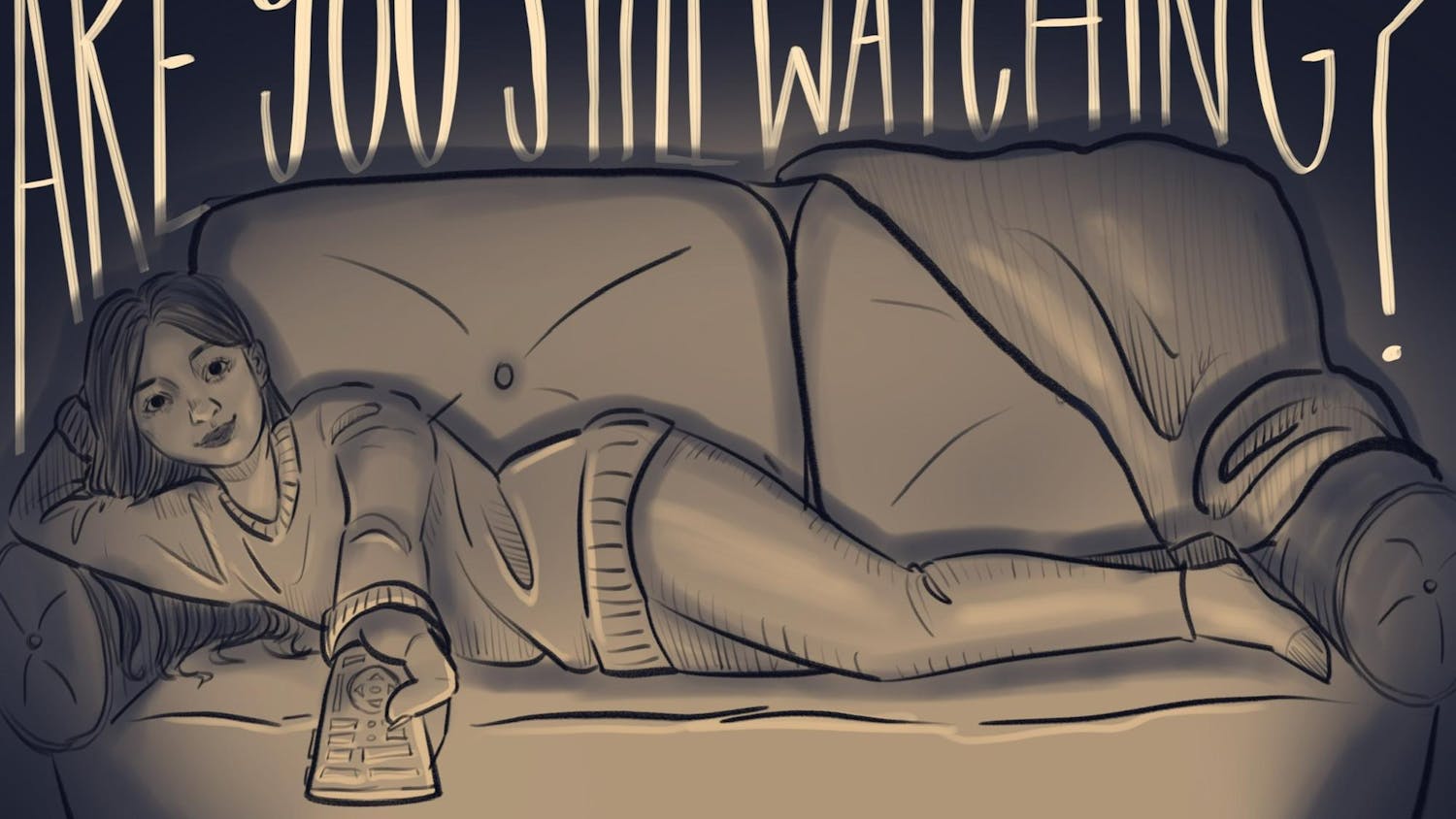
At only 23 years old, pop savant Olivia Rodrigo has seemingly fully realized the sickening nature of love.
Despite her age, the songwriter’s qualifications are career-defining, with her debut album Sour holding the record for the “longest-running debut album on the Billboard 200 Top 10 this century.” Success so young creates expectations that Rodrigo manages to raise whilst evolving. In her new album, you seem pretty sad for a girl so in love (stylized in all lowercase as a deliberate Gen Z cool girl move), she mixes her typical style of gut-wrenching ballads with ’80s synth beats. Rodrigo exits her Courtney Love-esque comfort zone, drawing closer into The Cure’s orbit.
Although the album splits into two distinct parts, Rodrigo makes it clear that each cannot exist without the other. The opening track and lead single “drop dead” immediately captivates the listener in a Versailles-worthy love story. Rodrigo flirts with her soon-to-be lover, her lyrics intentionally conversational, peppering in references and inside jokes. That aspect of welding conversation into poetry is a tactic she employs perfectly, depicting the thrill of learning everything about someone you deeply want to love.
In “stupid song,” she laments that no piece of music can describe the thrill and fear of falling in love (a concept practically unheard of to a music lover). Within this palpable synth-heavy desire, there’s an aching anxiety. Rodrigo shifts to her beloved piano (which has gifted us “drivers license” and “the grudge”) for “honeybee” where she melodically declares her deep love found in the fear of a looming goodbye.
Almost as if to compensate for that soft vulnerability, Rodrigo pivots to synth again with “maggots for brains,” which, despite the nauseating title, makes you want to dance. Feeling very “Friday I’m in Love,” she declares how without her “baby” she transforms into a brainless zombie, rotten and useless. While a romantic sentiment for some, the metaphor rings of self destruction. Her adoration has morphed from thrilling to oppressively omnipotent, all under an upbeat guitar and drums. Rodrigo almost assumes she must remain like this, only as long as she’s in love. “I know everybody changes, but I hope that we don’t” is the defining line in “u + me = <3.” Using the oldest trick in the book, she shows the wreck her relationship is headed for without explicitly saying it.
Retreating slightly into her pop-punk roots, Rodrigo writes of her jealousy in “my way,” blasting a girl (presumably some scorned ex) for writing poems and posing in her lover’s clothes. Using 2000s-style drums and the refrain of a siren, she declares herself a “petty bitch” before anyone else can. And yet, Rodrigo intentionally never questions her lover for his lack of defense. She doesn’t sing about his own thoughts on some girl wearing his old clothes. Rather, Rodrigo and her lover have become a unit, which is echoed in “purple.” The couple has become so thoroughly combined — melted together — that they’ve lost the ability to see the world alone.
On the heels of this omnipotent togetherness, Rodrigo realizes that, despite its strength, their love cannot fill every little crack in her happiness facade. The album’s second single, “the cure,” merges acoustic and full rock to create a ballad exposing her inability to sustain herself purely on love. It’s here where Rodrigo has the great realization we all must: Nothing material can be the solution when the problem is found entirely in ourselves.
Her insecurities, once hidden in the lines, display themselves prominently in “begged,” a guitar ballad where she guiltily reveals that her lover’s words mean less when she knows she forced them. To her, her devotion has been blazingly prominent. And yet, in spite of their unity, her lover cannot measure up. Deeply self-aware, Rodrigo spirals into a duet with The Cure’s frontman Robert Smith on “what’s wrong with me” where she can no longer ignore the paralyzing discomfort of her love. She ends the track with a lullabic echoed cry to her lover that “I think you’re what’s wrong with me.” Her realization, amidst a soft retro beat, is the point of no return for both the album and their relationship.
Turning back to her piano, Rodrigo solidifies a gentle tune of finality in “less.” No other instrument could perfectly convey the sting and ache of being broken up with. Although both Rodrigo and her lover knew the relationship wasn’t working, it was him who decided he loved her too much to see her suffer a minute more. In her melodic and easy vocals, Rodrigo manages to capture the special kind of grief over something that was once near-perfect, even in its current destruction.
The final two tracks of the album deal in her mourning, both pursuing different approaches. “Expectations” returns to the funky dance vibe, where she describes her mini dress and vodka cran, with her greatest new possession being a new set of considerations for future partners. The facade of moving on is dropped fully in the closing track of the album, “cigarette smoke.” Rodrigo croons and strums her guitar, finally turning all her bitterness toward her lover. For an album where she spends so much time in her own head (and even blaming another girl) she closes with a mix of despair and anger. Here she reaches a clarity previously elusive. She escapes from the oppressive nature of adoration and embraces the tenderness of a scorned lover.
In the closing track, Rodrigo sings in a grand chorus “Why’d I try at all?” Yet, we know why she tried. She tried because butterflies and a stomach ache are one in the same. She tried because of the beautiful, thrilling, oxygen-sucking spark that deep love lights. It’s not a cure — as Rodrigo makes clear — but it isn’t nothing.
Although the memories now turn dark, they were once glowing. Isn’t that motivation enough?

Kate LaGatta is a member of the Class of 2029 in the College of Arts and Sciences. She is a columnist for the Arts & Culture department and can be reached at klagatta@cornellsun.com.