Cornell Cinema’s projectionist preserves the craft of film exhibition while pursuing a decades-long creative project of his own.
If everything goes according to plan, no one notices the projectionist.
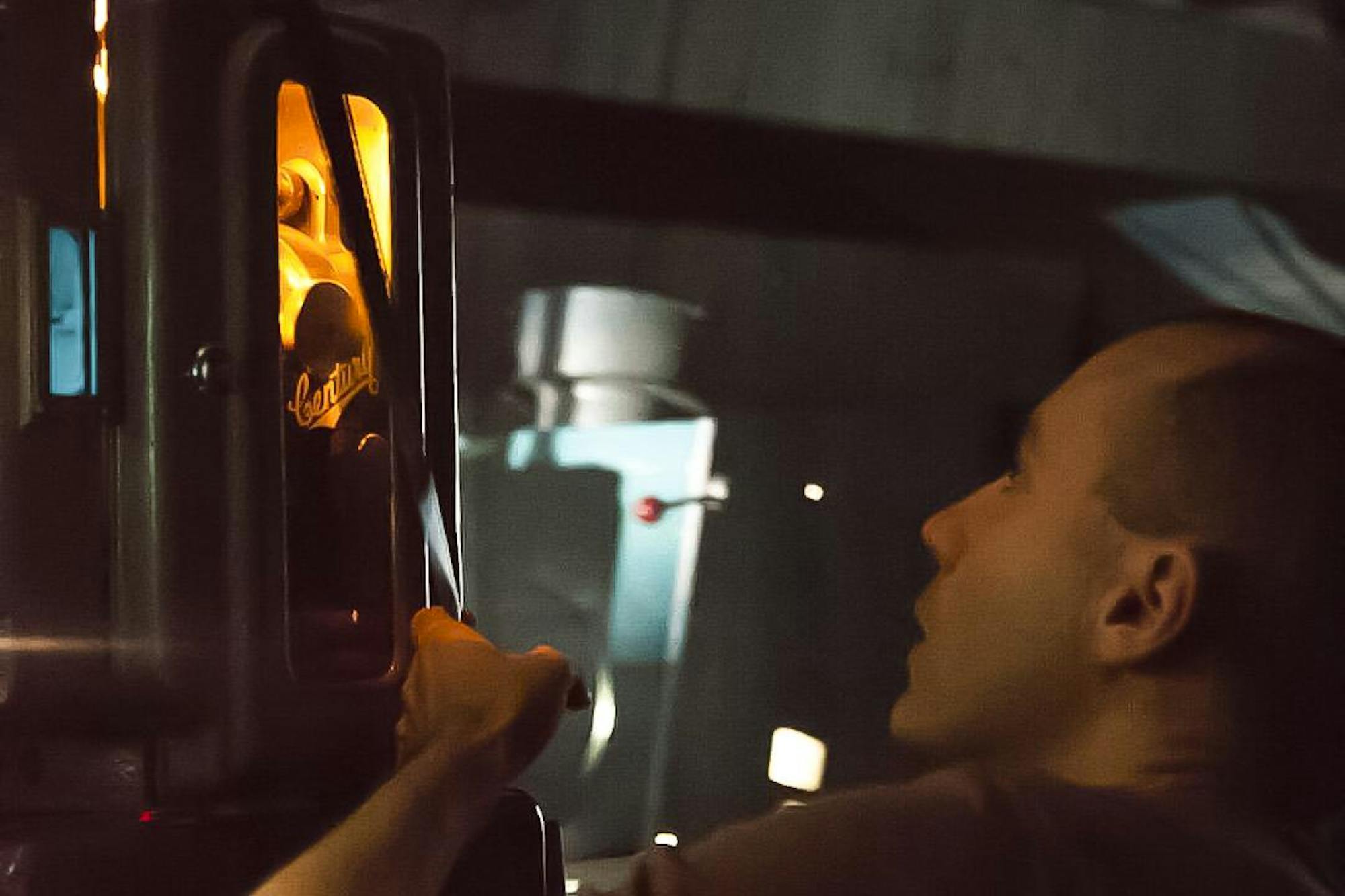
The projection booth at Cornell Cinema is dark where eyes adjust. 16 and 35 millimeter film reels marked with grease pencil line the shelves. Two film projectors sit side by side, a digital overhead hums quietly in the center and through a small window the faded walls of the empty theater stretch below.
This is where Tim White spends most afternoons — watching the audience watch the movie.
“It's a place to come and focus,” White said. “You're not bombarded by commercials vying for your attention.”
White, the lead projectionist at Cornell Cinema, arrived in Ithaca about a year and a half ago after years drifting through arthouse theaters, archives and film festivals, including Sundance. His work has taken him through institutions like Lincoln Center, Film Forum and The Museum of Modern Art in New York City, reinforcing his belief that cinema deserves to be experienced with care.
By day, White manages the technical aspects, as well as the student staffing, of the projection booth for the historic 1920 Willard Straight Theater. The discipline begins in the afternoon: testing digital files, checking audio levels and preparing the booth for the evening’s screenings.
But his life in film extends beyond the booth. Behind the technical work is a restless curiosity shaping both his career and a multi-decade filmmaking project. Originally from Rochester, White’s career in projection started accidentally while working at Rochester’s High Falls Film Festival. Eclectic temporary jobs carried him cross-country — Los Angeles, Oregon and, finally, New York City. His most formative stop was Anthology Film Archives, a nonprofit institution devoted to experimental cinema.
White recalls knocking on the door and simply asking if they needed help.
“It just so happened [that] it was a night where there were no screenings, and the director happened to answer the door,” he shared. “I gave him my resume and through an informal process I was hired.”
During his decade there, White interacted with filmmakers who pushed the boundaries of what movies could be, far removed from film culture of Hollywood. “I realized there’d been this whole aspect of filmmaking that was more aligned and kindred to pure creative art, rather than cinema productions involving hundreds of people.” Experimental filmmakers often work independently, creating projects outside traditional studio systems. For White, cinema became a medium that could be deeply personal and philosophically driven.
In 2008, White read a book that changed the way he thought about the world. Cosmos and Psyche, by cultural historian and astrologer Richard Tarnas, explores relationships between planetary movements and patterns in human history. Though initially skeptical, White said the book became a personal renaissance. “The book was written as a kind of Trojan horse into that academic world,” he commented.
The novel’s argument for a meaningful connection between planetary cycles, synchronicities and human events sparked what would become White’s personal film project. He has been developing the film on his own in fragments and experiments in various studios, coast to coast, for more than a decade.
“I began filming as early as 2014, recording narration, filming on location in California, filming visual effects in analog methods from 2016 to 2018 and have continued in fits and starts,” White said.
Inspired by Tarnas’ brilliance, White has come to see film as a route to conversation. This spark for reassessment pushed him back toward academia through literary courses connected to his project. “I'm making the film, in some way, to generate a conversation about the book,” he said. That culture of discourse, White says, is evident within Cornell Cinema. Presley Jordan ’28, a sophomore in the College of Arts and Sciences and a house manager at Cornell Cinema, shared that the collaborative atmosphere among staff members is integral to what makes the theater work.
“I went to Sundance under the impression of learning about law and movies,” Jordan said. “Similar to Tim, you meet a lot of people who do a lot of different things and take on different projects.”
After interviewing multiple student employees, one thing is clear: Cornell Cinema’s eclectic programming offers moments multiplex theaters simply cannot. Audiences frequently linger in the lobby after screenings discussing films with friends, staff members or strangers who have just shared the experience, something White is now proud to be a part of. “Everyone that comes to a cinema hopefully understands there's a pact that people are making that we're going to be present and concentrate on this thing that people have worked hard to make,” White said.
In an era when technological distractions continue to increase and many people watch films alone on laptops or phones, the theater’s atmosphere feels increasingly rare. For White, that collective focus is one of the most important aspects of cinema. “For many people, what has become an acceptable level of immersion has shrunk and shrunk and shrunk to the point where people will watch a movie with headphones [in] on their smartphone,” noted White, who doesn’t own a smartphone. “To me, that's kind of unfortunate.”
White speaks about film with the kind of encyclopedic recall that only comes from years spent watching, threading and studying it. Many projectionists carry creative ambitions of their own, developing projects between screenings while studying every rhythm, frame and technical detail that keeps cinema alive. Still, the booth remains hidden from the audience.
When the theater lights fade and the film begins, the projector hums softly above the crowd and somewhere behind the glass, Tim White watches the audience watch the movie, another perfectly timed changeover unfolding unnoticed.
Grace Downing is a member of the Class of 2026 in the College of Arts and Sciences. She can be reached at gkd28@cornell.edu.
The Sun is interested in publishing a broad and diverse set of content from the Cornell and greater Ithaca community. Arts & Culture wants to hear what you have to say about the arts, our cultural moment and our creative community at large. We welcome guest pieces for our guest column, Be Our Guest. Please email associate-editor@cornellsun.com.