The first time I encountered the musical Urinetown, written by Greg Kotis, I thought it was a joke. I sat through a two-hour production about a dystopian world in which you have to pay to pee and left, woefully missing the mark on the social and political implications of the show. Only after watching the Melodramatics Theatre Company perform Urinetown last weekend, five years after my first watch, did the depth of this dark comedy set in. Though laced with campy theatrics and satirical jabs at the wealthy bourgeoisie, Urinetown makes an entirely serious point about the fate of our world should we neglect to take care of it.
“Don’t you think people want to be told that their way of life is unsustainable?” announced Officer Lockstock (Jana Mildner ’26), the show’s self-aware narrator, as Urinetown came to a close. Mildner noted that this was, in essence, the theme of the show: the “brutal lesson” that the audience should walk away with. In the world of Urinetown, a 20-year drought has led to the widespread ban of public toilets in an effort to preserve water. Instead, inhabitants of each town must pay a fee in order to use a public urinal, fees which are enforced by a monopolizing corporation headed by the flamboyant and charismatic Caldwell B. Cladwell (Alex Miloszewski ’27).
Of course, this results in tension between the low-income townspeople and the upper-class businessmen and police officers, essentially forming a clan divide akin to that of West Side Story or Romeo and Juliet. And sure enough, an unexpected connection arises between Hope (Arianna Regis ’29), the daughter of Cladwell, and Bobby Strong (Astrid James ’27), the leader of the townspeople revolution — it’s about as cliche as it comes. This bond, as well as rising discomfort about Cladwell’s iron grip on the town, ultimately leads to a high stakes battle between the rebellion and law enforcement, raising awareness not only about the underlying implications of a struggle between capitalism and socialism in times of crisis, but also the presence of indiscriminate police brutality.
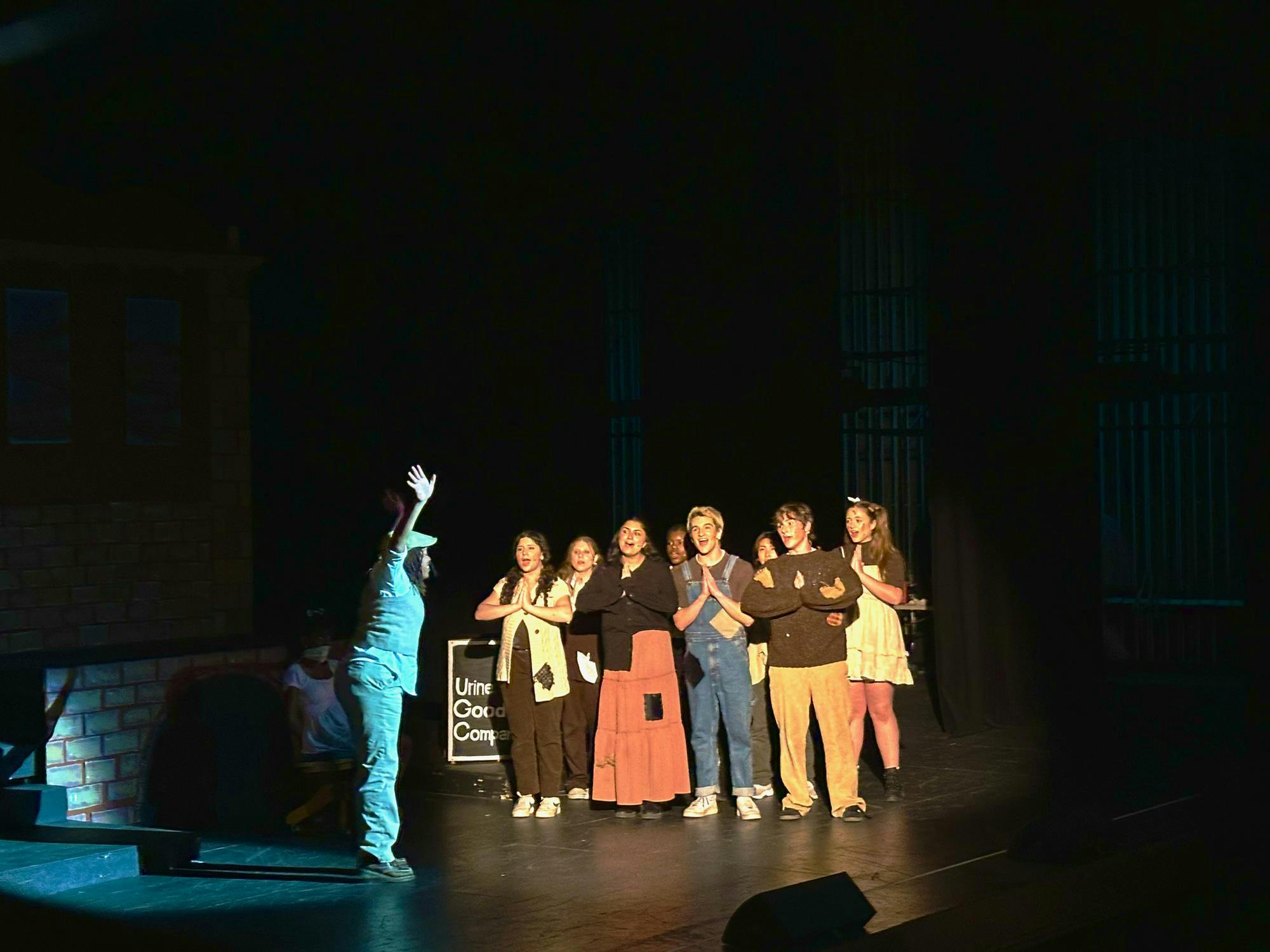
Urinetown employs Brechtian Theatre techniques, also known as Epic Theatre, which alienate the audience from the plot to encourage them to think more critically about the social and political message of the show. Such techniques include breaking the fourth wall, as Officer Lockstock often did in order to provide deadpan exposition or detached commentary, a rejection of realistic staging, which led characters — specifically in Cladwell’s office — to behave more like caricatures than believable human beings and a concrete, unchanging set that focused plot development almost entirely on the actors. The set of Urinetown in the Schwartz Center’s Kiplinger Theatre was designed by Zjena Salmon-Plasil ’28 and consisted of a single house, center stage, with a public bathroom off to stage right and Cladwell’s corporate headquarters rising in the background, conveniently shaped like McGraw Tower in a subtle statement about the reflections between the two corporations.
Brechtian Theatre focuses on a style of staging that is almost cartoonish, with exaggerated movements and slapstick comedy. Urinetown emphasized this, particularly in the satirical, fast-paced “Cop Song,” featuring Officers Lockstock and Barrel (Matthew Kushner ’29). With straight faces, both Mildner and Kushner delivered a hilariously dark performance, portraying with uncomfortable irony the dynamic of fearmongering between law enforcement and the townspeople.
Another highlight of the Melodramatics’ production was the townsperson ensemble. This group of nine showcased not only powerful vocals but also complicated and riveting choreography. Each actor shone in individual solos, and together the group dynamic was electric, featuring engaging character choices and even a series of flips and tumbles from freshman Peter Buskirk.
Caricature acting was present across the cast, particularly for Cladwell, but Miloszewski noted that this exaggerated facade dropped in the second act in order to rein in the comedy and draw the audience’s attention back to the seriousness of the subject matter. After all, past the urine jokes and the fun poked at businessmen, Urinetown is at its core a prophetic vision of the world to come should we continue to allow it to deteriorate. Though the fictional musical portrays a dystopic world, the dynamics between the bourgeoisie and the proletariat are based on fact.
Urinetown is a dense musical, but the Melodramatics tackled it masterfully. The eclectic mix of jazz and boogie-woogie music alongside high-energy choreography by Reese Zolkin ’29 fostered the perfect, comedic environment to consider the climate crisis. Although a musical about pee might sound unappealing on the surface, it deals with current political dynamics with more brazenness than many musicals I know. And after walking out of that theatre, you’ll never take your toilet for granted again.

Gia Lish is a member of the Class of 2029 in the College of Arts and Sciences. She is a staff writer for the Arts & Culture department and can be reached at glish@cornellsun.com.