


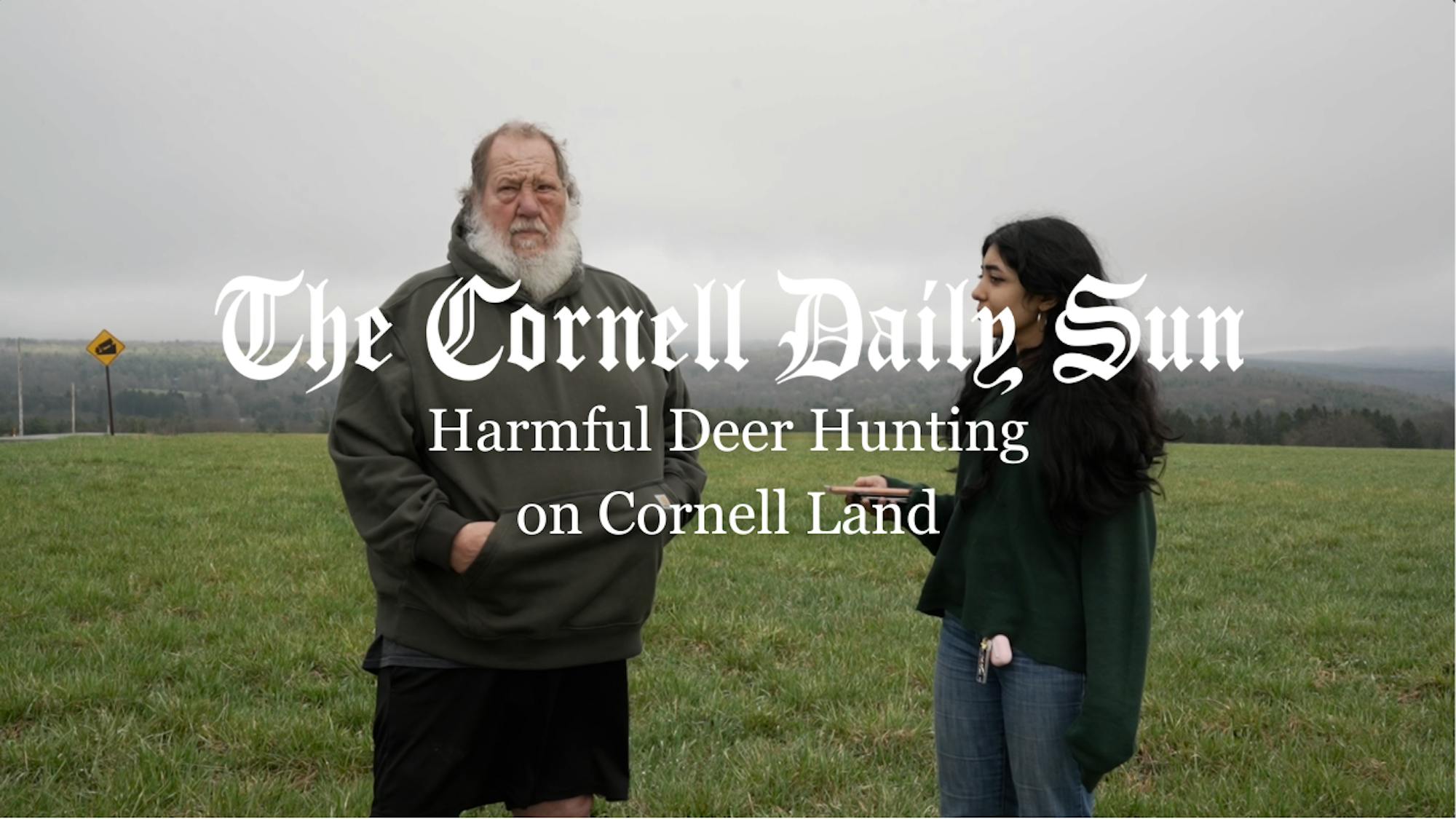
In many areas across its 5,490 acres of land, Cornell allows for deer hunting, aiming to improve forest health. Local hunters like Bill Enslow, however, claim that overhunting is destroying the deer population.
The Cornell Botanic Gardens website links increased deer populations to “reduced forest structure, decreased native plant populations …, increased invasive species growth, and higher rates of Lyme disease” in Cornell’s natural areas, when compared to 20-30 years prior. Deer management, or deer hunting, the site states, makes for “good stewardship” of land.
Enslow, however, believes “that nature will take care of itself.”
“I don't believe there should be any hunting on Cornell land,” Enslow said in an interview with The Sun. “But if there [is], do what the state does with their hunting season, don't say, ‘well, the deer are killing off the woods,’ and do a genocide right now.”
Enslow said he used to hunt deer in the University-owned Mount Pleasant area, but now claims that he does not see deer there anymore.
As a hunter in the area, Enslow shared concerns that, especially during the winter, some hunters bait and shoot deer, alleging to have knowledge of hunters using corn to lure deer on the land without repercussion.
When asked about whether Cornell uses baiting tactics to hunt deer, a University spokesperson wrote that “ all of our management programs are legal and comply with New York State Department of Environmental Conservation regulations and applicable laws.”
According to the NYSDEC big game hunting regulations, the use of bait or salt licks to hunt deer is illegal.
In 2008, the Botanic Gardens expanded their deer management and hunting programs “to include broader ecological management goals” focused on forest regeneration, part of which includes partnering with the NYSDEC in piloting New York’s first Deer Management Focus Area.
The DMFA, which encompasses over 60,000 acres surrounding Ithaca, allows for an extended hunting period in areas of “overabundant deer populations.”
Within the DFMA, registered big game hunters can hunt up to two antlerless deer per day during the general hunting seasons — which includes the regular firearm deer hunting season from Nov. 15 - Dec. 7 and the bowhunting and muzzleloading seasons spanning from Nov. 15 to Jan. 1.
During bowhunting season, hunters with the proper permits can use vertical bows or crossbows, while during the muzzleloading season, a muzzleloading rifle or pistol loaded through a muzzle which shoots a single projectile with a bore of 0.44 inches or larger can be used.
They are also able to hunt during a special DMFA season running from the second Saturday in January to January 31, according to the NYSDEC.
Additionally, Deer Damage Permits, a kind of animal nuisance permit, can be issued when hunting during the regular hunting seasons fails to curb impacts of deer overabundance.
Currently, Cornell land is open to nuisance deer management from Feb.1 - April 13 at McLean Bogs, Edward Lake Cliffs, Fischer Old-growth Forest, Coy Glen, Eames Memorial, Ringwood Ponds and South Hill.
White-tailed deer, the only deer allowed to be hunted on Cornell-owned land, breed from October through January and give birth in late spring — the same time frame that DDPs allow for extended hunting.
Enslow said he and other hunters he’s spoken to in the area “don't like the ethics of shooting pregnant does and fawns after the regular hunting season.”
Local hunter Mitch Sutfin, who has lived in the Ithaca area since 1959 and hunted on its land for over half a century, said he first noticed a decline in the deer population around seven or eight years ago.
Around that same time, he said he quit hunting in the Mount Pleasant area, where he said “you can sit [for] a week on [the] bordering property of Cornell, and you won’t see a deer.”
Sutfin additionally mentioned hearing about baiting tactics used by both Cornell and the City of Ithaca.
“It’s almost a genocide,” Sutfin said. “Deer will go to a food supply. They're hungry, it's cold, it's a shame.”
Enslow said that he thinks the Cornell student body “should be made aware of [the hunting]” because students hike in the greater Cornell land, and he’s “sure that they’d like to see the wildlife.”
“I would really like the student body to know about [the hunting],” Enslow said. “Let them decide. I'll go along [with] whatever they decide. You know, if they decide it's okay — all right — it's your deer, it's your wildlife. I would think that people would like to see deer, watch them [and] not kill them.”
Article by Shubha Gautam
Filmed by Amogh Baradwaj
Edited by Amogh Baradwaj
Produced by Amogh Baradwaj and Benjamin Leynse
Amogh Baradwaj is a member of the Class of 2026 in the College of Arts and Sciences and a video staffer for The Cornell Daily Sun. He can be reached at ab2982@cornell.edu

Shubha Gautam is a member of the Class of 2028 in the College of Arts and Sciences. She is an assistant news editor for the 144th Editorial Board and can be reached at sgautam@cornellsun.com.


