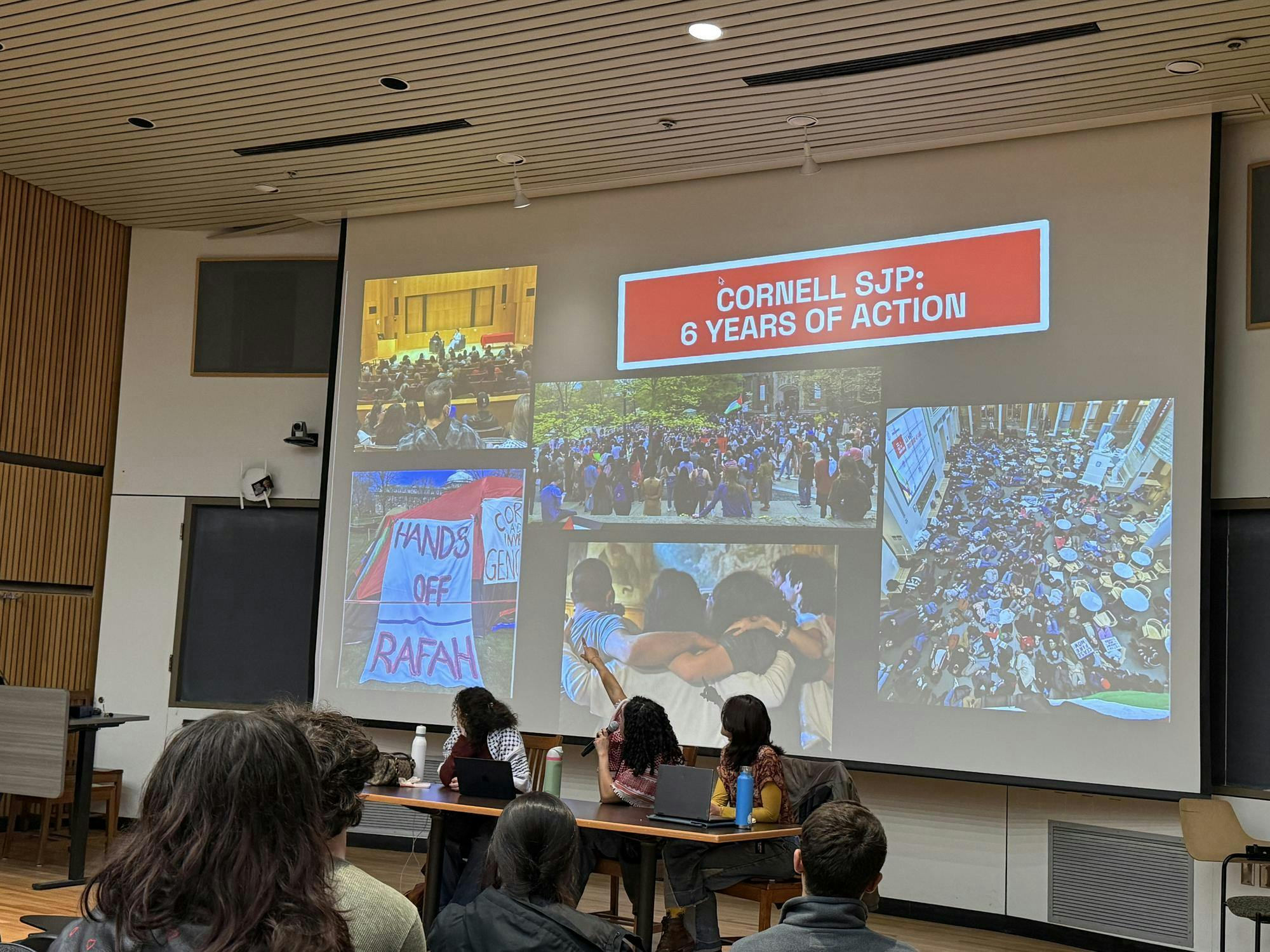
Malak Abuhashim ’24 M.Eng. ’24 discussed her activism and experiences as a Palestinian at Cornell at an Alumni Activist Panel hosted by Students for Justice in Palestine at Cornell and The Progressives at Cornell on Wednesday evening.
The event, which drew an audience of approximately 25 people, featured a panel moderated by SJP Co-President Sayuri Pfeiffer ’26 and Vice President Yasmeen Masoud ’28 and a Q&A session. The panel was sponsored by Gender Justice Advocacy Coalition and affiliated with Muslim Educational and Cultural Association and the Kashmiri Cultural Alliance.
At the talk, Abuhashim discussed her Palestinian activism at Cornell and beyond, her family in Gaza and her experience with doxxing and harassment. She also fielded questions about navigating activism after graduation and how Cornell has shaped her.
Abuhashim first felt a “sense of activism” when she was six years old, while watching a news story of Gaza being bombed by the Israeli army, she said during the event.
“That whole feeling of identity where I have a homeland that I can never go back to, it was very hard,” Abuhashim said. “Nobody knew about [what was happening in Palestine]. I felt the need to always speak and say: ‘No, this is what's happening, you should know about this.’”
Abuhashim currently is involved with the Palestinian Youth Movement, a “grassroots, international movement that organizes Palestinian and Arab youth to struggle for Palestinian liberation,” according to its website.
She also reflected on how the role of activism changed across her time at Cornell.
Abuhashim arrived at Cornell in 2019 to what she described as a “culture shock” in an interview with The Sun. Abuhashim attributed this to the lack of Palestinian presence on campus, especially since she grew up in a predominantly Muslim community, she said at the event.
She joined SJP at Cornell during her freshman year, which at the time, “was just four or five people sitting in Goldwin Smith every Friday talking about current events.”
“The first couple of years [of SJP] was really just educating,” Abuhashim said at the event. “After that phase, we realized that not enough people really cared.” Abuhashim shared that they realized they could get people to care “through solidarity, by connecting our struggle to other struggles.”
Abuhashim said that awareness of Palestinian activism rose at Cornell in May 2021, after Israeli officials ordered the forceful eviction of Palestinian families living in Sheikh Jarrah, a Palestinian neighborhood of Jerusalem. Days later, Israel launched airstrikes into the Gaza Strip, killing over 200 people.
Abuhashim attributed the increase in awareness in part to social media, specifically mentioning a video filmed by one of the families as a settler was displacing them.
In response to the events at Sheikh Jarrah, SJP and other organizations on campus hosted a protest. At the protest, Abuhashim shared the story of the forceful displacement of her grandfather from Yibna in 1949.
“It was the first protest that I helped organize on campus,” Abuhashim told The Sun. “I had always been talking about Palestine, but it was the first time that I was talking about Palestine and people were paying attention in a way.”
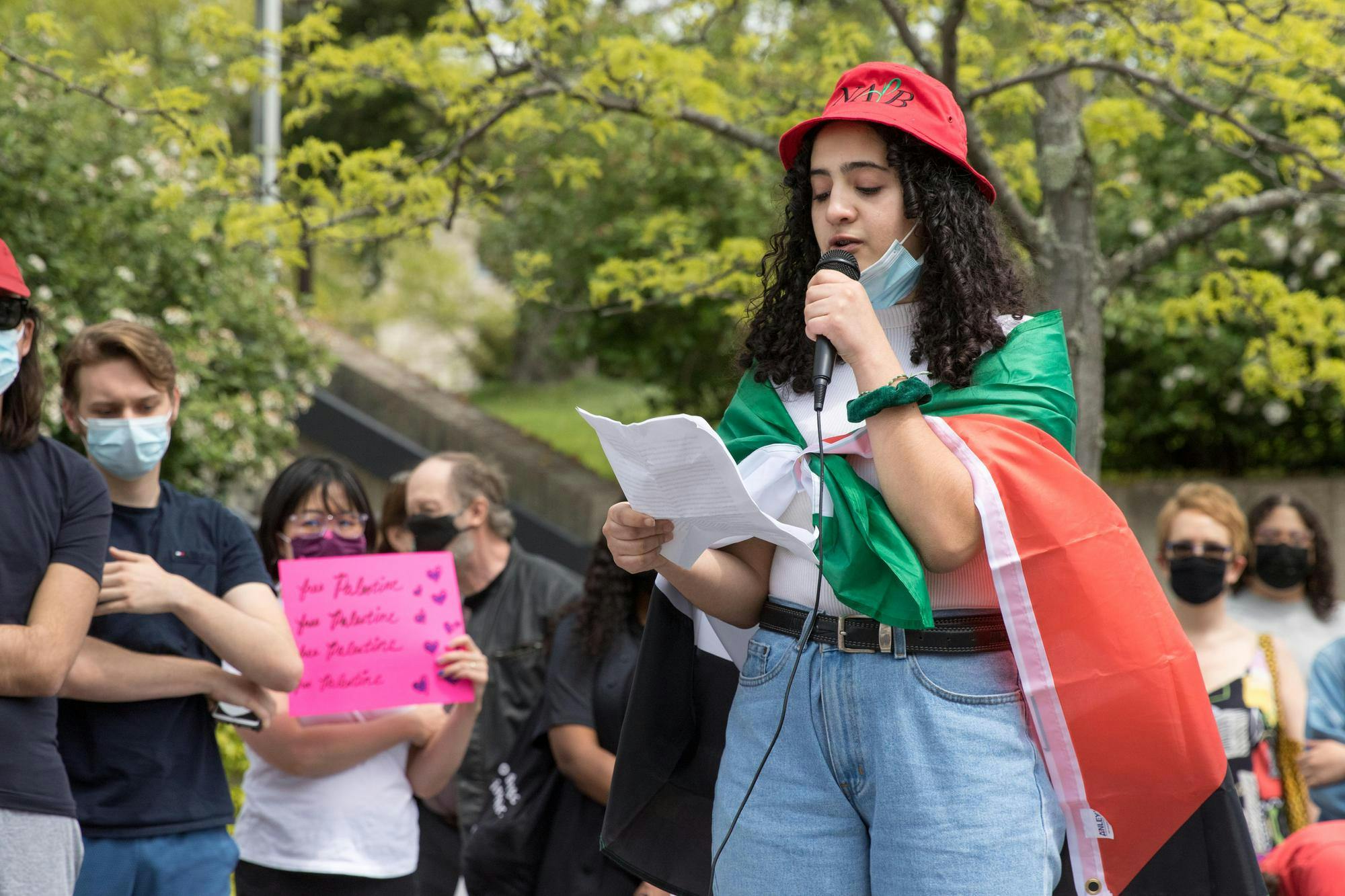
During the protest, someone in the crowd took photos of Abuhashim and her friends and uploaded them to Canary Mission, Abuhashim said. Canary Mission is a database that “documents people and groups that promote hatred of the USA, Israel and Jews,” according to its website.
“I was very afraid because, to me, that was my worst fear,” Abuhashim said about getting doxxed on Canary Mission.
“There was a lot of self-censorship,” Abuhashim said about her concerns of retribution for her own activism, later adding that “being Palestinian and admitting it put[s] a target on my back, immediately, and I don't even have to do anything.”
Abuhashim and her family have experienced several instances of doxxing, she said. About a year ago, someone found phone numbers of Abuhashim’s family members and sent them messages accusing Abuhashim of being a terrorist and threatening to report her to the FBI and get her family deported.
However, after getting doxxed for telling her grandfather’s story at the protest in 2021, Abuhashim realized, “no matter what I do or don't do, no matter what I say or don't say, they're gonna use it against me. And so why am I censoring myself and preventing myself from speaking the full truth to try to protect myself when nothing is really gonna protect me?”
She explained that “the next big thing” that occurred in Palestine was the October 7 attacks. On Oct. 7, 2023, Hamas led attacks in southern Israel that killed approximately 1,200 people, including approximately 400 people at the Supernova music festival. In response, Israel launched a large-scale invasion of the Gaza Strip that has killed approximately 75,000 Gazans as of February, according to a study published by The Lancet Global Health.
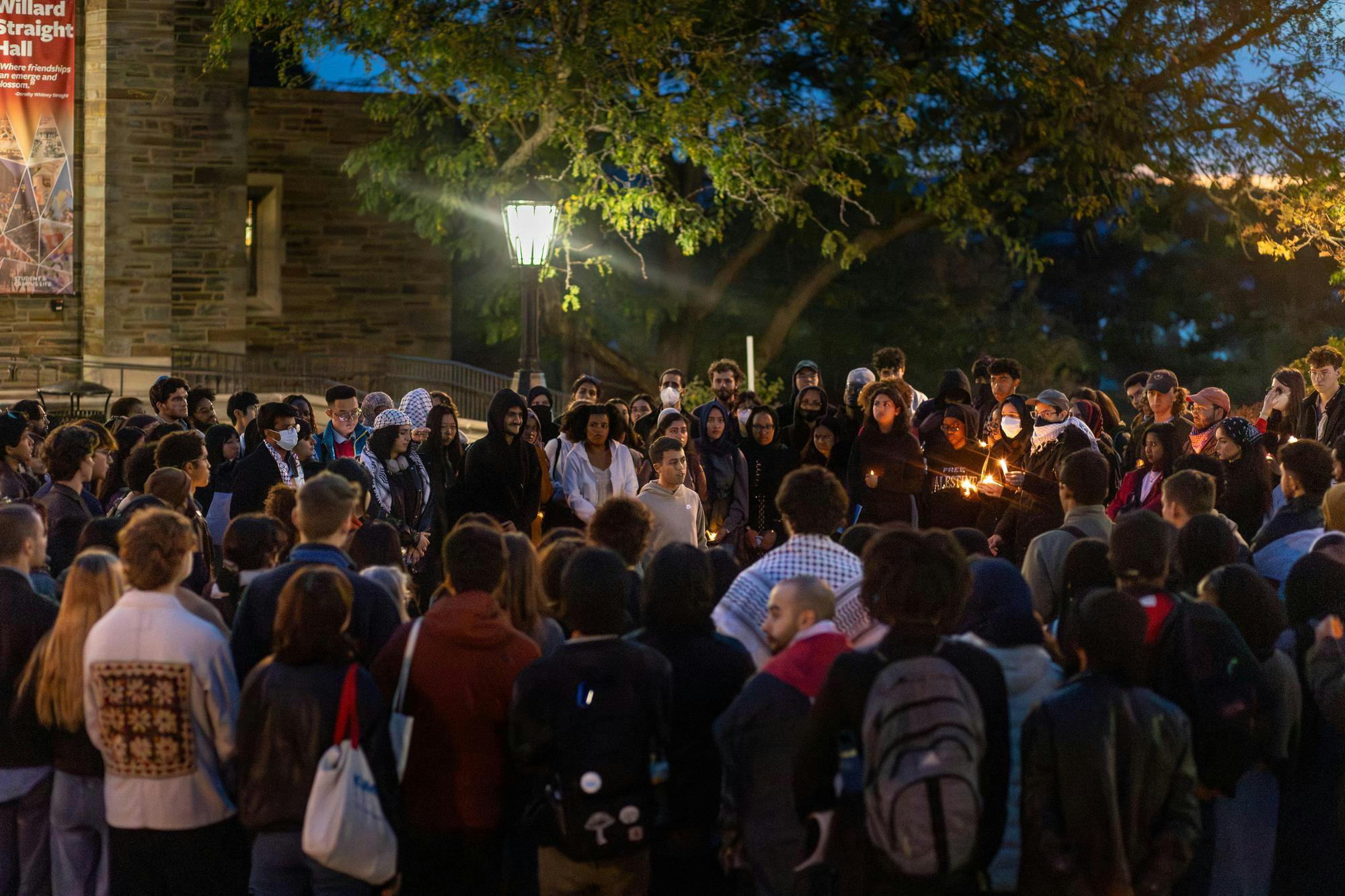
“I remember feeling so lost and so hopeless and so distraught at the images that were on my phone and the fact that we needed to do something,” Abuhashim said. “At the same time that I'm supposed to be going to class and caring about my exams and my grades, there are people — my family — who are in their houses that are scared for their lives and they don't know if they're gonna live tomorrow.”
In addition to discussing her activism at Cornell, Abuhashim commented on the movement’s relationship with the University’s administration.
Abuhashim told The Sun that due to the University administration’s response to what was happening in Palestine and Israel, she "never felt more uncomfortable being Palestinian anywhere in [her] life than being at Cornell.”
“[President Martha Pollack] spoke to the Jewish community and the Israeli community saying, ‘I'm sorry for what you're going through. You guys have a lot of pain, and take it easy and carry some resources,’ which is great,” Abuhashim said at the event. “When you're suffering, you should offer support, but at the same time, she refused to speak to the Arab and Muslim community and the Palestinians, and she refused to acknowledge our pain and our suffering.”
The University did not respond to comment regarding Abuhashim’s experiences with Cornell’s administration.
Throughout her time at Cornell, Abuhashim helped organize and participate in a variety of demonstrations including the occupation of roads, protests at trustee events, the Spring 2024 encampment and die-in protests to represent those killed in Palestine, she said.
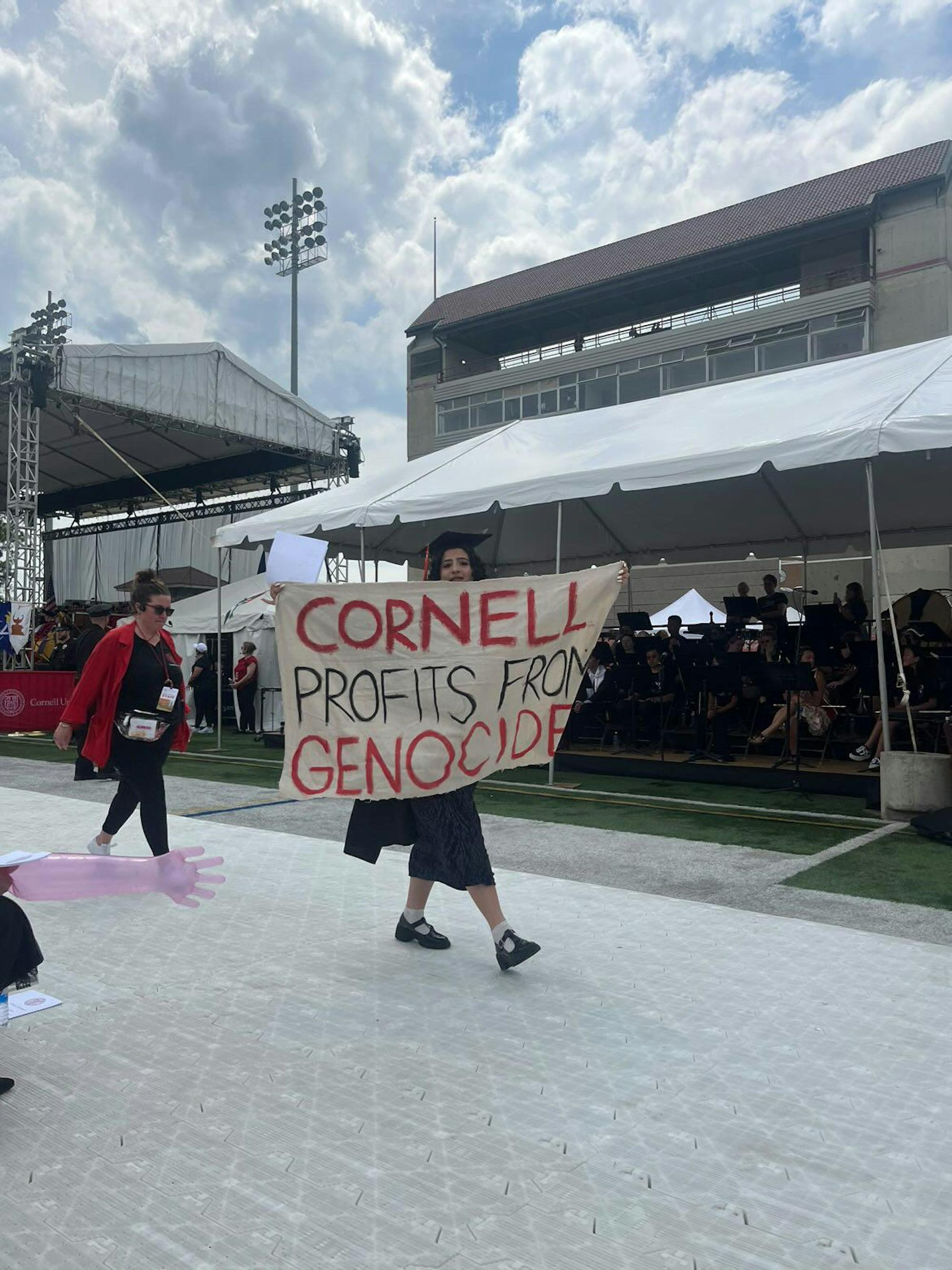
Abuhashim ended both the moderated panel and Q&A session by discussing the importance of hope in the Palestinian movement.
“I'm not saying don't be afraid,” Abuhashim said. “There are risks to doing Palestine advocacy, but I'm saying do it afraid. Me coming here and speaking, it's not that I'm not afraid to speak in front of people. I don't like public speaking. I actually hate it, but I will do it because even though I'm afraid, somebody has to do it and if it's not me, then who's gonna do it?”
She explained that she tries to maintain optimism despite the threats that her family and the broader Palestinian community face.
“My optimism to some might not make sense,” Abuhashim said. “What keeps me going is that this is but a moment of the full story and there is a future and things are bound to change and I wanna be part of that change.”
Coral Platt is a member of the Class of 2029 in the College of Arts and Sciences. She is a news editor for the 144th Editorial Board and can be reached at cplatt@cornellsun.com.