On a chilly evening, the familiar wooden beams of the Ithaca Farmers Market pavilion were transformed into a vibrant, glowing enclave. Underneath a canopy of warm string lights, the chilly upstate New York air gave way to the rich aromas of roasted meats, sweet mint and familiar spices. This was “Midnight in Marrakech,” a Moroccan cultural night hosted by the Cornell Arab Student Association that offered students a temporary, yet entirely immersive, escape to North Africa.
Marketed as a “love letter to Morocco,” the event was designed as an invitation to experience the warmth of a culture that prioritizes gathering and community. For an organization committed to fostering a welcoming space for Cornell’s several hundred students of Arab heritage, the evening was a masterclass in cultural celebration, meticulously curated to bridge the gap between Ithaca and the Arab world. Being Arab myself, and travelling all the way from Kuwait to study at Cornell, I can attest to the fact that the Arab Student Association’s efforts truly do matter in making us feel anchored in our heritage. For one night, the ache of distance was replaced by the comfort of the familiar.
The night began at around 7:30 p.m., with a marketplace that immediately set a tone of authentic Moroccan hospitality. Attendees trickled in slowly, wandering into the traditional value characterized by its intricately patterned table settings and glowing lantern centerpieces. A photo booth was available alongside pop-up exhibitions highlighting Moroccan artistry.
The Maarouf Gallery, a New York City-based photography practice by ASA co-president and event organizer Douae Maarouf ’27, displayed stunning visuals capturing the essence of the Sahara and Tangier’s coast. Nearby, a stunning collection of traditional and modern clothing was on display for purchase, highlighting the elegance and craftsmanship of Moroccan wedding and celebration attire.
Perhaps the most aromatic corner of the marketplace was the Moroccan skincare and beauty vendor. Tables were heavily laden with jars of traditional black soap, Nila powder, golden bottles of pure Argan oil and saffron-infused body creams. My friends and I decided to test a few of the products and left with small, beautifully packaged tokens of apothecary. As of writing this article, my arm has never smelled so good.
By 8 p.m., the focus shifted to the dining tables as the feast began. Dinner was accompanied by the Middle Eastern Music Ensemble. Co-founded in 2002 by multi-instrumentalist Nikolai Ruskin and Prof. Emeritus Martin Hatch, music, the Ensemble features instruments from across the Arab world, filling the barn with traditional melodies and setting an enchanting backdrop for the meal.
The menu itself was delicious. Attendees were treated to traditional entrees served with couscous — Djaj Mhamar, roasted chicken and Laham Bilbarqoq, a savory and sweet dish of lamb and apricots — alongside a variety of salads and appetizers. As dinner wound down around 8:30 p.m., the crowd’s attention was captured by Meriem Farah ’29, a student of Moroccan descent from Westchester, who delivered a deeply soulful vocal performance. Accompanied by Heba Idris ’28 on the guitar, Farah sang “Nia” by Oum and “Ha Widi” by Jaylann, drawing loud applause and cheers from the captivated audience.
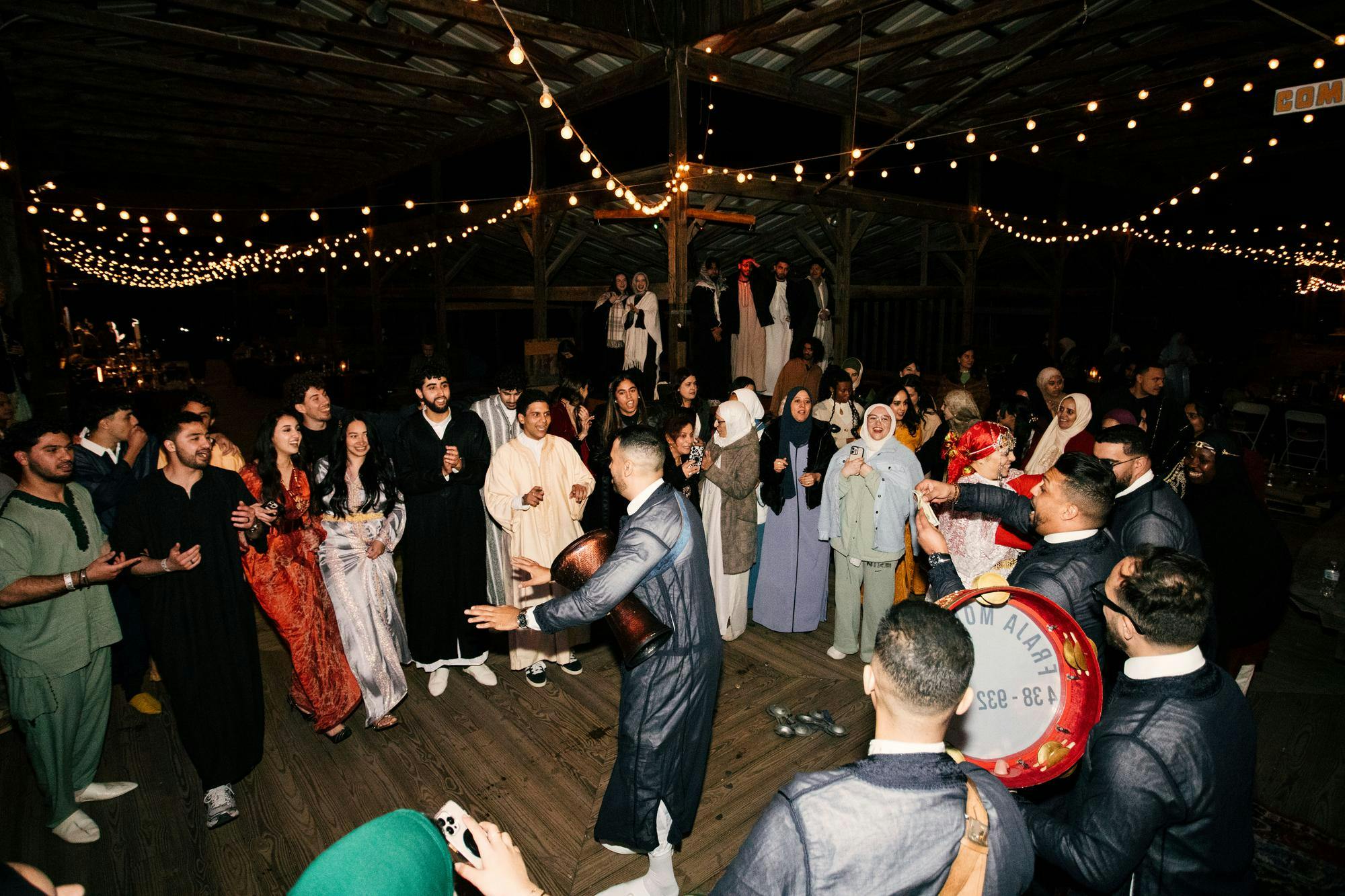
But the night was far from over. At 9:30 p.m., the relaxed, acoustic atmosphere was shattered by Fraja Montreal. The group brought the high-energy tradition of Dakka Marrakchia, a musical performance originating from Marrakech, built on rhythm, chant and collective energy. Armed with traditional drums and horns, the group ignited the venue, bringing everyone to their feet and forming a dance floor in the center of the pavilion.
Reflecting on the night’s impact, Maarouf shared how the atmosphere provided a profound sense of belonging. “It literally meant everything to me,” Maarouf said, noting that she became emotional throughout the night. “There were so many points throughout the night that I truly felt like I wasn’t in Ithaca for a quick second. … It genuinely felt like I was back home with my people.” For someone raised in the diaspora, she explained, the event highlighted common Moroccan traditions that served as an “overbearing” and “emotional” reminder of home.
I can’t speak for everyone, but for myself, the vibrancy of the night was underscored by an unspoken poignancy. In recent months, a devastating conflict has gripped the Middle East, particularly in my home, Kuwait. For people with ties to that part of the world, where the airspaces have been closed and life has been upended by the threat of drone and rocket strikes, the distance has never felt so cavernous. Yet, somehow, all the way in Ithaca, I seemed to be back again.
Though Marrakech sits thousands of miles from the shores of Kuwait, the evening served as a sanctuary for a collective identity that knows no borders. To those currently cut off from their families back home, of whom I know a few myself here at Cornell, reminders of their culture serve as visceral tethers to a home that feels increasingly precarious. In the steam of tea and the familiar cadence of music, I found a fleeting peace — a reminder that no matter how fractured your lands may become, culture remains an unbreakable, shared hearth.
Ali AlSaif is a member of the Class of 2029 in the College of Arts and Sciences. He is a staff writer for the Arts & Culture department and can be reached at aea252@cornell.edu.