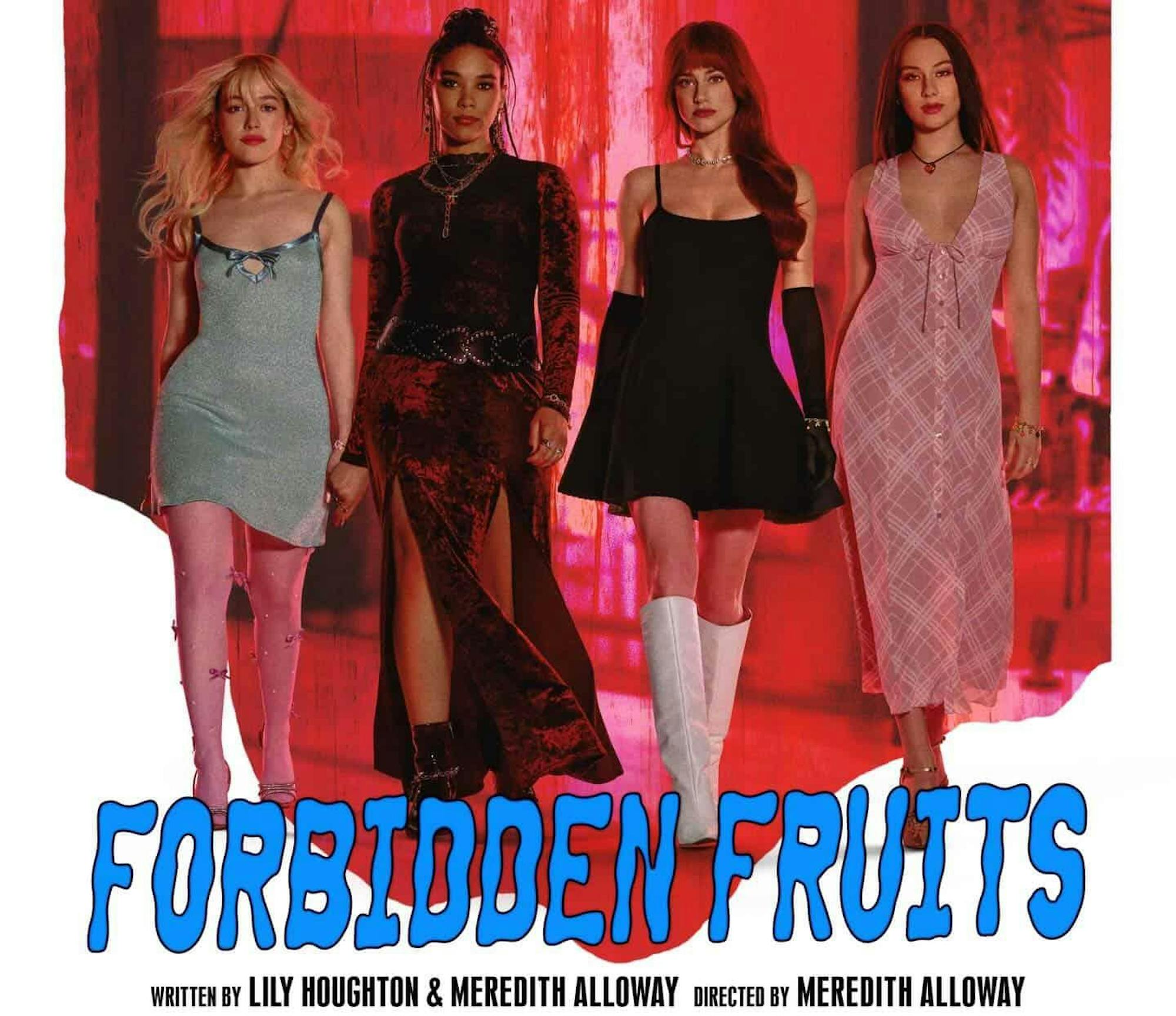
Forbidden Fruits, directed by Meredith Alloway and co-written with Lily Houghton, puts a horror twist on a classic Mean Girls-inspired comedy. Fans of Diablo Cody (who fittingly produced the film) and Mona Awad will certainly find something to love here. However, while the film is appropriately campy and entertaining, its lack of substance causes the film to lose some steam by the end.
The story follows a group of sales associates at a mall boutique called Free Eden, each of them connected by their fruit-themed names: the slightly edgy Fig (Alexandra Shipp), the ditsy Cherry (Victoria Pedretti) and their ringleader, Apple (Lili Reinhart). Instead of ruling over a high school, the fruits hold court in the local mall. Forbidden Fruits begins in the tradition of Heathers and Mean Girls when new girl Pumpkin (Lola Tung) begins to work at the mall and is quickly absorbed into the group. Like Cady Heron, she attempts to end the rule of Apple by befriending the other fruits and learning their secrets.
It quickly becomes clear, however, that this is no ordinary friend group; the girls are part of a coven, where they adhere to strict guidelines, set by Apple, and cast spells on the men who get in their way. Although Apple’s coven is meant to focus on female empowerment and friendship, she constantly belittles her fellow witches in order to keep them in line. As Pumpkin grows closer with the fruits, she begins to uncover secrets that could end Apple’s reign forever.
Forbidden Fruits wears its influences on its sleeve. At times the characters outwardly reference films like Mean Girls and The Devil Wears Prada, paired with allusions to movies like Psycho and even The Shining that hint at the darker turns to come. The film is incredibly successful at recreating the aesthetics of the early 2000s romcoms it references, and includes a layer of camp that never veers too far into cringe. Forbidden Fruits is impressively entertaining throughout, thanks to the sharp screenplay and great performances. I particularly enjoyed Pedretti as Cherry, Apple’s Gretchen Wieners-esque sidekick desperate for approval and Reinhart as Apple, a character that, while no doubt inspired by Regina George, successfully modernizes the classic mean girl archetype.
Part of what makes Forbidden Fruits unique is its setting. The mall that Free Eden resides in isn’t stylized or retro in feeling — it’s a typical washed-out modern shopping mall, devoid of style or personality. The girls feel out of place against neutral, sludgy backdrops and normal, everyday shoppers. The fruits themselves aren’t rich trendsetters, but normal, middle-class sales associates. Apple lives out of her car, Fig is biding her time at Free Eden to save up for graduate school and Cherry has to provide for herself after losing her family. The everyday setting makes the coven’s activities all the more eccentric, which really lends itself to the film’s aesthetic.
While Forbidden Fruits definitely isn’t trying to portray an important theme or message, its attitude becomes a hindrance in the third act. When the film becomes more serious by trying to entwine the plot threads scattered throughout the film, the vision loses what made it so special. It’s refreshing to see a film satirize this kind of teen drama with such success, and casting off any comedic elements in the final confrontation slows the film down significantly.
The film also lacks a strong narrative perspective. Traditionally in stories like this, the outsider — in this case Pumpkin — leads the audience into a new world, introducing them to the rules of the group and providing a frame of reference for what the outside world should look like. Here, however, we meet the fruits before we meet Pumpkin, and never get much of a sense of who Pumpkin is outside of her relationship to the coven. While Alloway shows phone calls between Pumpkin and her overbearing mother, the camera itself never leaves the mall, keeping Pumpkin’s private life away from the audience. While this is definitely an intentional choice, it’s also an alienating one that makes it harder to invest in the interpersonal relationships that become important in the film’s final half hour. Without a sense of who Pumpkin is, it’s difficult to root for her in her battle against Apple, whose character is much more clearly defined.
Despite this, Forbidden Fruits is still an extremely entertaining film, and one that is incredibly successful at what it sets out to do. Forbidden Fruits is one of the most fun movies in theaters right now and should not be overlooked.
‘Projections’ is a column focused on reviewing recent film releases.
Nicholas York is a member of the Class of 2027 in the College of Arts and Sciences. He is a columnist for the Arts & Culture department and can be reached at nyork@cornellsun.com.