What is the first thing that comes to mind when you think of Michael Jackson? The moonwalk, a single rhinestone glove, black loafers with white socks (which he somehow made work), mirrored sunglasses, the red Beat It jacket, Neverland Ranch, Sugarfoot, Bubbles the chimpanzee …
What? You were with me until Sugarfoot?
Is it possible that you remember Michael Jackson’s androgynous voice, his gravity-defying dancing and his iconic beats — but don’t recognize “Sugarfoot”?
Let’s try this a different way. What do The Jacksons, Madonna, Elton John, Lionel Richie, Janet Jackson and Michael Jackson all have in common?
Come on … you know this.
Sugarfoot, of course.
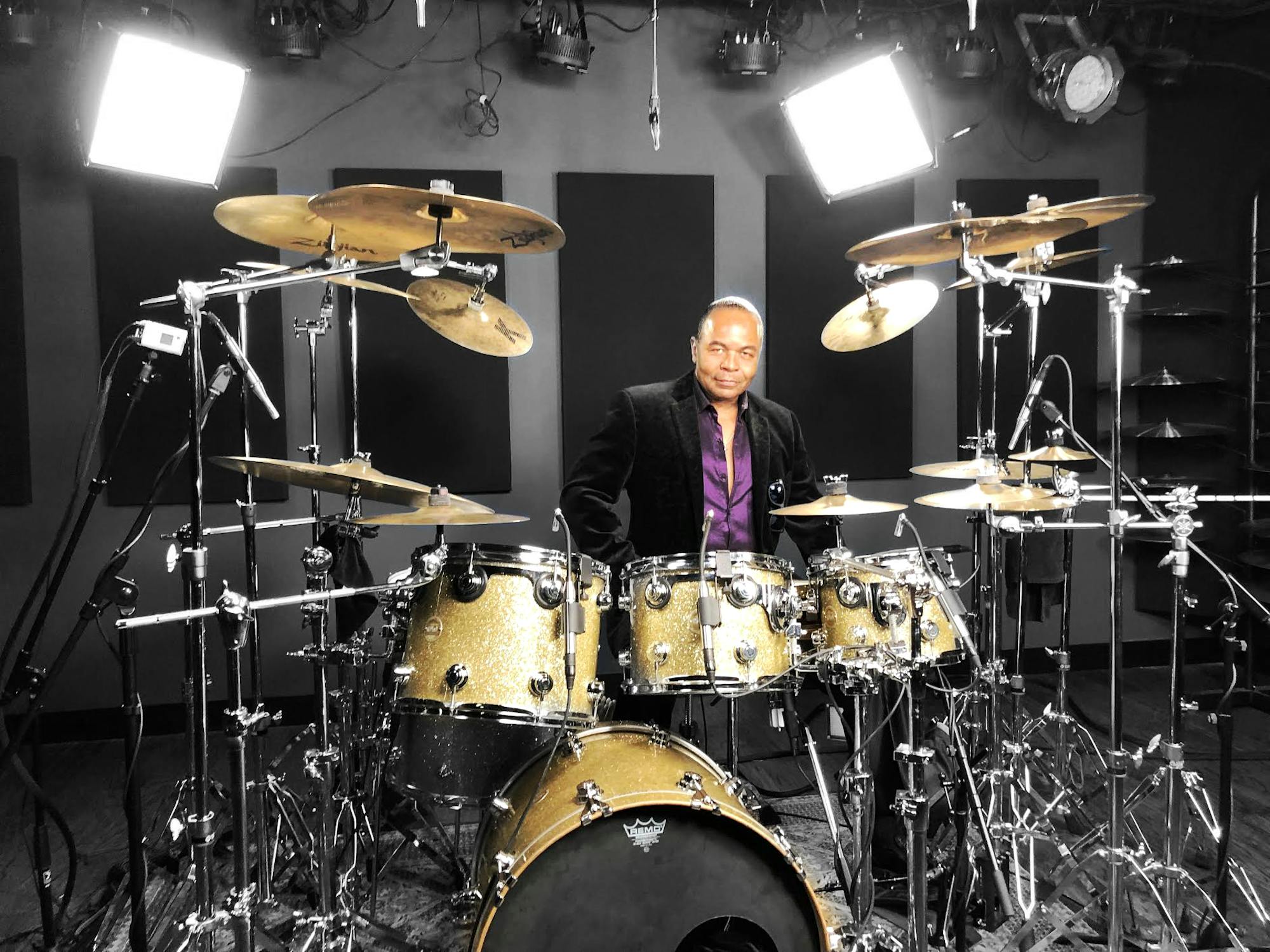
Sugarfoot, or otherwise known as Jonathan Moffett, is the legendary drummer behind some of the most iconic live performances in modern music, whose relationship with Michael Jackson and his family spanned more than 30 years. In addition to the Jacksons, he played for many other artists, including Madonna for five years, George Michael for two years and Elton John for two years, on some of their most defining tours.
His drumming wasn’t just accompaniment, it was timing, tension, energy. Rhythm! His beats shaped performances, penetrated souls and made you, or your parents, move — whether that meant dancing, or for those of you that lack rhythm, just nodding along. Sugarfoot was the force at the center of the spectacle — the nuclear fusion that made the stars shine.
With the new Michael Jackson biopic Michael on the horizon, I wanted to talk to someone who was part of that world, and that someone is Sugarfoot.
Prior to speaking with him, I put my world-class investigative skills to work by typing his name into Google. There, I found YouTube videos of Sugarfoot playing in front of a gazillion people with Madonna at Live Aid at JFK Stadium in Philadelphia in 1985, as well as a full performance from the Jacksons’ 1984 “Victory Tour,” where I watched him hold down center stage behind the relentlessly energetic, single-gloved Michael Jackson.
After decades in the music business, countless drum strikes and playing for crowds in excess of 100,000, Jonathan Moffett sat down with me to talk about his life and the upcoming movie Michael.
My first question was, “Why Sugarfoot?” In reply, Moffett politely smiled indicating that this was not the first or last time he would be asked that question. “I got that nickname when I was young,” he answered. “I was playing in a band and the leader said everyone had to have a nickname. He said the way I worked the pedal for the bass drum was sweet, so he named me Sugarfoot. I hated it. That didn’t sound cool at all. I wanted something tougher like Ace or Duke or Titan, but he insisted on Sugarfoot, and it stuck.”
As someone who has always wanted to play the guitar, but has yet to invest much time in it, I asked him how he learned to play the drums. He explained that he was self-taught, learning by ear — listening to records featuring drumming legends like Ringo Starr of the Beatles and Charlie Watts of the Rolling Stones and playing along with their songs. Although he cannot read music, this method gave him a highly sensitive ear. That ability to pick up notes audibly turned into a skill that allows him to learn songs quickly.
Having watched some of his performances on YouTube, I asked him what the most intense concert he ever played in was. “All of them,” he answered. “I kind of get into a zone when I play, so for me, they are all intense. However, I will say that as far as the shows themselves go, Michael played every concert like it was the most important one of his life. He put everything into every performance. He learned something from every performance, each one building upon the next, getting better, inching closer to perfection as he went along.”
Sugarfoot hasn’t just played with famous musicians; he’s played with icons. I was curious how that happened. For example, how did he go from playing with The Jackson’s “Victory Tour” in 1984 to Madonna’s “The Virgin Tour” in 1985? His answer indicated the economic reality of musicians. If the star is not performing, then touring musicians are not working. He explained that Madonna had heard him play and reached out to him about traveling with her, stating, “Since Michael was working on preparing for his Bad Tour, I had time, so I told her yes.” Most musicians would be lucky to work with one legend during their lifetime; however, Sugarfoot effortlessly moved from one to the next. Still, Michael was his clear favorite. In fact, he told me that he had been rehearsing with Michael Jackson for his “This Is It” residency, which was set to take place at London’s O2 Arena the night before Michael died.
“We were rehearsing the night before he died,” Sugarfoot recalled. “After rehearsal, we spoke, we told each other we loved each other, and then we hugged. That was the last time I saw him. At least I got to tell him how I felt.”
After a sullen moment, I shifted the interview to the new movie. I asked how he felt about watching something in a movie theater that he lived through. “I’m just excited to see Jaafar play Michael,” Sugarfoot responded. “He’s Jermaine’s son, I’ve known him most of his life. It must be surreal for him to play his uncle in a movie.”
I asked him what he knew about the movie itself and how he felt about it.
“I was invited to the set, so I went to check it out,” he answered. “I saw Jaafar there. We hugged. It was a deeply emotional moment for both of us. It’s a lot of pressure to play the greatest entertainer of all time, but I think he’s definitely the right guy to do it.”
As a collector of vinyl records and a self-proclaimed music expert, interviewing Sugarfoot provided me with an insider’s perspective of not only what it is like to perform at concerts, but also what it is like to make music. If you want to hear Sugarfoot right now, just open Spotify and play Madonna’s song “Like a Prayer.” That’s him playing the drums.
So, the next time you think of Michael Jackson — the moonwalk, the glove, a grown man holding a chimpanzee — listen a little closer.
Because somewhere beneath it all is a beat you’ve heard before.
You just didn’t know its name.
But now you do.
Sugarfoot.
Aiden Gaddis is a member of the Class of 2027 in the College of Arts and Sciences. He is a staff writer for the Arts & Culture department and can be reached at ajg335@cornell.edu.