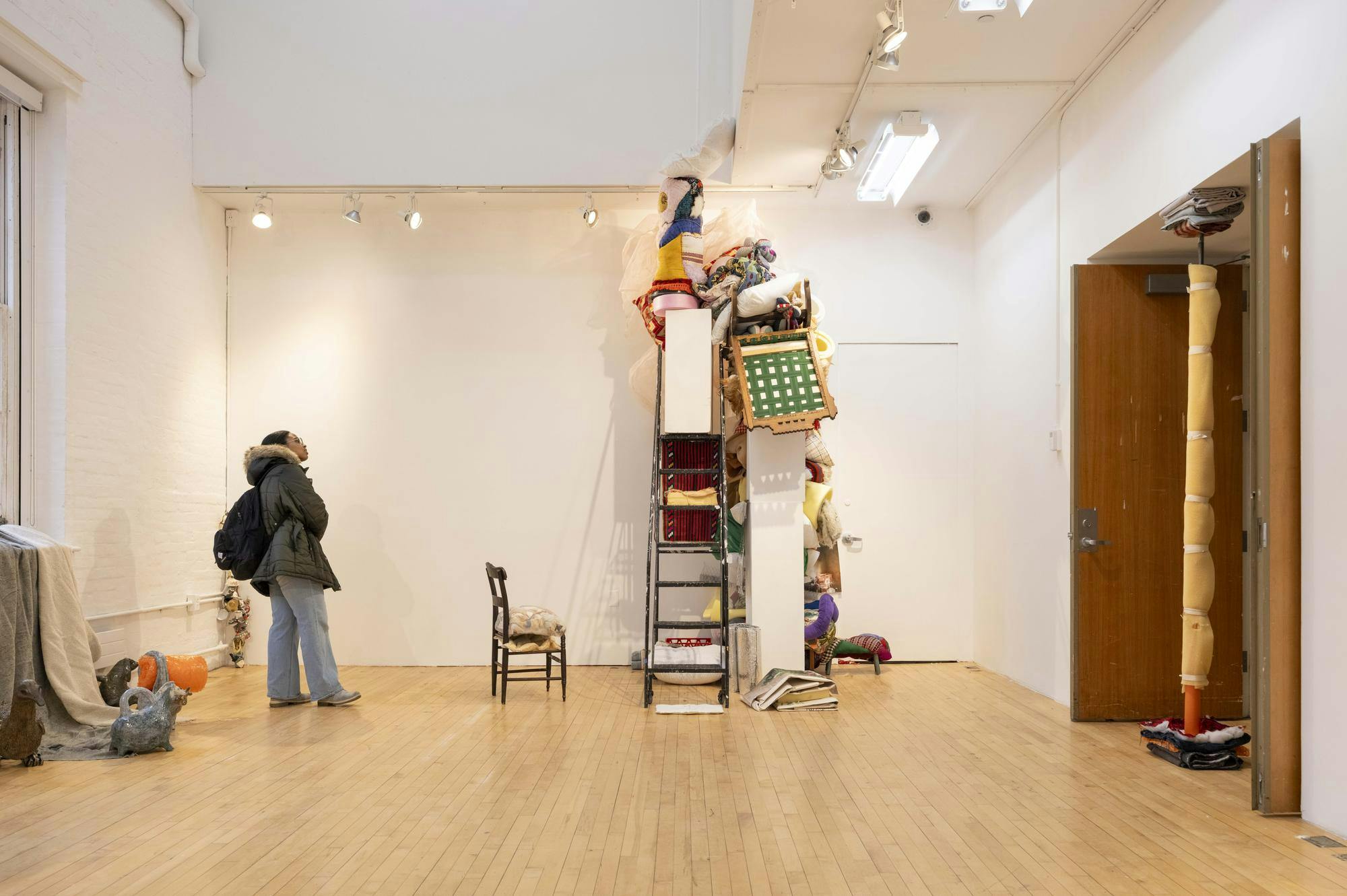
When I arrived in the gallery housing the art installation “how to fix a leaking ceiling” by Cornell MFA student Lilian Shtereva ’27, I was unsure whether I was in the right place. The space had a distinctly unfinished appearance, particularly with the foam-wrapped pole stretching from floor to ceiling in the middle of the doorway. My perplexed attention was immediately drawn to a large column made of a seemingly haphazard assortment of textiles, cushions, household objects and even an upside-down chair. A smaller pillar on the other side of the room supported a stack of pillows reaching to an overhanging section of ceiling. Strikingly, the art extended beyond the limits of the gallery, with upholstery textiles hanging out of the windows all the way to the ground outside. Underneath the windows, a collection of ceramic animals in tones of blue, green and brown added to the personality and whimsy of the space. The artist herself, who had been seated in a small chair next to the larger pillar, resolved my uncertainty by getting up to welcome me in.
Shtereva was born and raised in a small village in Bulgaria, moved to the city of Veliko Tarnovo, Bulgaria for art school and then moved to the United States to continue her studies. Her work is strongly tied to her unique set of experiences in the many places she has lived, as she discusses in her text introduction to the gallery. When I asked about the exhibit’s title, “how to fix a leaking ceiling,” Shtereva explained that a leaking ceiling needs to be repaired by any means possible, with whatever supplies are at hand. Accordingly, the materials used for this art installation were a seemingly random assortment of items. Broken teacups, bubble wrap and bare foam rolls joined handmade cushions and colorful traditional Bulgarian textiles to create a chaotic arrangement of color and texture. Shtereva, drawing on her varied background, associates the gathered nature of these materials with the resourcefulness that becomes necessary in challenging situations.
One subject Shtereva and I continually revisited in our conversation was her use of space. During my time in the gallery, she and I moved all around the room, often sitting down on the bare wood floor to talk more deeply and look more closely at the art. Shtereva’s work is informed by the geographical spaces she has inhabited, but it is also intrinsically tied to the present physical space of the gallery, adapting to the unusual shape of the room with all its corners, pipes and overhangs. Shtereva explained to me, “You either respond to the space or you push against the space. I try to do both.” She works with the room by leaning objects delicately against walls and nestling colorful textiles into pipes near the ceiling, but she breaks its boundaries by hanging fabrics out of the windows. The room is a fundamental part of the artwork, far beyond merely housing it.
In creating this exhibit, Shtereva sought to emulate the constant evolution of a living space. Accordingly, the installation itself has taken many forms. When I spoke with her, the gallery was in its third iteration, with more movement to come. I even watched it change during my visit; after I commented on a ceramic water vessel that was placed on the floor among the sculpted animals, Shtereva stood and moved the vessel to another corner of the room, where it remained for the rest of our conversation. This casual adjustment emphasized the gallery’s fluidity and vitality. Unlike many artworks, which are displayed in their completed forms and meant only to be observed, Shtereva’s gallery was, at its core, perpetually unfinished.
The constant movement of this work, combined with Shtereva’s use of space, made stepping inside this gallery immersive in a way many art galleries are not. Shtereva even invited me to touch and pick up the ceramic animals, making the impact of my presence tangible. By entering the space, I became part of the larger story of the artwork. My backpack and coat, which I laid on the floor by the doorway when I entered, were just as much part of the space as the ceramic animals by the windows. As I immersed myself in the gallery, I felt that I understood it more, or could at least bring more of my own personal interpretation to it.
Fully appreciating any art, especially work like Shtereva’s that is intentionally disorienting, requires time. Though I was confused initially, my appreciation of the artwork grew as I spoke with the artist about the choices she made when assembling the gallery. The more time I spent examining the details of the space, the more absorbed I felt. This careful attention is more valuable than ever in today’s digital world; instant gratification has become almost a way of life rather than a luxury, but taking time to experience art can never be replaced by an AI-generated summary. Thankfully, as Shtereva described to me, art can invite viewers — myself included — to slow down.
Shtereva’s gallery is a living space in two senses. It represents a space in which to live, but it is also a space that is itself alive. In any iteration of “how to fix a leaking ceiling,” what appears at first glance to be a random array of objects takes on layers of meaning as a viewer experiences it, one small element at a time. Through her use of space, movement and a wide variety of found materials, Shtereva has created an artistic ecosystem that both guides and is guided by the viewer’s perspective.
Though “how to fix a leaking ceiling” is no longer on display, more of Shtereva’s artwork can be found on her website and Instagram.
Raina Lockwood is a member of the Class of 2027 in the College of Arts and Sciences. She is a staff writer for the Arts & Culture department and can be reached at rl978@cornell.edu.