

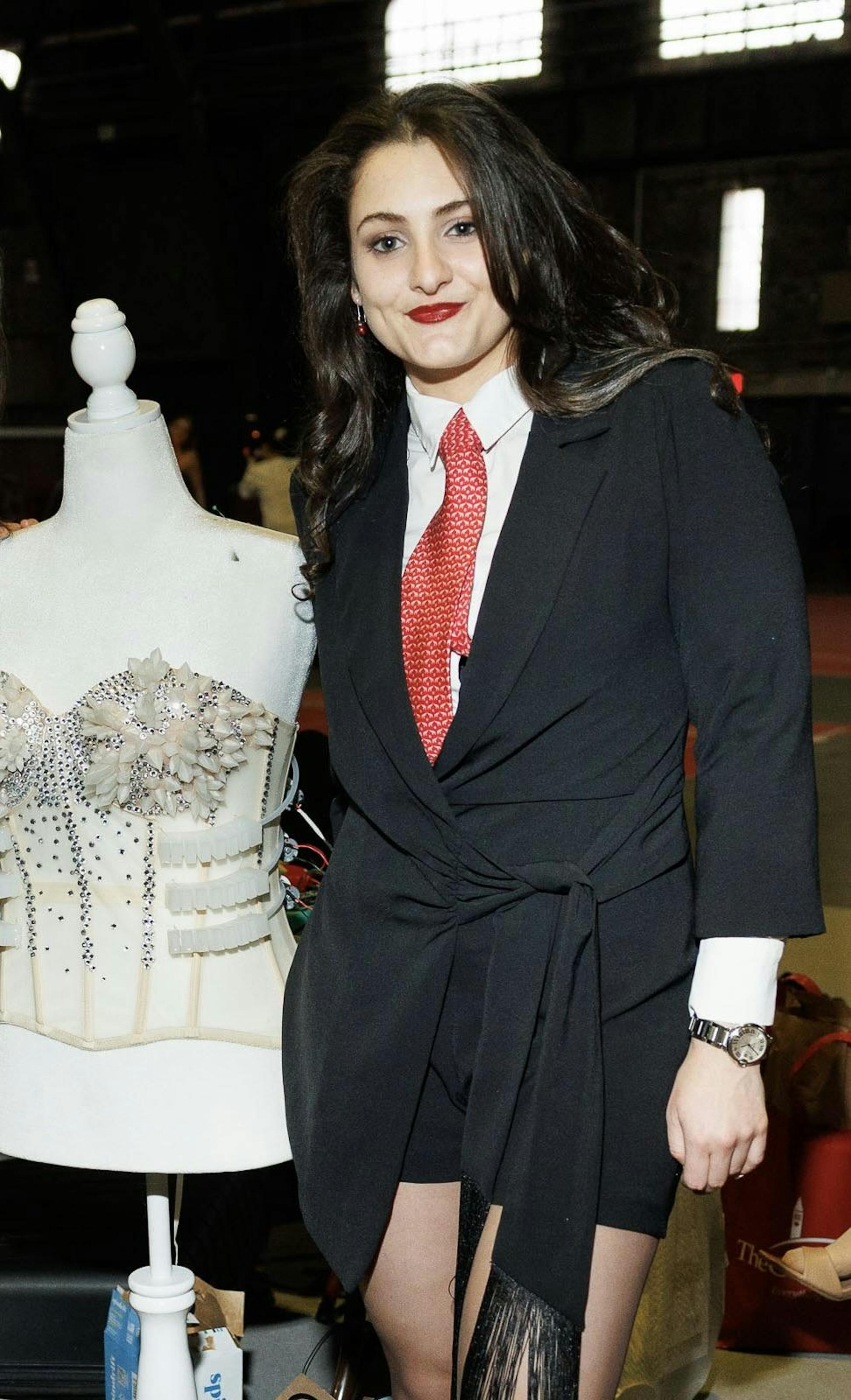
Backstage at the Cornell Fashion Collective Spring Runway Show, Maia Hirsch was not watching the crowd. She was glued to the backstage monitor, eyes fixed on her breathing dress moving down the runway. The dress, a structured gown covered in 3D-printed crystals and soft robotic structures made out of silicone that physically expanded and contracted, synced to the wearer's heartbeats. As her creation moved under the lights, one thought consumed her: Would it work? Until it did, nothing else mattered.
In that moment, the engineer and the designer merged into one, she held her breath while the dress took its own. This is the story of mechanical fashion designer Maia Hirsch.
Hirsch is a Ph.D. student in robotics at Cornell University, a two-time New York Fashion Week exhibitor and the designer behind three technologically integrated gowns that have made people stop, gasp and ask questions. She creates dresses that breathe, dresses that light up when you lift your gaze, dresses that bloom when two people shake hands. She makes these alone, with a soldering iron and a sewing kit side by side.
She also really does not like choosing.
Rewinding to 2020, Hirsch’s journey begins in a Miami apartment during COVID-19. Hirsch was a freshman, studying engineering remotely. Her classes took place in the Israeli time zone meaning her school day ran from midnight to 8 a.m. During the day, she interned at a fashion company.
“I loved that job so, so much,” she said. “But I felt like it was missing something.”
What was missing, she decided, was the present. Fashion has not evolved at the same pace as the rest of the world. People were making extraordinary advances in science and technology, and yet the fashion company she was interning at was doing exactly the same things it had always done.
“We were still doing the same things people used to do 100 years ago,” she said. “If fashion is about expression, it doesn't really express very well how far we've come technology-wise.”
This idea sat with her for three years, until she landed an internship at Cornell Tech and walked into the makerspace for the first time. She finally had the tools to do something with all her creativity and ideas that had been bottled up for years.
Growing up, Hirsch’s family was split on what she would pursue career wise. Half expected an artist and half expected an engineer.
“I kind of did my own thing,” she said.
She briefly studied civil engineering, a middle ground between architecture and something more tech-ish. She then liked it so much, she switched to mechanical engineering. The furthest thing, she remarks, from anything aesthetic.
Each of Hirsch’s dresses carries a dialogue she could not quite say out loud. The Gazing Dress lights up from the bottom only when the wearer looks up — a response to watching people around her stare down at screens, mistaking a filtered reality for the real thing. “It only looks pretty if you look up,” she acknowledges.
The Living Crystal Dress expands and contracts on the body, its 3D-printed crystals rise and fall like breath. She designed and built it for the 42nd Annual CFC Spring RunwayShow, whose theme explored the relationship between humans and machines. Hirsch's quest was simple: Could a machine replicate something as crucially human as breath? She was determined to find out.
The Blooming Dress is her most personal work. Covered in petals, it opens only when someone shakes the wearer’s hand. While closed, a visible barrier stands between the two people facing each other. When it blooms — only while both hands remain clasped — that barrier falls. Letting go, it rises up again.
“Peace is not a one-sided decision,” she says. “Both sides need to want it.”
The process begins with her sketches on her iPad. From there, Hirsch works backwards, envisioning the end result and then figuring out what it takes to get there. She orders materials online, returning most of them, and spends an “unreasonable” number of hours at the Cornell Maker Club, where she now has her own locker. She taught herself most of it: 3D printing, soldering, circuitry and soft robotics.
Hirsch’s social media following, mostly consisting of young girls in high school and college, has become something she has become intentional about. The message she tries to convey is straightforward: You don't have to choose between being an engineer and being feminine. Engineering, she points out, remains a very male-dominated field. Not hostile, in her experience, but still heavily embedded. Her response is to show up exactly as she is, feminine and technical: unwilling to let go of either quality to fit in.
“I get messages from girls saying they almost quit engineering,” she said, “and now they're not going to.”
After Cornell, she wants to build a research and development company with three branches: entertainmentment, medical wearables and an experimental division she describes, without irony, as figuring out what people will wear on Mars.
When asked what comes next, she answered the way she answers most things:
“I don't really like choosing,” she said. “So I'm trying to choose everything,”
Maia Hirsch’s work can be found on Instagram at @maiahirschlab.

Allegra Gonzalez Barbieri is a member of the Class of 2028 in the College of Arts and Sciences. She is a contributor for the Arts & Culture department and can be reached at ag2745@cornell.edu.


