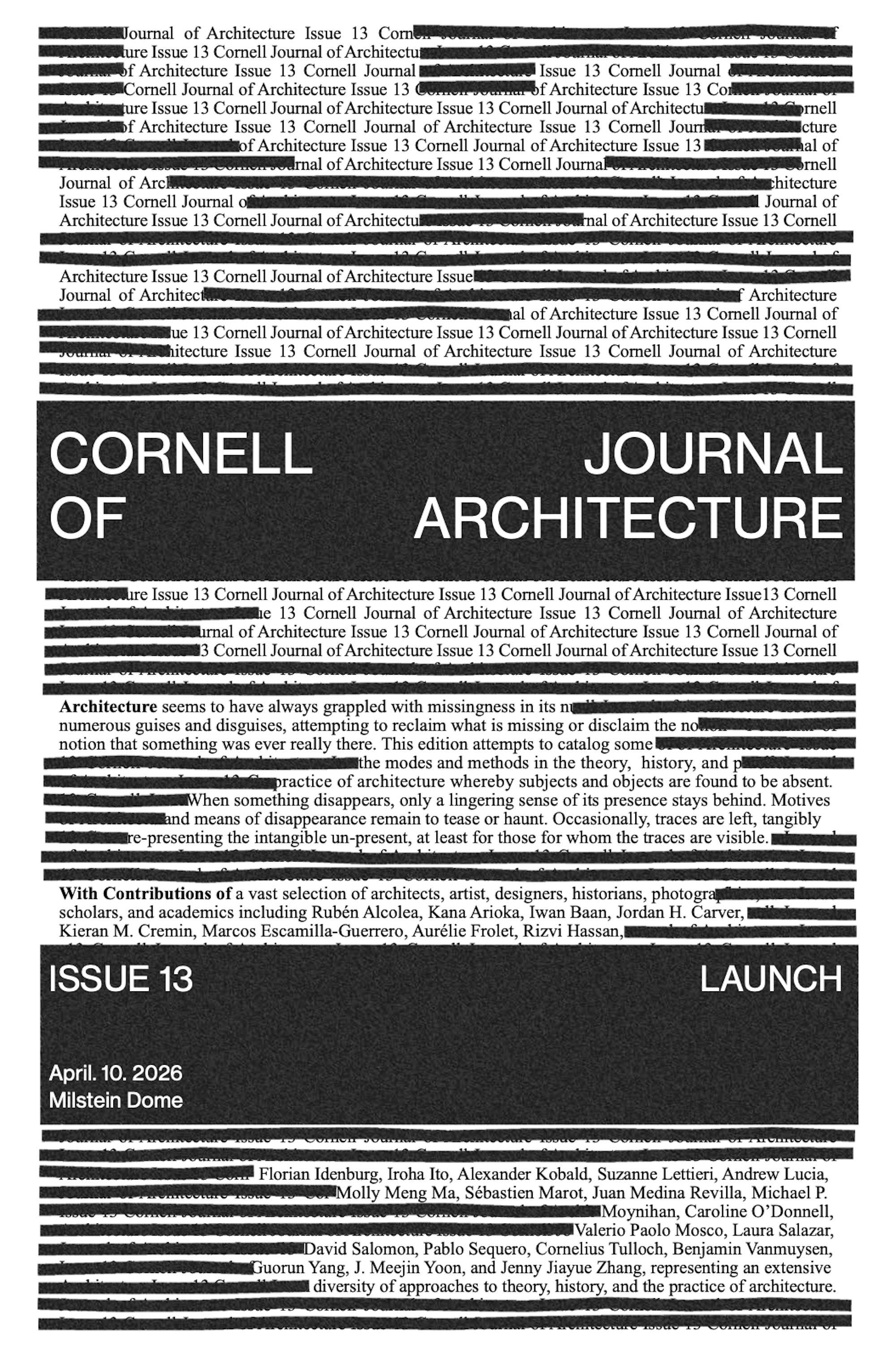
After an extremely dedicated revitalization effort by students within Cornell’s College of Architecture, Art and Planning, the 13th issue of the Cornell Journal of Architecture is ready for publication.
The first issue of the CJoA was published in 1981, spearheaded by influential architect Colin Rowe. For a while, issues were released periodically every three years. The publication, however, began to undergo various dormant periods; it came to a halt in the ’90s before it was brought back in 2008 only to not be seen again until 2017. At its conception, the Journal was heavily focused on architectural theory from leading experts in the field, but, over time, it has shifted to reflect the concerns of Cornell’s own AAP students and real-world architectural discourse.
Following publication of the 12th issue of the Journal in 2017, AAP students began to plan the 13th issue, which would be released in 2019. They landed on a theme of “Missing” per the influence of the then editor-in-chief’s young son, who associated the number 13 with superstition, like the common fear of the 13th floor of a hotel.
Ironically, after the COVID-19 pandemic, the Journal went missing itself and likely would have come to an end if it wasn’t for the sustained efforts of AAP students and faculty over the past two years. It has since been revived and will be ready for publication later this week.
The current team working on the Journal consists of Emma Silverblatt, Visiting Critic and Judith Kinnard Early Career Design Fellow in Architecture, Associate Professor of Architecture Val Warke and student editors Lydia Brawley-Magee ’28 and Kalven Owen ’28. Over the past summer, this issue of the Journal’s structure and graphics were nearly completed, leaving Brawley-Magee and Owen to make the final push toward publication. I had the opportunity to sit down with Brawley-Magee and Owen for an interview, where they gave me a thorough look at the process of creating an issue.
As for its content, the Journal is unique in that it is paired with an AAP course for students to brainstorm a theme, compile ideas and collect pieces for publication. This allows architecture students to explore their interests beyond the rigid confines of required courses, also encouraging them to brush up on their theory and literary skills, which are often overlooked in the field.
The pieces for this issue of the Journal were mainly written five years ago, before the Journal was nearly lost. Brawley-Magee and Owen were tasked with uncovering where those articles — which were mostly physical, rather than digitized — were hiding and putting them together. As a natural consequence of the passing of a rather chaotic five years, the framing of this issue has certainly shifted in nature. The pieces and their focus on what is ‘missing’ come into a new light when considered within the context of our current social and political climate. Though the content will doubtlessly remain strong, its relevance will have shifted in nature when faced with a different federal administration and increasingly applicable topics such as mass deportations.
The newest issue also faces some concerns that previous issues have not: namely, decreasing attention spans. The collaborators who have worked on “Missing” have poured massive amounts of effort and care into the issue. Will their readers do the same? According to Owen, in the synthesis of this issue, special attention was placed on the structuring of the content, with smaller pieces being placed toward the front and a larger emphasis on graphic design. The editors found a delicate balance between focusing on the academic content of the issue and making it engaging for the average reader, a struggle fought by many academics.
Molded to accommodate the lowered attention spans of their peers, the students’ passionate efforts to revive the Journal speak to the larger societal conversation on a decreasing care for the arts. Fortunately, we can all glean some hope and admiration from the AAP students and faculty who have worked since 2019 to create this issue.
Plans for the 14th issue of the Journal are already underway. For Owen, what’s most important is “trying to make it as accessible as possible to be picked back up” by future students, to make the risk of the Journal fading into obscurity as slim as possible. Brawley-Magee emphasizes, “The Journal in particular is built and has been run on generational knowledge,” which, while a gift, is also part of what makes it hard to revitalize. It’s important to both of them that the Journal remain accessible and recognizable to both past and incoming faculty and students.
In honor of the release of the 13th issue, there will be a special launch on April 10 in Milstein Auditorium, which will feature a book talk and exhibition, followed by a reception.
Abigail Winsett is a member of the Class of 2029 in the College of Arts and Sciences. She is a staff writer for the Arts & Culture department and can be reached at agw66@cornell.edu.