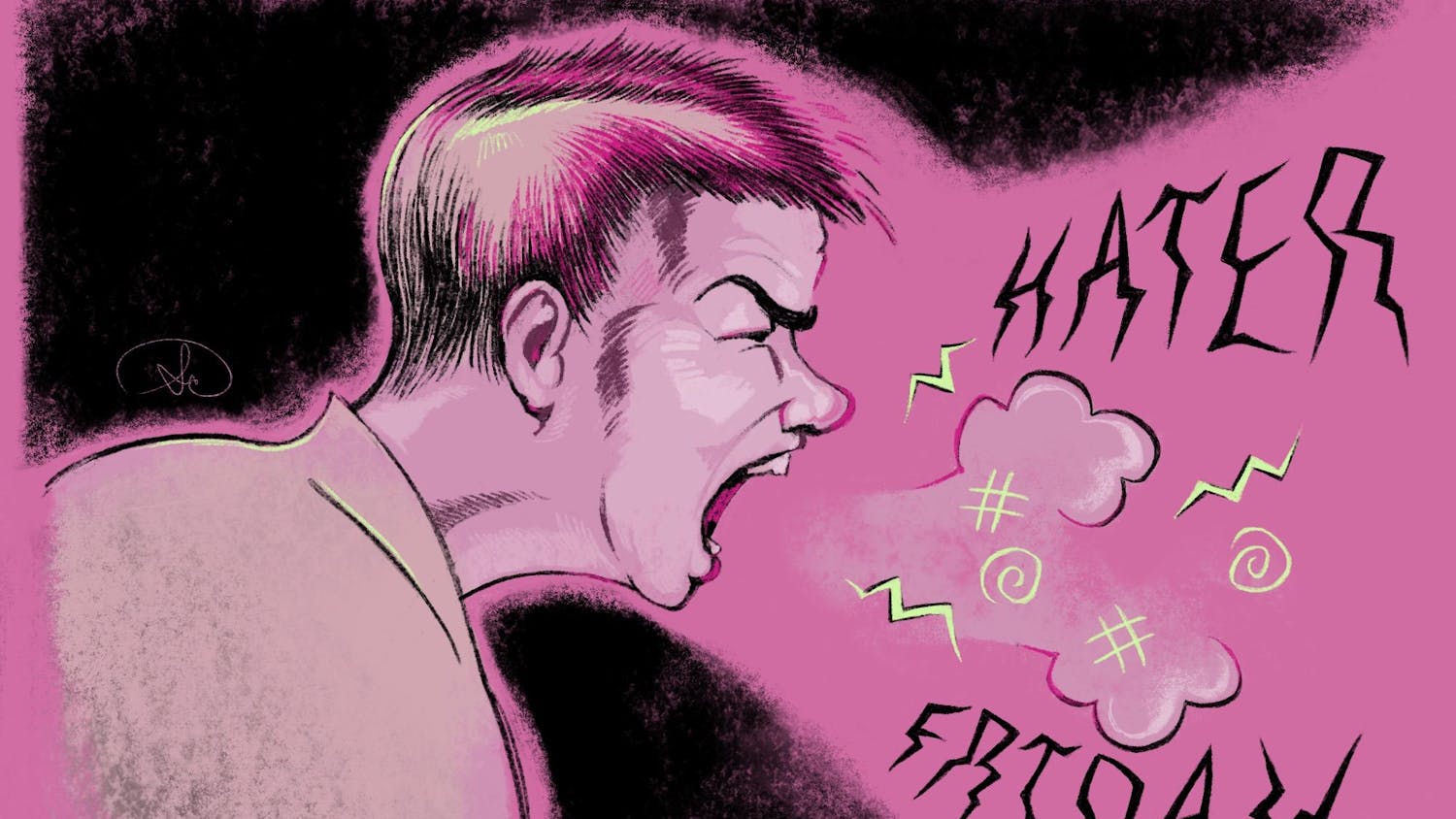
On March 21, Cornell Cinema screened Julia Ducournau’s Titane (2021) as both the conclusion to its annual French Film Festival and the inception of a new initiative titled Transgressing in collaboration with the LGBT Resource Center and the Gender Equity Resource Center. Following the film was a panel discussion moderated by Assistant Director of the LGBT Resource Center Tina Coyne with Victoria Seravini, Teagan Bradway and Claire Menard. The group elaborated on its themes including the horror of the human body, family, trauma and LGBTQ+ cinematic narratives (textual and subtextual).
Ducournau’s first movie, Raw (2016), functions simultaneously as a cannibalistic body horror and a coming-of-age drama. Naturally, she followed this up with the Palme d’Or winner Titane, another body horror film that transitions into a touching drama about gender, sexuality and chosen family.
The story follows Alexia (Agathe Rousselle), who inadvertently causes her father to crash their car as a child, forcing doctors to insert a titanium plate into her head. This may or may not be the cause of her erotic fascination with cars that is shown throughout the film. As an adult, Alexia is a dancer at motor shows who moonlights as a serial killer, violently lashing out at the guilty and innocent alike. After a sexual encounter with a Cadillac and a grisly (but not entirely successful) mass murder attempt, a pregnant Alexia goes on the run from the law, disguising herself as a missing boy from 10 years ago named Adrien.
This central premise is a clear allegory for gender transition. Critics of Titane have cited it as a harmful depiction, given that Alexia only becomes Adrien out of a necessity to avoid the police and goes through graphic bodily mutilation in the process. They have also pointed out that the horror genre has a longstanding trope of homicidal queer villains in films such as Psycho (1960), The Silence of the Lambs (1991) and even more recently in Insidious: Chapter 2 (2013).
However, as the panel argued, Titane subverts these prior examples because, post-transition, Adrien’s violent tendencies generally fade away, whereas gender dysphoria is often credited as the motivator for earlier antagonists’ savagery. In order to pull off a socially-acceptable performance as a man, Adrien must tape his feminine body parts, shave his head and break his nose in moments that make the viewer squirm and also examine how we interact with gender in private versus in public.
Adrien experiences a model of both healthy and toxic masculinity in the father of his adopted persona, Vincent (Vincent Lindon). An aging fire captain, Vincent habitually injects steroids in order to hold onto the muscles and strength that came more easily in his youth. He tries his best to be a good father to Adrien, though he doesn’t always know how — especially when his gender confusion comes to light. Vincent runs a tight crew of firefighters that he trains Adrien to join, defending him against all mockery or scrutiny. Adrien’s eventual embracing of his masculine identity also includes conforming to detrimental mentalities, such as when he chooses not to get involved in a scene where a group of men harass a woman on a bus.
Some of the most beautiful moments of Titane can be found in Vincent’s acceptance of Adrien and his identity, especially when it becomes more and more clear that this is not the son he once lost. From the perspective of an outsider like his ex-wife, it’s tragic that Vincent’s trauma has held onto him for so long that he desperately wants to maintain the delusion of having his son back. But as Vincent and Adrien grow closer, the film argues for the value of new beginnings and found family in the healing process.
As the plot shifts gears, Adrien is stuck with a significant reminder of his previous identity: the pregnancy that begins to manifest itself in unorthodox ways. Just like with masculinity, this is where Ducournau focuses on the terror of the feminine and the maternal. This is similar to other works such as Rosemary’s Baby (1968) — the fear of not being in control of one’s own body, or of having an alien entity inhabit it (further intensified by the baby not being ‘normal’). Adrien’s attraction to automobiles is born out of an inability to genuinely connect with other human beings; the sterile sensuality of cars is far more preferable. At the conclusion of the film, as Adrien gives birth with the caring assistance of Vincent, a harmonious relationship between flesh and machine is finally realized.
Titane is a visually-arresting, genre-bending ride full of thrills, sentimentality and tactility. It may make viewers uncomfortable, but it is never pointlessly provocative. For those looking to expand their grasp on the horror genre or experience a story that is, even with its bizarre subject matter, authentically human, I cannot recommend this movie enough. Julia Ducournau’s latest film, Alpha, premiered at the 2025 Cannes Film Festival to mixed reviews and begins a limited theatrical run on March 27, 2026 (including at Ithaca’s very own Cinemapolis). I plan on approaching it without any preconceived notions and the knowledge that it will certainly be worthy of discussion.

Colton Sears is a member of the Class of 2028 in the Nolan School of Hotel Administration. He is a staff writer for the Arts & Culture department and can be reached at cds284@cornell.edu.