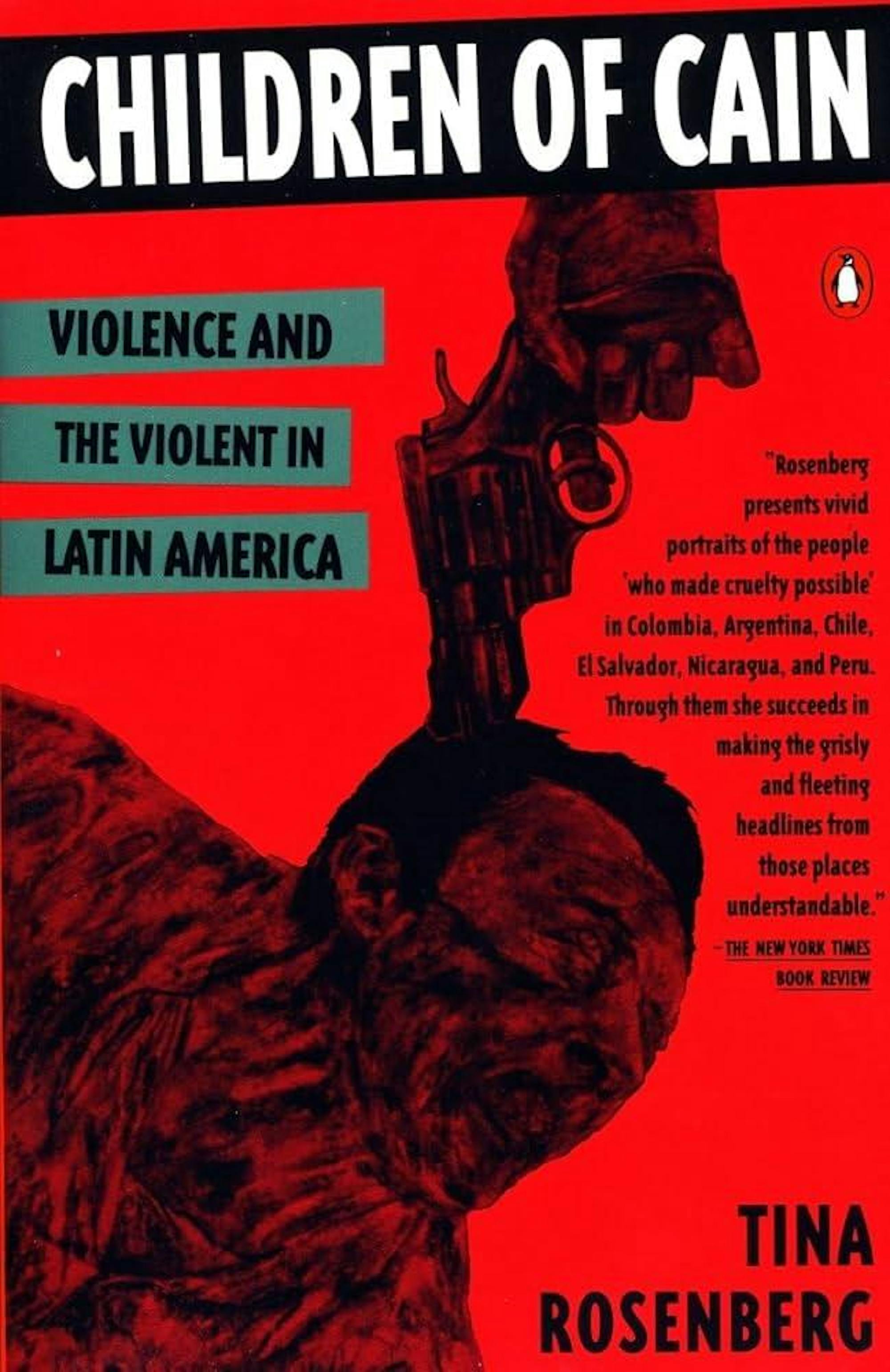
In a poor neighborhood in Tacna, Peru, a man named Jorge Lopez builds a concrete wall down the middle of a woman’s yard and dares her to do something about it. She cannot. The woman, Gladys Meneses, has no property title, no lawyer, no birth certificates for her children and a tuberculosis infection eating through her lungs. The wall stays. It is the kind of injustice that happens every day in every poor country in the world and goes entirely unrecorded — except that American journalist Tina Rosenberg was there, sitting in Gladys’ yard, taking notes.
But Gladys is only one story in Rosenberg’s 1991 nonfiction book Children of Cain: Violence and the Violent in Latin America. This chapter, called “Dialectic,” builds a portrait of Peru around three people who would never share a room: Gladys, quietly drowning in a system that was never built for her; Javier, a Shining Path guerrilla who sees a single, violent solution to the country’s poverty and institutional rot — burn it down and start over; and Ricardo Vega, a sociologist in the highlands who thinks there might be another way. Rosenberg doesn’t rank or judge them. Instead, she just lines their stories up and lets the tension breathe.
Take Javier: on paper, he is a terrorist. In Rosenberg’s hands, he is also a funny, sharp, sentimental 21-year-old who worries about his mother, schemes to win back an ex-girlfriend and asks Rosenberg to bring him Reeboks from Chile. Then, the “switch flips” — he is reciting Mao Zedong quotations in a reverent hush and explaining why the Tiananmen Square massacre was actually quite hopeful. Both of these versions of Javier are real. In refusing to choose between them, Rosenberg argues that witnessing means resisting the urge to make people legible at the cost of making them true to their own contradictions.
Then there is Gladys. Rosenberg doesn’t describe her poverty in percentages or policy language. She describes the contents of her room: two small beds, a heap of old clothes, a Bayer herbicide poster on the wall, a picture of a blue-eyed Jesus. She also describes Marco, Gladys’ son, endlessly pushing a chair back and forth through the narrow passageway beside the concrete wall because there is nowhere else to go. Rosenberg lets the details speak for the politics. A reader may absorb and subsequently forget that 48% of Peru’s working population operates outside the formal economy. However, it is much harder to forget a little boy who has nowhere to play.
Rosenberg’s witnessing philosophy is especially compelling when she turns it on herself, admitting that she has spent so much time in Latin America that she has become numb. Poverty at sufficient scale stops registering as a collection of individual human emergencies and instead becomes a kind of weather — ever-present, acknowledged and unalterable. It is the kind of thing you learn to dress for rather than fight. Gladys’ concrete wall, however, breaks Rosenberg’s numbness precisely because it is a small, individual wrong that could conceivably be righted. Rosenberg tries to help by hiring a lawyer, visiting the courthouse and navigating a bureaucracy that is shown to be essentially decorative. What she finds instead is that Gladys has simply replaced one patron with another. Lopez’s earlier role is transferred to Rosenberg, as Gladys gives her faith entirely to a foreign woman with a notebook. In that moment, the journalist who came to document powerlessness finds herself implicated in its reproduction.
Ricardo’s story is memorable, likely because he’s the only one of the three who makes a costly choice without the promise of anything in return. He moves to the Puno highlands, learns enough Aymara to say “Hello” and “Hurry up,” organizes campesino farmers to take over land and farm it and writes unanswered letters to Bob Dylan. Although his story is almost undramatic next to everything else in the chapter, the contrast is striking. Sendero Luminoso, or the Shining Path, a homegrown Maoist guerrilla movement that spent a decade making rural Peru ungovernable, wants him dead for it. The group eventually sends 24 fighters to destroy Ricardo’s headquarters, the Catholic Church-backed network of campesino federations he’d spent years building across Puno, and a commander comes looking for him with a machine gun. By the end he’s just tired, the way people get tired when they’ve been doing something hard for a long time with no particular end in sight. It’s worth remembering, at this point, that Gladys is still there too, still poor, still negotiating with the Lopezes, still planning to ask the man who stole her property for a loan to buy fruit to sell in the contraband market. That’s what survival looks like when the system never once worked in your favor.
Rosenberg doesn't tell you it was worth it, for Ricardo, for Gladys or Javier. She just tells you that they were there, that they did the work and that the concrete wall is still standing. Somehow that’s more devastating than any conclusion she could have ever written.
Aima Raza is a member of the Class of 2027 in the School of Industrial and Labor Relations. She is a staff writer for the Arts & Culture department and can be reached at araza@cornellsun.com.