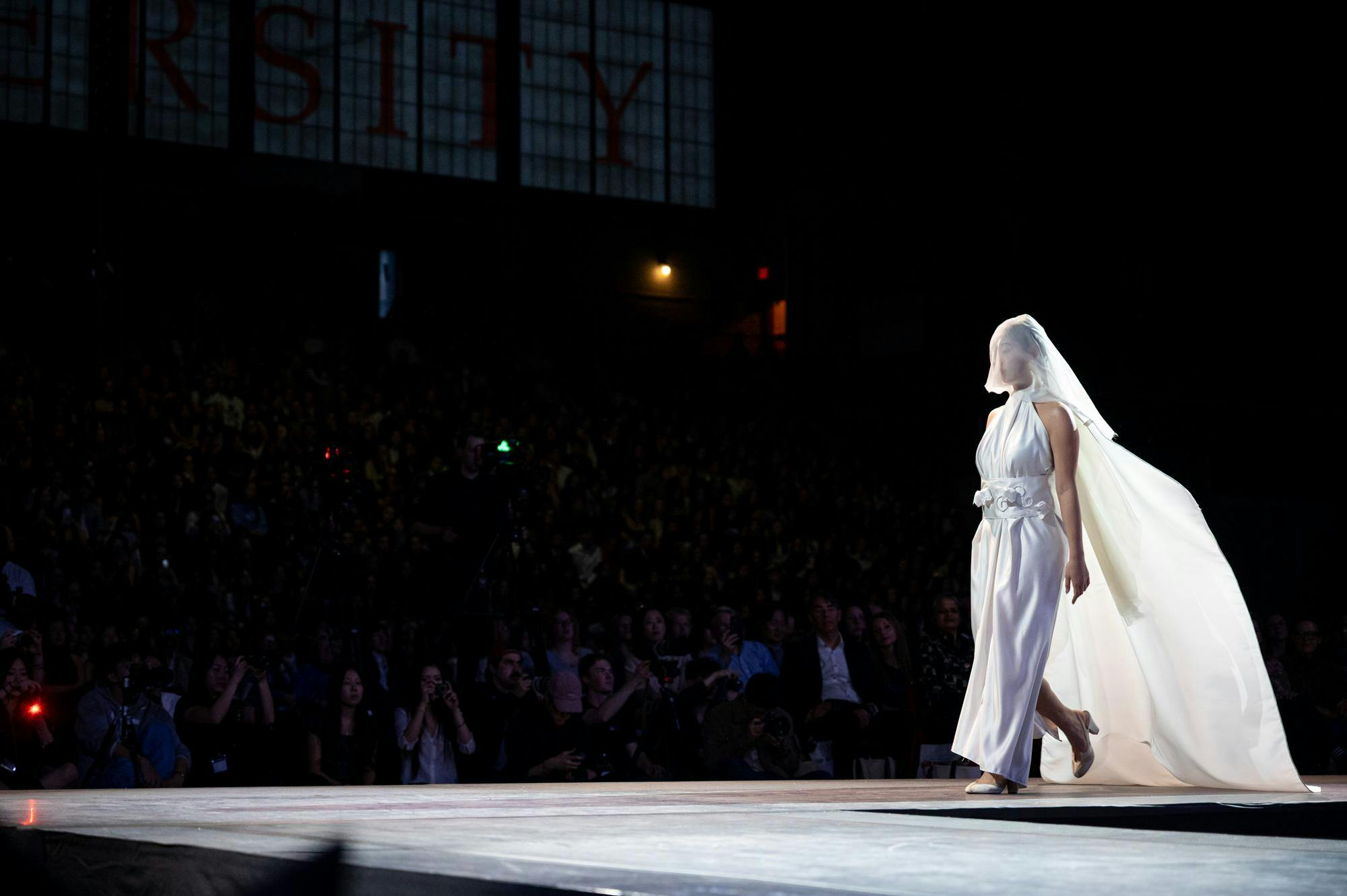
On March 21, nearly three thousand people gathered in Barton Hall to watch Cornell Fashion Collective’s 42nd Annual Spring Runway show. Second only to Slope Day in attendance, the CFC show featured the unique work of 42 floor designers, with looks ranging from well-tailored streetwear to impressively abstract avant-garde pieces.
The collective takes a four level approach; the first and second level designers create one or two looks based on a central theme, and the third and fourth level members design their own personal collections of up to 12 looks. This show was a feat of logistical prowess, as an entirely student-led organization transformed the space into one for fashion students to truly showcase their skills. The first showcase, “Greyscale,” was developed by the collective’s level one designers, using a lack of color to place a greater emphasis on the construction of the pieces themselves. The second, “Deux Ex Machina,” is meant to be even more intricate and meticulous for the level two designers as they use their looks to test the barrier between nature and technology. These pieces are technical masterclasses, emphasizing the rigor and conceptual creativity needed to develop such outfits.
Where the show really seemed to take off, however, was during its third and fourth levels, as each designer focused on telling a story by developing deeply personal collections. Taking inspiration from their own lives, the designers seemed to have a rich connection to their collections, a palpable elevation from the previous looks. This latter stage of the show stood out especially because of how the models showed off what they wore, using their staging and choreography to further highlight their message. For example, Madison Feely ’26’s collection “Homebody” was focused on childhood, leading her models to do more than an elegant strut. Instead, their movement ranged from stomping around playfully across the stage to posing like a T-Rex in front of the cameras. With Alexis McMurray ’26’s “Made for Moments,” one model took off her coat to reveal a bodysuit underneath, further signifying the freedom fashion can bring as the collection overall tackled the intricate relationship one has with themself.
The upperclassmen collections only faltered when designers tried to make their otherwise homogenous looks appear diverse with singular attempts at something different. That is to say, one look out of the larger collection would be distinct rather than following the concept in the same way as the other outfits. By not sticking to one continuous interpretation, making it appear like a well-rounded line, or committing to an entirely varied collection, some looks simply appeared out of place. Regardless, each member of the collective at this level created exceptional pieces, driven by personal inspiration and passion.
Another designer from the collective’s fourth level was recent December graduate Lucy Jones, who presented “Crosseyed and Painless,” a ready-to-wear collection composed of 10 looks, an incredibly difficult undertaking. Although some designers may begin their process with the conceptual aspect, Jones described hers as one driven by instinct. “The inspiration for my collection was stuff I wanted to make and/or wear,” she said. “I’m a very spontaneous person … every time I finished one piece, I’d be like, ‘okay, what’s next?’” Her collection is based around both her own style and the unique culture of fashion in her hometown of Los Angeles, underscored with the recent resurgence of ’60s trends nostalgia.
Jones is one of many designers whose childhoods directly contributed to their love for fashion, as well as their desire and dedication to pursue it to this extent. “My mom taught me to sew,” she said. “I think I started using a sewing machine when I was four or five.” But now with a Bachelor’s of Science in fashion design management and a deeper understanding of the technical aspects of fashion, Jones’ experience showcases how vital each component of fashion is to pursuing it professionally. Moving from two looks the previous year to 10 this year, she also elaborated on the demand that comes with it, noting “You don’t truly understand what it is to be a fashion major until you know where the showers are on campus.”
Despite being a student organization, membership in the Cornell Fashion Collective is essential to success for fashion students, being their only chance to present the fruits of their labor to such a large audience. If anything, this fact only underscores its importance and how dedicated those involved are, as it transforms a previously academic process into something else entirely. Instead of relying on professors and teacher’s assistants for feedback, students rely on their peers, working directly with them to better each other. Simulating a professional environment, this process undoubtedly demonstrates the intensity of the event and prepares students for jobs in the profession.
CFC’s 42nd annual runway show concluded on Saturday evening as more than a campus event; it is a testament to the creative prowess and strength of those pursuing the arts at Cornell. Students spend days at a time working tirelessly in the studio, with their passion driving the production of these kinds of shows. “I’m really impressed by the work of my peers,” Jones remarked. “The grit and resilience of my friends and classmates is unbelievable.”
Aarav Bavishi is a member of the Class of 2029 in the Brooks School of Public Policy. He is a staff writer for the Arts & Culture department and can be reached at arb438@cornell.edu.