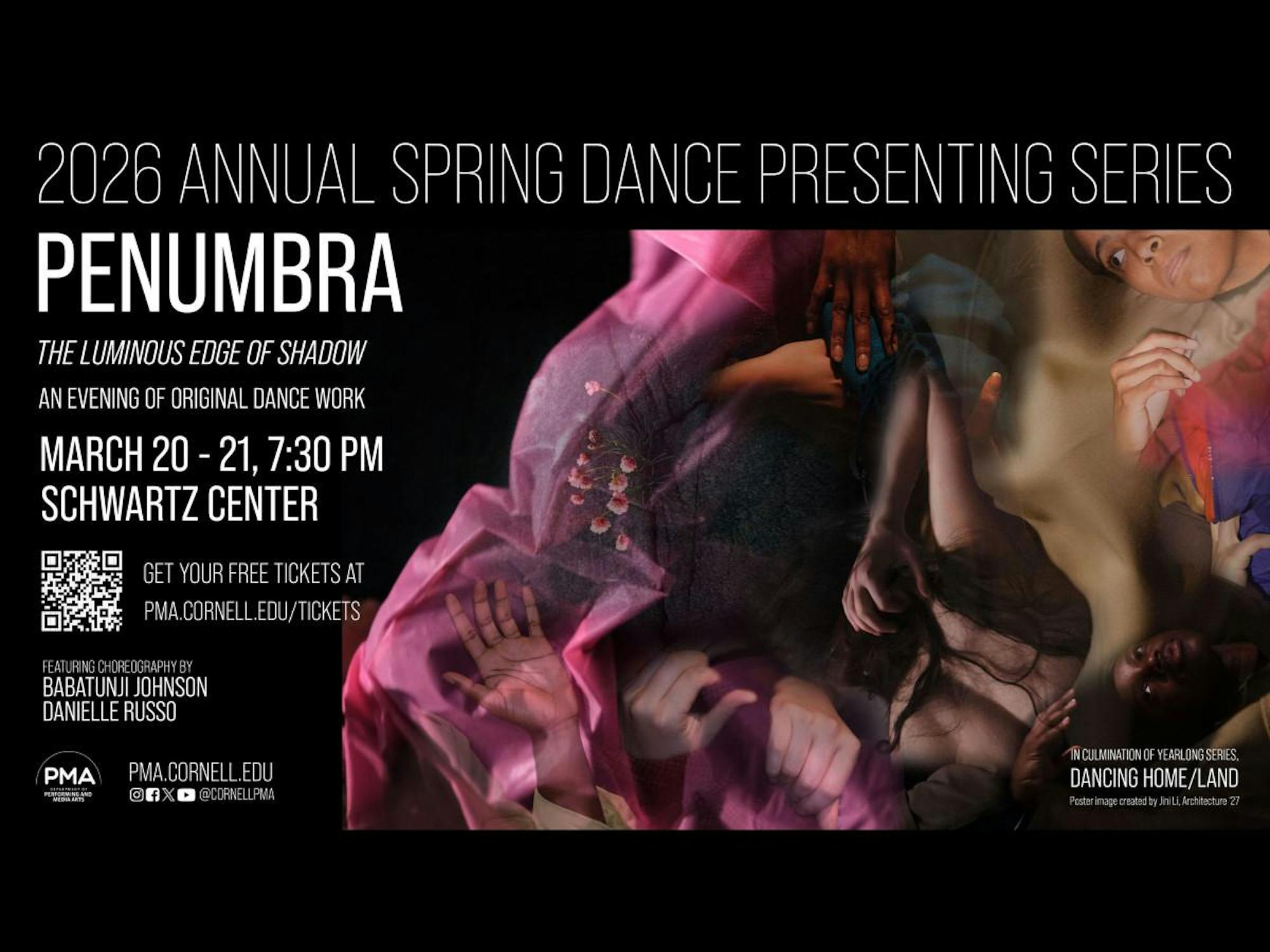
I believe the mark of good art is when it inspires the creation of more art, so when I walked away from PENUMBRA itching to write about it, I knew I had seen a truly phenomenal performance. On March 20 and 21, Cornell's Performing and Media Arts Department presented "PENUMBRA," a two-act original show featuring nine talented dancers exploring light, identity and consciousness. The show was fully produced by students enrolled in the PMA 1611: Rehearsal and Performance course. As described in the program, PENUMBRA "delve[s] into the shadow self and the tensions between impulse restraint and the ego," simultaneously drawing on the work of Carl Jung and Sigmund Freud. The word penumbra refers to the illuminated edge of a shadow, an idea which performers played on in both their movements and the production of the show, as they spun in and out of the stage lights.
The first act of the program, titled "seemingly perfect, radiant" interwove the dancers' poetry and thoughts with their incredible footwork, with each dancer shining in their solo. Every dancer had a motif that they repeated throughout the performance, including both questions such as "Where did everyone go?" and "What is home?" and lines such as "Uniqueness is precious" and "You remember too much." These motifs helped steer the interpretive choreography, which was both intimately emotional and yet incredibly controlled. The show kept me enraptured, as I constantly felt myself trying to keep up with the moving elements of each number. By repeating movements in sync and out of sync, the dancers portrayed a desperation to both seek self and escape self. At the same time, they spilled in and out of different colors of light with intentionality. Beyond the artistry of the show itself, every person on stage demonstrated a true passion for their art, both in their acting and their athleticism. At the end of the act, in a powerful final moment, the dancers stepped into the bright light and out of the shadow. Between lighting, costuming and the multitude of jackets that the dancers constantly moved about the stage, I found the use of color particularly striking, and that focused interest in color spilled over into the second act.
The second act, titled "Society," featured dancers in black coats, each with colorful costumes underneath. One isolated dancer, Jolene Conti ’29, remained alone until the end, even as the other dancers found themselves taking off their coats and beginning to dance joyfully together. That loneliness, the fear of not fitting in or not being good enough, echoed the mental health struggles and questions of identity that characterized the first act. Conti explained the piece as an exploration of "how we can express ourselves and still be socially acceptable and what happens when we shed that. The kind of struggle between fitting in and expressing oneself." Once again, the talent on that stage was absolutely undeniable.
Reflecting back on the first act, Conti said, "We created our own solos and then [choreographer Danielle Russo] took those solos and … crafted around it." She went on to share how closely the dancers were involved in every step of the process. The show played a part in the larger annual PMA theme of home, land and self. However, as Conti told me, the final product "became very much the honest truth of [us] as a cast" and the cast's desire to "support each other and love each other and be there for each other, hold each other, catch each other when we're falling." I thought that came across beautifully in the choreography, with dancers clinging to themselves and one another. She also mentioned the prevalence of improv, remarking that in her own poetic speech, the text changed significantly; during the Saturday performance, some of the lines she spoke had "never been said on that stage before" because she and her fellow dancers "kept playing around and changing things until the end."
Overall, I found the show hauntingly beautiful. Hearing about the improvisation in the show, the hard work of both cast and crew and the fearless exploration of self and community just added to the experience. Once again, the Performing and Media Arts department left me questioning the layers of my own self. I remain fascinated by the idea of shedding our layers to reveal the different versions of ourselves. How do we struggle to fit in? When and why do we choose not to? What is home? Is it a place? A person? A front row seat in the audience of PENUMBRA? PENUMBRA absolutely left me with more questions than answers, but I know one thing for sure: I am in awe of the athleticism and artistry that PMA displayed, and I cannot wait to see more from these dancers moving forward.
Emily Federovitch is a member of the Class of 2029 in the College of Arts and Sciences. She is a staff writer for the Arts & Culture department and can be reached at eaf258@cornell.edu.