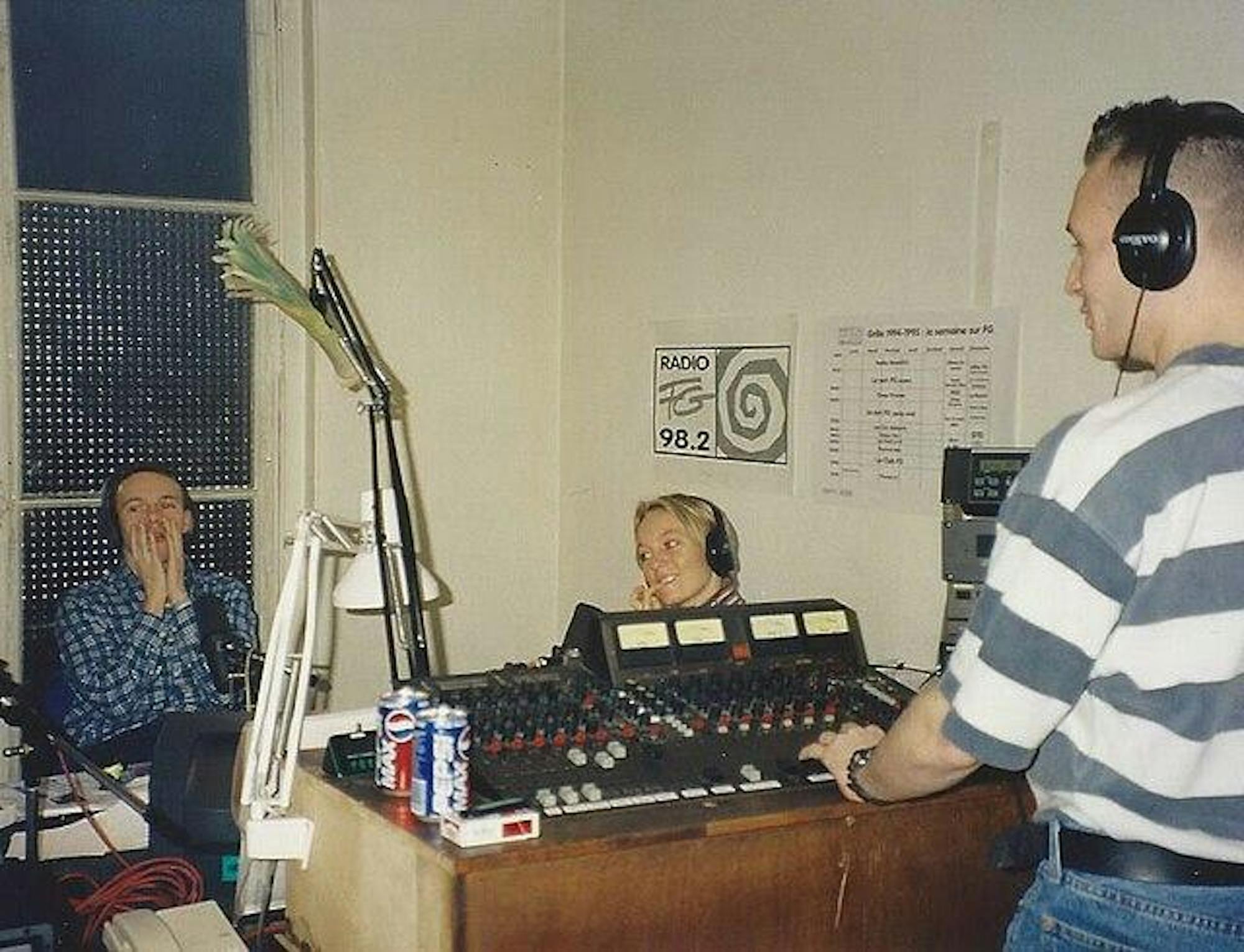
In Carl Sagan's Contact, aliens discover and connect with us here on Earth by intercepting radiowaves. As a DJ, it’s a nice thought; maybe aliens will tune in to my set, hear me play Pearl Jam for an hour and be so impressed by my taste that they decide to make contact. In reality, I can tell you that, for the most part, being a DJ feels like speaking into the void. I can imagine my voice carried off into the distant vacuum of space, reaching only the ears of a couple middle aged dads on the way, if I’m lucky.
It’s not surprising that radio is something of a dying art. The advent of music streaming has long caused the decline of physical media, such as vinyls and CDs, and radio is experiencing a similar phenomenon. For a while, radio still had something going for it: It was an expected feature embedded in most cars. Now, Apple Carplay and other forms of Bluetooth listening have taken over, and many cars are being built without radio capabilities entirely, meaning radio is at an all-time listening low.
When it comes to analog media, it’s a fine line as to whether or not something will be effectively saved by the younger generation. For example, vinyl records have been deemed cool by the masses, so — while they are perhaps not being bought at the rate they once were — they’re still a pretty prosperous market. The same can be said for CDs, though on a slightly lesser scale. On the contrary, DVDs and VHS tapes have fallen largely out of favor. Radio, which is something people can’t physically show off, doesn’t have the same overt social benefits as collectible media. Maybe one day a viral TikTok creator will influence the Gen Z crowd to save radio. Until that day, what’s to be done?
In a realistic, though perhaps pessimistic view, it can be a bit hard to conceptualize why people may care to revive radio at all, especially student-run stations when they’re largely incompatible with our daily lives. Cornell’s student radio WVBR FM 93.5, for example, has a streaming app, but why would students choose to listen to this when they could instead listen to their own playlists on Spotify or Apple Music? In the past, before the advent of cell phones, college radio stations were a powerful center for student protest, voice and thought. Today, if I want to know what my peers think about something, I can just hop on Fizz. Although many student-run stations take initiative to renew student interest by hosting performances or parties, the actual act of listening to the station is difficult to convince people to do.
The truth is that tuning into the radio requires effort, and people are increasingly disinclined to put effort into anything, echoing the phrase: “Everyone wants a village, but no one wants to be a villager.” Radio stations are the absolute epitome of community, especially in college. Your DJ peers are going on-air and carefully selecting music to play for you every hour, sharing their thoughts on each song. Local businesses get on and boost special events, not to mention celebrity appearances and giveaways. Just listening to the same thing as other people in your area creates a sense of community, especially when you consider the fact that each station has a limited reach, meaning listeners are your friends, your neighbors and even your professors. Music is a cultural tool, and Cornell’s unique culture can best be felt and embraced by listening to the music your peers play for you.
The reason radio matters isn’t because one day aliens might use the waves generated to rescue humanity, though I supposed they might. It matters because it encapsulates a sensation that we are increasingly losing in modern times: community. College can be one of the loneliest times in a person’s life, especially as we take refuge online instead of in public spaces. Thus, radio becomes a kind of third space for students to connect with one another, so long as we don’t fall into the trap of not putting in a little effort.
Abigail Winsett is a member of the Class of 2029 in the College of Arts and Sciences. She is a staff writer for the Arts & Culture department and can be reached at agw66@cornell.edu.