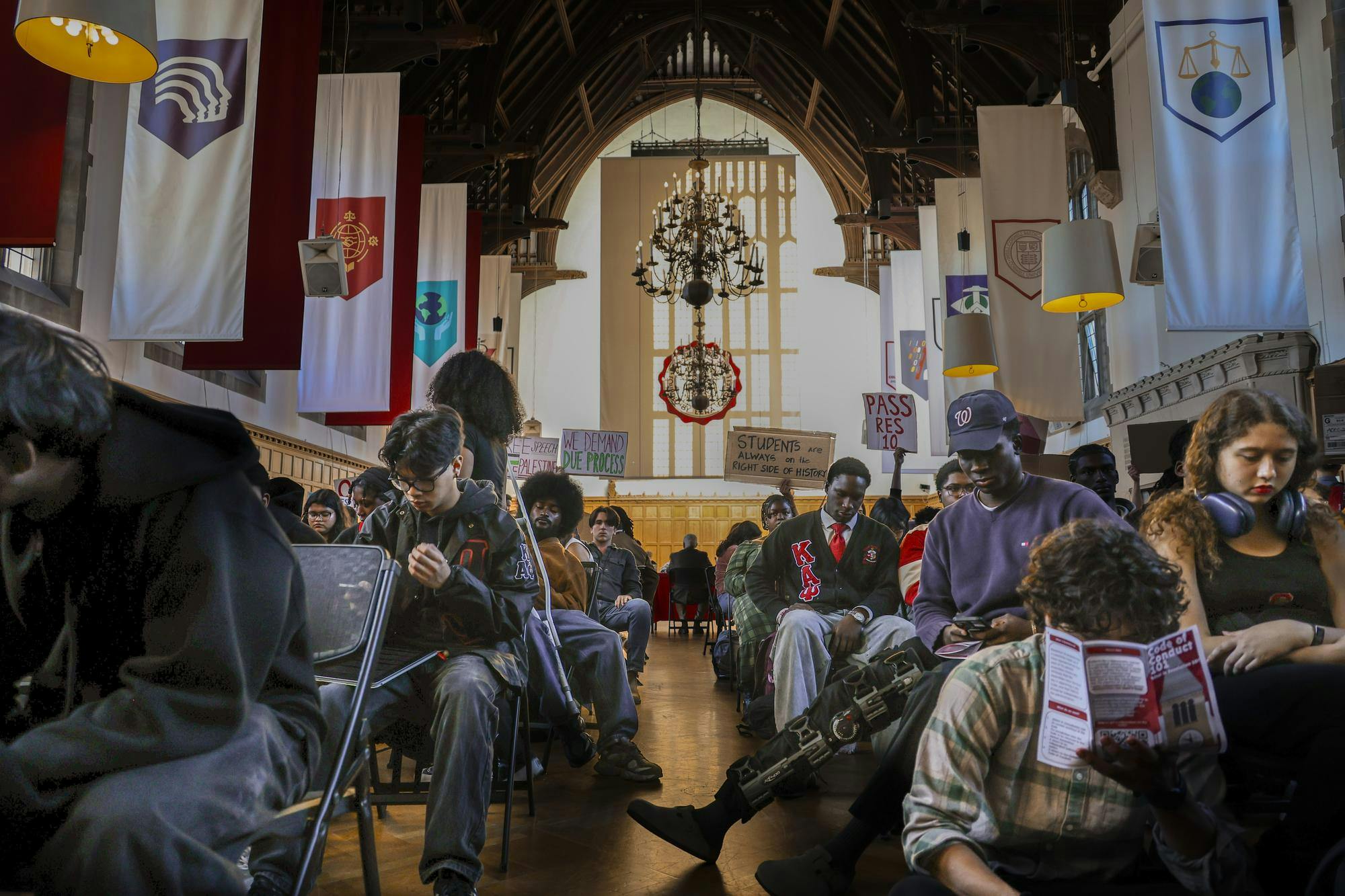
In a room packed to full capacity, the Student Assembly voted to pass Resolution 10: Addressing the Administration’s Undemocratic Review of the Student Code of Conduct and Affirming Cornell’s System of Shared Governance in a 21-1-2 vote.
The Assembly also rejected their finance committee’s recommendations to reduce funding for ALANA Intercultural Board, Cornell’s Multicultural Greek & Fraternal Council and the International Student Association. Now, the finance committee will go back to the drawing board to reevaluate the organizations’ funding allotments and create new recommendations.
The vote followed a three-hour-long meeting filled with attendees' stomps, claps, jeers and cheers that began with a visit from President Michael Kotlikoff and Vice President for Student and Campus Life Ryan Lombardi.
An Instagram announcement to “Pack the Vote for ALANA" by Black Students United, La Asociación Latina, South Asian Council, Native American and Indigenous Students at Cornell and ALANA garnered a crowd for the meeting.
ALANA is a supplementary funding board that sponsors 138 other organizations and has funded over 117 events over the past two semesters. Approximately 130 students filled all seats and packed against the wall with over two dozen more waiting outside and peering through the windows.
When Kotlikoff and Lombardi walked into the room, the crowd erupted into a flurry of motion and noise as attendees picked up and turned their chairs to face away from where the administrators sat. Attendees standing along the walls also turned their backs on administrators. Many attendees held signs facing Lombardi and Kotlikoff in support of Resolution 10, ALANA, free speech, Palestine and more.
Kotlikoff and Lombardi’s discussion with Assembly members consisted of conversations surrounding updates on federal funding, Student Code of Conduct revision questions and more.
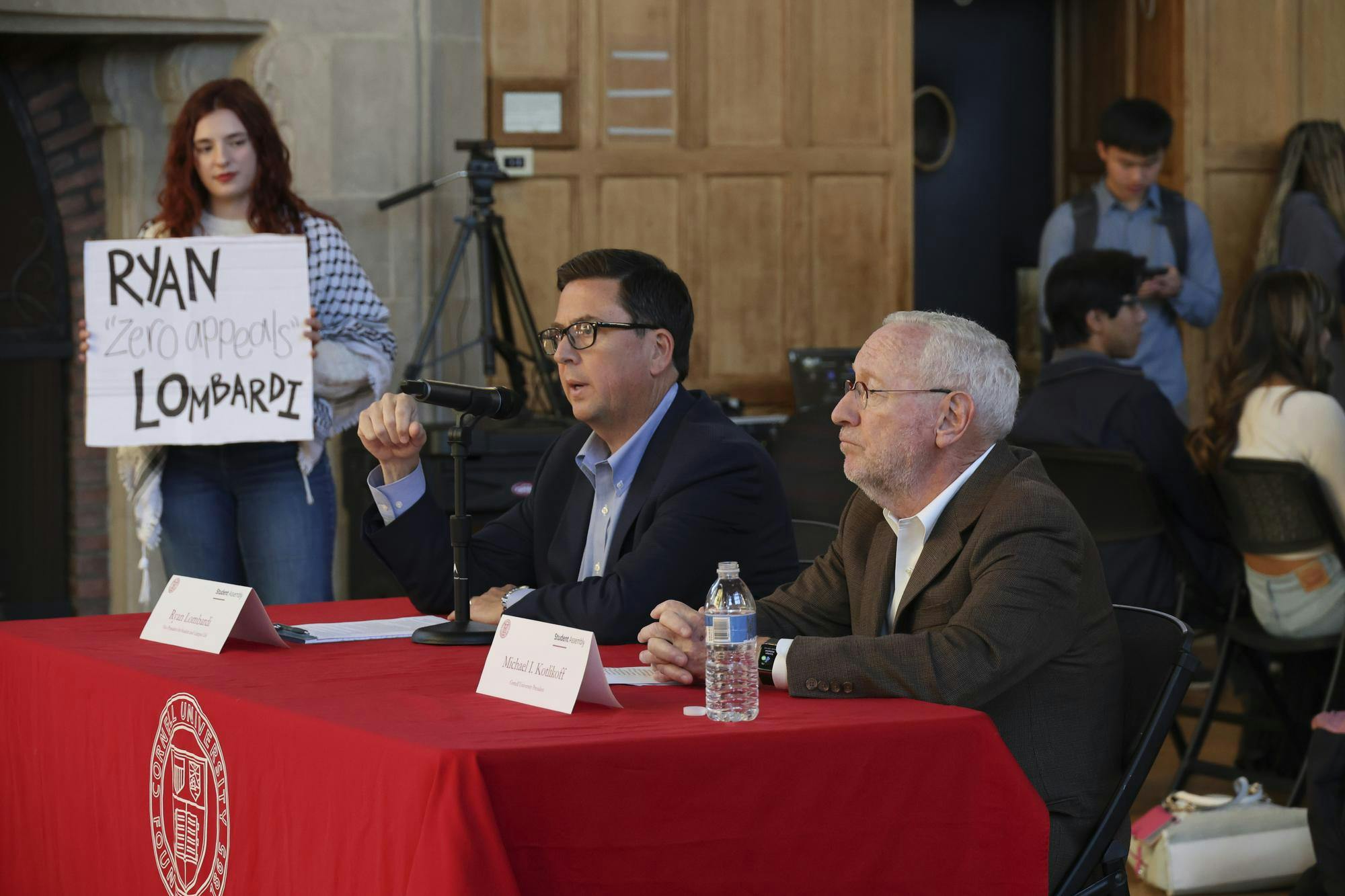
During a Q&A with members of the Assembly, Industrial and Labor Relations Representative Max Ehrlich ’26 asked about Prof. Eric Cheyfitz, literatures in English, and the due process behind the professor’s investigation — before ripping a printed copy of University Policy 6.4, the procedure for resolution of reports against employees in front of the administrators.
“Under the section for appeals to the committee on academic freedom and professional status, it says, quote, ‘The dean or equivalent unit head must accept the committee's findings with fact and conclusions,’” Ehrlich said. “However, your University administration has overturned the committee's findings in clear violation of your own rules of due process.”
Ehrlich then held up the policy and said, “So I guess I can just — ” and ripped the paper packet down the middle.
“Do you plan on continuing to violate your own due process rules? And should I print out any more pages of your rules and tear them up?” Ehrlich asked the administrators.
Kotlikoff responded, “I believe that Provost [Kavita] Bala addressed this issue quite substantively in the Faculty Senate yesterday. It is an issue I think you should address to Provost Bala.”
At the Faculty Senate meeting, Bala said on the topic, “As a university, we would be violating federal anti-discrimination law if we accepted their findings based on [their threshold of evidence].” Bala’s actions fall under a separate University policy, Faculty Handbook Section 6.6, which allows for a college’s dean to report the results of an investigation to the Provost, who then holds the power to determine if future proceedings are warranted.
In light of the name of change of the Office of Discovery and Impact, which removed the word "diversity" from the name, Executive Vice President Christian Flournoy ’27 asked, “How do you feel that even with these financial pressures that the University is facing, that you can make sure students are continuing to feel represented and not feel like that their identity, or that their ability to be comfortable on campus will be washed away?”
Kotlikoff replied that the University had not instituted any measures that would give that impression to students, followed by a statement about the boundaries of students’ rights on campus.
“I certainly hope that's not the case. I mean, there's nothing that we've done that I'm aware of that should give that impression to students,” Kotlikoff said. “I say it [in] every situation. … Cornell is 'any person, any study.' That doesn't mean that any person can do whatever they want to do on this campus and violate and infringe other people's rights, but it does mean that we support every student at this campus, and our commitment to that is maintained.”
Author of Resolution 10, Aiden Vallecillo ’26, went back and forth with Lombardi and Kotlikoff in questions regarding the Code. Vallecillo asked questions about the University’s due process, Office of Student Conduct and Community Standards reports and if he would support student voices if they plan to amend the Code.
Vallecillo questioned the administrators about the current process of University discipline, asking, “Do you personally believe that the central administration is competent to judge acts committed against itself as a principle of due process?”
Lombardi replied that he “believe[s] they can” since the current Code of Conduct says that this is the way that the revision process must be conducted.
Following the previous question, Vallecillo asked, “If and when this assembly does pass a resolution requesting that a process that is more democratic and that involves not just our input, but elected representatives that we select are on committees, when that occurs, will you continue supporting students' voices and what we are requesting be done to amend the code?”
“I always support student interests on this campus,” Lombardi replied, which was followed with booing from attendees. “I have for 10 years and my record speaks for itself. So I'll just leave that there. There are thousands of students that have come before that would argue that as well.”
When the 30-minute presentation ended, Assembly President Zora deRham ’27 invited Kotlikoff and Lombardi to stay to listen to the public comment period, where many attendees were waiting to speak.
Kotlikoff and Lombardi left immediately after their presentation, and as they exited the room, crowd members asked, “You scared to stay? Don’t want to listen to us?” and chanted, “shame, shame, shame” as they turned their chairs back around to face the Assembly.
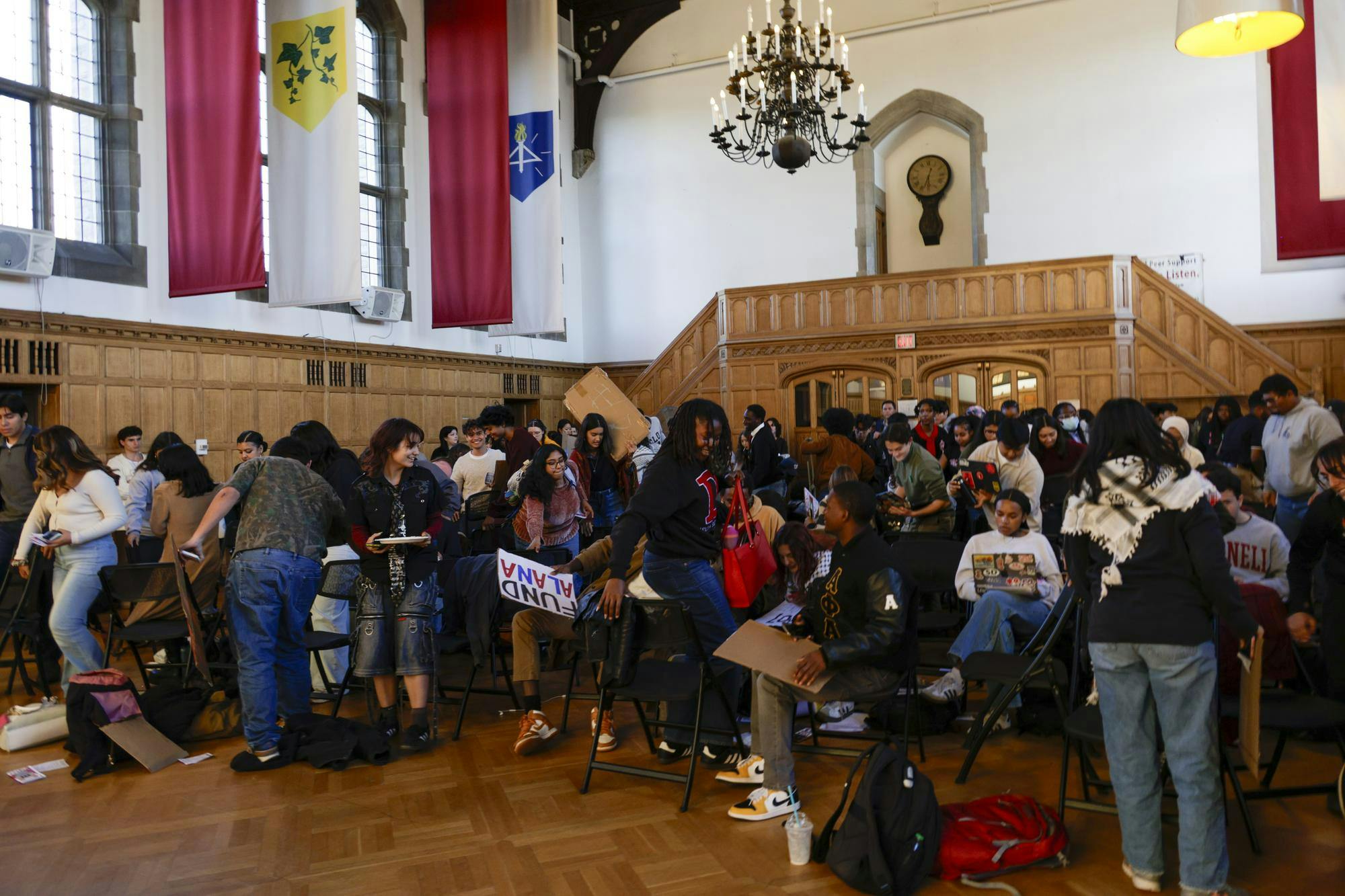
During public comment, students involved in numerous cultural organizations on campus came to support ALANA, Multicultural Greek & Fraternal Council sororities and fraternities and International Student Association as the Assembly’s finance committee was posing their recommendations to cut funds to the organizations later in the meeting. The recommended budget for the 2026-2028 SAF Allocation Cycle included approximately a 29.29 percent decrease for ALANA, a 55 percent decrease for MGFC and a 5.88 percent decrease for ISA.
Musa Jallow ’26, co-president of BSU, advocated for the rejection of the financial committee’s proposition.
“For the notion of budget cuts to even be proposed in a time where community is even more important than ever, for hundreds of students to have to show up and show you all what these cuts would look like and how many people you would actually be affecting is deeply upsetting,” Jallow said.
Afsheen Alvi ’26, co-president of ALANA and previous director of ISA’s executive board, further shared that if the Assembly approved the budget cuts, ISA would be able to support less than 40 percent of event requests.
“Cornell cannot be world-class if it is not open to the world, and being open to the world means supporting every student across it who trusts Cornell to protect them,” Alvi said. “This begins at the very initial level of supporting our programming and our attempts to share internationalism with Cornell's campus.”
Ava Osorio ’28, vice president of public relations for LAL, expressed dismay that club sports and Slope Day received an increase in funding while the cultural organizations received a decrease.
“The Student Activity funding allocations show that Slope day and club sports are receiving an increase of over $306,000 while ALANA, ISA, MGFC and the class councils, the organizations that uplift our cultural identity based and student-led communities, are facing costs totaling over $148,000,” Osorio said. “It's a statement of whose voices matter on this campus and whose don't.”
After public comment, the Assembly ruled to reject the recommendations, meaning that the finance committee will meet with ISA, ALANA and MGFC to discuss the information presented in their petitions and give new recommendations for the Assembly.
The audience also celebrated when, after four weeks of discussion, Resolution 10 passed in a 21-1-2 vote. deRham abstained from voting, and Students with Disabilities Representative Hayden Spector ’26 and Representative At-Large Ezra Galperin ’27 voted against the resolution.
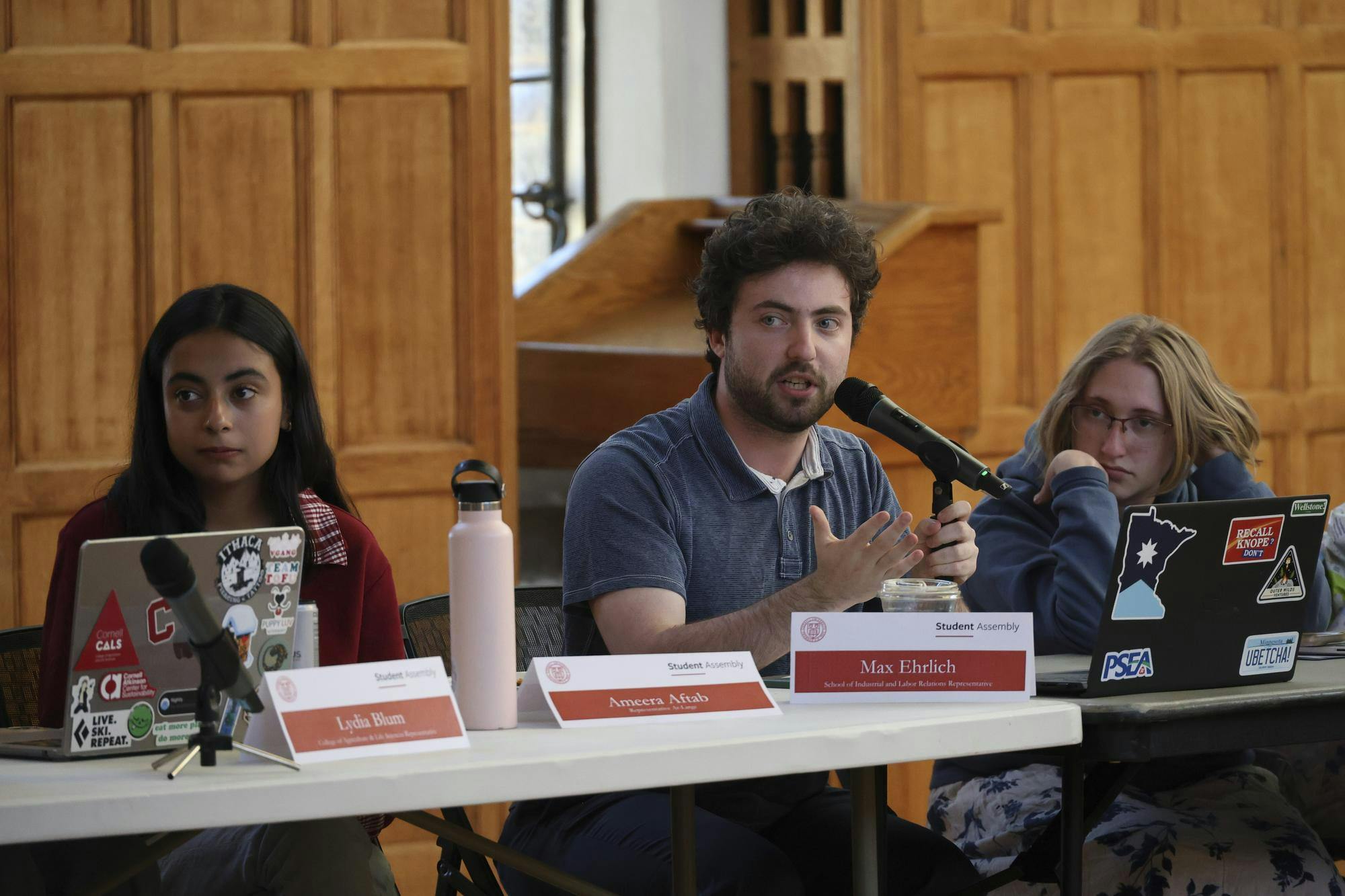
Industrial and Labor Relations Representative Max Ehrlich ’26 argued with Kotilkoff about Student Code of Conduct proceedings.
Resolution 10 has been several weeks in discussion, with the resolution being brought to the Assembly for four separate meetings.
While it passed through this meeting unedited, a few Assembly members attempted to make alterations to the resolution. Vice President of Communications Thor Waguespack ’28 suggested that a committee be created of exclusively students, rather than all the assemblies, like the original resolution suggested.
The amendment was rejected and debate closed when Assembly Representative-at-large Ameera Aftab ’26 declared, “The students are here and they said they want it the way it is.”
Speaking to the Assembly before the vote on Resolution 10 opened, Vallecillo expressed support for its passage, reminding everyone “let's remember who represent, [and] let us represent them.” He also addressed the attendees, expressing support for the resolution and for the student body to stand against the Code revision process.
“This fight does not end with Resolution 10, this fight does not end with the referendum, we will take it to the street, we will take it to the halls, we will make sure our rights are respected,” Vallecillo said.

Dorothy France-Miller is a member of the Class of 2027 in the College of Agriculture and Life Sciences. She was the managing editor of the 143rd Editorial Board and was a news editor for the 142nd Editorial Board. She can be reached at dfrancemiller@cornellsun.com.
Isabella Hanson is a member of the Class of 2027 in the College of Arts and Sciences. She is a senior writer for the news department and was a news editor for the 143rd Editorial Board. She can be reached at ihanson@cornellsun.com.