This article is part of a series on Jeffrey Epstein’s connections to Cornell University. Find the other pieces here.
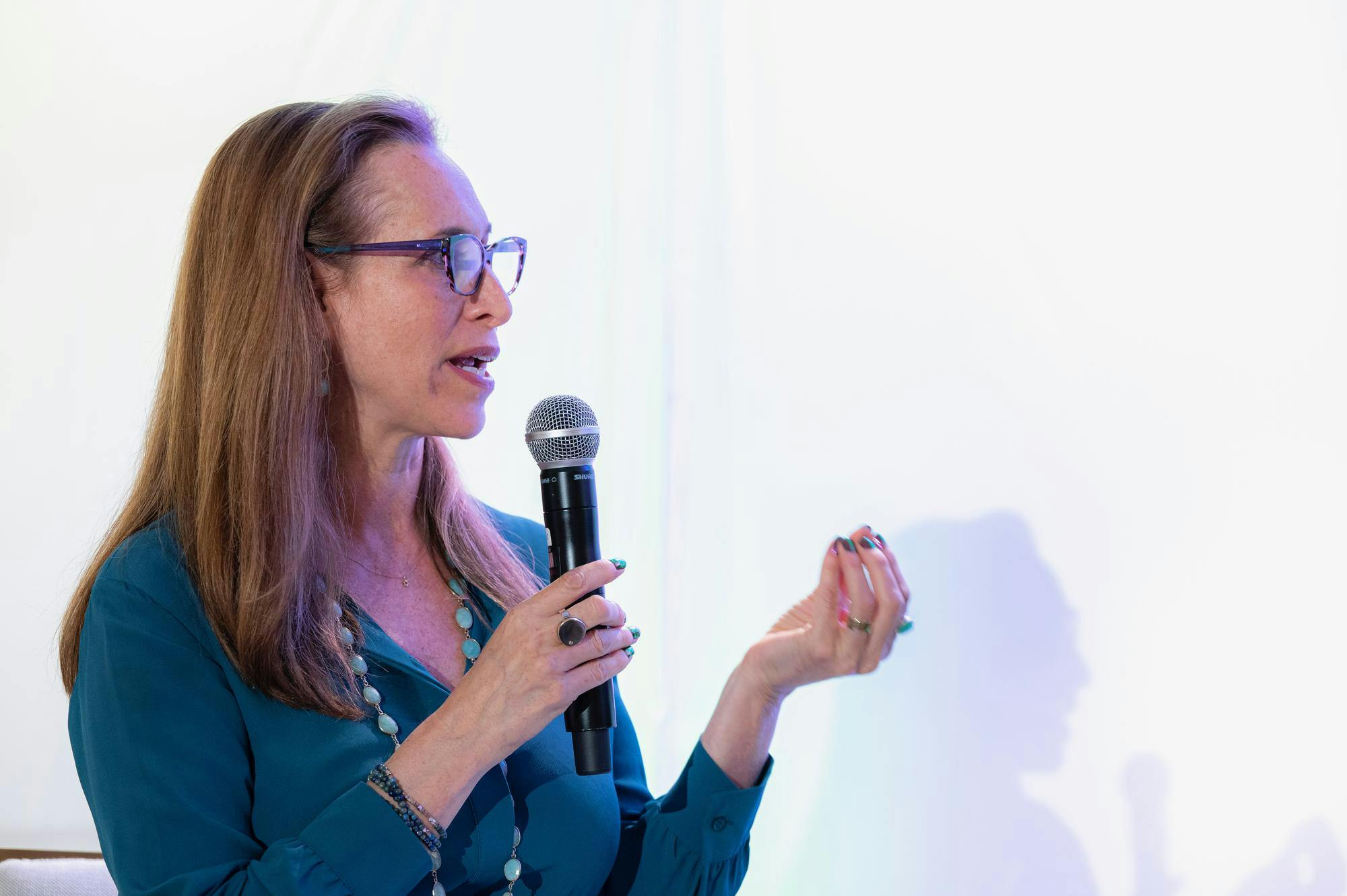
Rachel Foster’s ’89 sense of “repairing the world” started early: At nine years old, she declared herself a vegetarian.
Now, Foster, an attorney, anti-trafficking advocate and co-founder of World Without Exploitation, works with Epstein survivors to advocate for the release of files and accountability for abusers.
Foster said she values the idea in the Hebrew phrase tikkun olam — or, translated, “to repair the world.” She described the phrase's meaning to her as “living the notion of repairing the world,” and that people “have an obligation to repair the world.”
Foster said she first got involved with victims of convicted sex offender Jeffrey Epstein and longtime associate Ghislaine Maxwell through Elizabeth Stein, an anti-trafficking activist and victim of Epstein, who came to WorldWE in the midst of reports that Ghislaine Maxwell — one of Stein’s abusers — might get a pardon.
WorldWE was founded in 2016 to be “the connective tissue” between anti-trafficking and gender-based violence organizations and intended to spotlight organizations when they need it and bring organizations together to push policy.
“[Stein] said, ‘It would be so great if we could come together,’ and we said, ‘Let’s organize [Epstein survivors],’” Foster said.
On Sept. 3, the first rally including Epstein-Maxwell survivors was held in Washington, D.C.
“From then, we began organizing them and created a strategic advocacy plan to get the files released,” Foster said. “Up until then, victims felt siloed, silenced and sidelined, and they really came together as a collective voice.”
At the time of the rally, Congress had yet to schedule a vote on the Epstein files, and President Donald Trump was publicly opposing their release in Congress and by the Department of Justice.
After the rally, Foster and Epstein survivors wanted to pile on pressure on Congress to schedule a vote on the release of the Epstein files. Their “multi-pronged plan,” according to Foster, included billboards, meetings with representatives and a PSA.
For one, “Courage is Contagious” billboards were put up across the country, urging representatives to release the files, and reminding them that this vote could be important to their political future.
Meanwhile, many survivors were meeting with representatives to release the files “regularly,” Foster said, and a PSA was planned featuring survivors holding up pictures of themselves when they met Epstein.
“It was another incredibly powerful moment of them coming together and talking about the pain they felt,” Foster said.
Because Speaker of the House Mike Johnson (R-L.A.) quickly scheduled a Nov. 18 vote about the release of the files only five days before, on Nov. 13, WorldWE wanted to get as many eyes as possible on the PSA to place pressure on the House to vote in favor of the release.
WorldWE made the decision on Nov. 15 to place the spot on Monday Night Football. Despite the fact that NFL ad spots are hard to come by and pricey, WorldWE was finally able to place the ad, due in part to LinkedIn billionaire Reid Hoffman's intervention and an accelerated approval timeline from Disney, who owns rights to MNF through ABC.
The PSA went viral — amassing over 92 million views and 10,000 letters to Congressional representatives through WorldWE’s website.
The day of the vote, Nov. 18, only one representative voted against releasing the Epstein files. WorldWE and Epstein-Maxwell survivors finally won the release of the files on Nov. 19, when the Senate voted unanimously for their release.
Foster said her work advocating for Epstein survivors and other survivors of the sex trafficking trade began with her mother, Zelda Foster, the pioneering social worker and a leader of the hospice movement. Foster said her mother has been “the most influential person” in her life.
Because of her mom and her “liberal, Jewish upbringing,” Foster said she “grew up with a strong sense of doing social good and giving voice to people who had less power and voice.”
Foster attended Cornell’s School of Human Ecology, where she studied human development and family studies. While in Ithaca, Foster worked with survivors of sexual assault at the Tompkins County Task Force for Battered Women, Empathy Assistance and Referral and the movement aimed at getting the University to divest from apartheid South Africa.
Foster graduated from Brooklyn Law School in 1994 and spent over 15 years at Brooklyn Legal Services representing HIV survivors facing housing inequality. She then traveled the country for five years under the organization The New Abolitionists — which is an organization dedicated to protecting trafficked people. Throughout this period, she interviewed more than 150 sex trade and trafficking survivors, she said, about their experiences and policy ideas.
“That way of looking at individuals, what they struggle with, how to be an advocate for them, really is very much rooted in that course of study that I got at Cornell, as well as being raised by a social worker,” Foster said.
Foster said that at the time she co-founded WorldWE, gender-based violence and anti-trafficking organizations across the country were “working in silos, and not necessarily working on policy issues,” she explained, adding that many were “overworked, understaffed, and underresourced.”
“I was involved with issues around sex trafficking when Lauren [Hersh] and I co-founded World Without Exploitation,” Foster said. “I was always interested in issues of gender-based violence, and this was an extension of that and [of] thinking of who was most vulnerable: youths, those in poverty, those who have been victims of childhood sexual assault.”
One important portion of WorldWE is the Survivor Training, Advocacy, Networking, and Development program, where victims of sex trafficking and sex trade find support and advocacy opportunities in their communities.
Despite victory in the release of the files, Foster said her work is not close to over — especially due to the new ways sex traffickers can exploit young girls and women, through online platforms and apps that make it easy to exploit and even easier to get away with it, not to mention artificial intelligence’s new methods of nonconsensual undress.
Foster has also founded the Brooklyn Cat Cafe, helped build the first domestic violence shelter that allowed pets and partnered with the Urban Resource Institute to build shelters in New York and Pennsylvania.
She does not lose hope, she said, because of WorldWE’s youth coalition, a group of 15 to 28-year-olds working to educate their communities and generation about trafficking and advocate for change.
“It is important, as a mother and as somebody who works so closely with young people, to keep up the hope against all of it. You need to find those moments of hope. I feel like it is not optional to lose hope,” Foster said, adding that young people “are the hope.”
Foster underscored the importance of the release of the files.
“[It is important] not just for Epstein-Maxwell survivors, but all survivors who are watching this moment,” Foster said. “When you come forward, will there be accountability, or will those who perpetrated the crimes be protected?”
Clarification, Feb. 3, 2:30 p.m.: This article has been updated to include the accurate acronym for World Without Exploitation and to adjust a quote from Foster's grammar for clarity.
Update, Feb. 5, 3:00 p.m.: This article has been updated to include more information about Foster’s legal education and background as an attorney.

Atticus Johnson is a member of the Class of 2028 in the College of Arts and Sciences. He is a news editor for the 144th Editorial Board and can be reached at ajohnson@cornellsun.com.