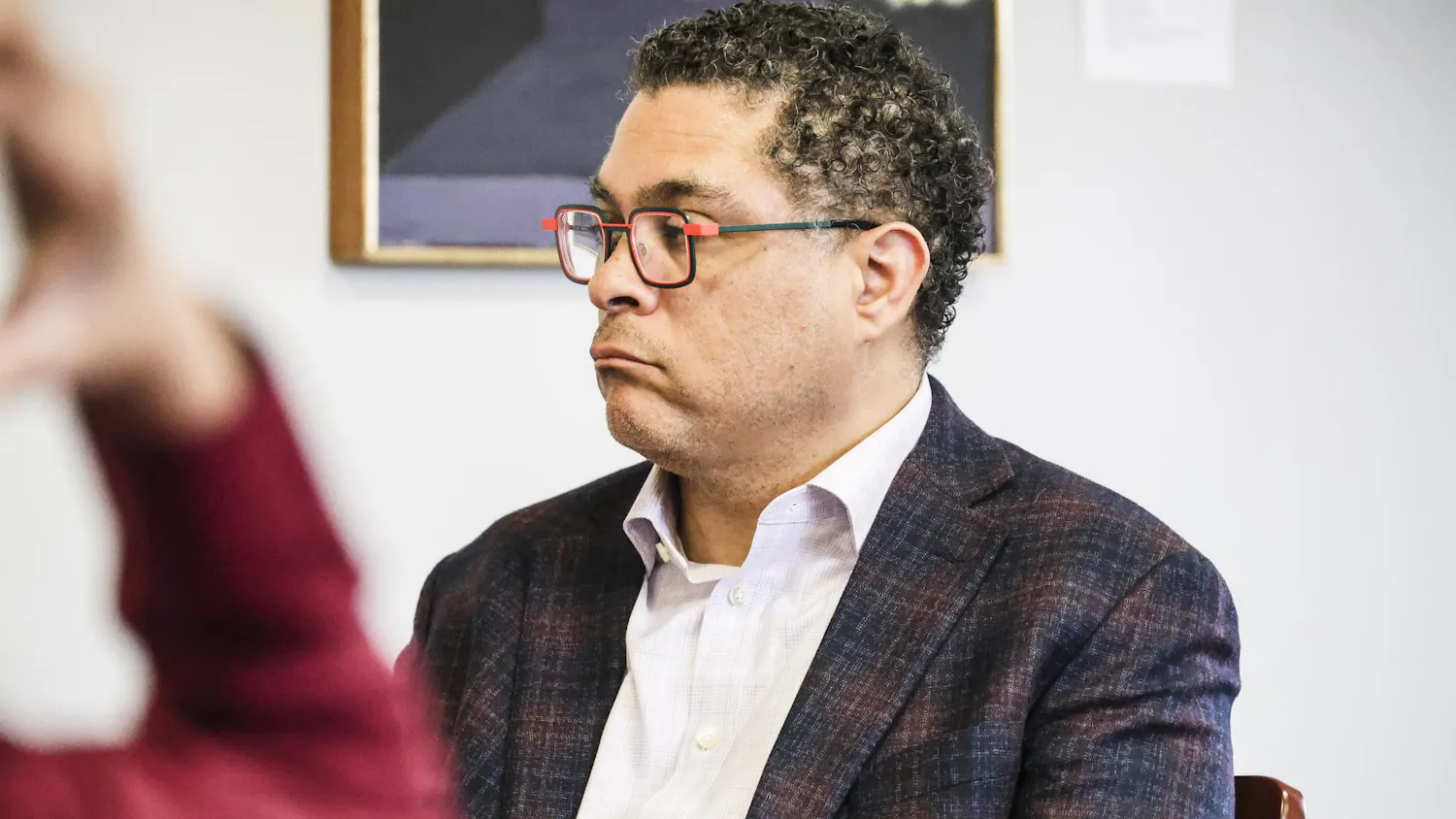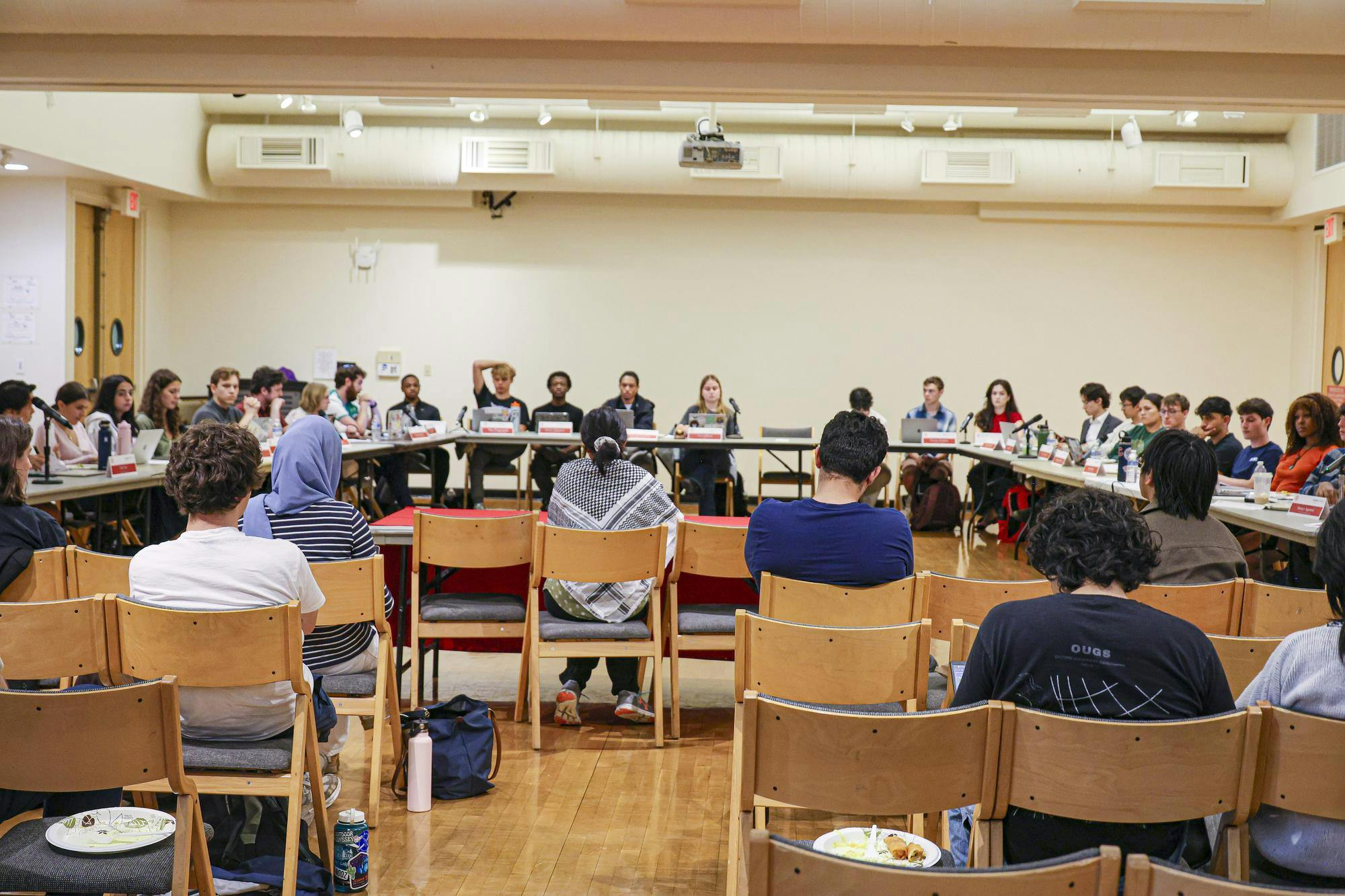
Nearly 25 students attended the Student Assembly meeting on Thursday to speak on behalf of Resolution 10 and Resolution 9, which condemn Cornell’s process of reviewing the Student Code of Conduct and seek to end Career Services’ promotion of ICE recruitment respectively.
After being tabled last week, Resolution 10: “Addressing the Administration’s Undemocratic Review of the Student Code of Conduct and Affirming Cornell’s System of Shared Governance” was passed to the third and final reading calendar to be put up to vote next week, and Resolution 9: “Ending Career Services Collaboration With ICE” was unanimously passed. The meeting was held in the Appel Commons, different from the Assembly’s typical Willard Straight Memorial Room meeting location.
Resolution 10 was tabled at the Sept. 18 Student Assembly meeting after members raised concerns over the word choice, with Assembly President Zora deRham ’27 saying it "reads like one big complaint."
After a week, Aiden Vallecillo ’26, the resolution author and Assembly worker’s representative, presented the resolution.
The meeting follows mounting unrest across the Cornell community over the Code’s revision and the administrative structure that enacts it. The Code is currently undergoing its first revision since its implementation in 2021, and Resolution 10 criticizes the “exclusion of the elected Assemblies” in the revisions of the Code.
The Code previously fell under the purview of the elected University Assembly. This changed in 2020 when the power to make decisions was vested entirely in the vice president of Student and Campus Life, who delegated it to the Office of Student Conduct and Community Standards.
Now, the Code’s review committee consists of six administrators, three undergraduate students and one graduate student. The committee, chaired by Dean Marla Love, includes deRham and graduate student Nicholas Brennan, president of the Graduate and Professional Student Assembly.
Resolution 10 requests that the Code should be revised by a committee of three “freely elected” members from the University Assembly, the Student Assembly, the Faculty Senate and the GPSA, and that the revision be approved by each of the bodies.
Brendan Klein J.D. ’26, a respondent codes counselor for OSCCS, presented to the Assembly before public comment was held. The Office of Respondents’ Code Counselors provides free assistance for those accused of violating the Student Code of Conduct, the Code of Academic Integrity or Cornell University Policy 6.4.
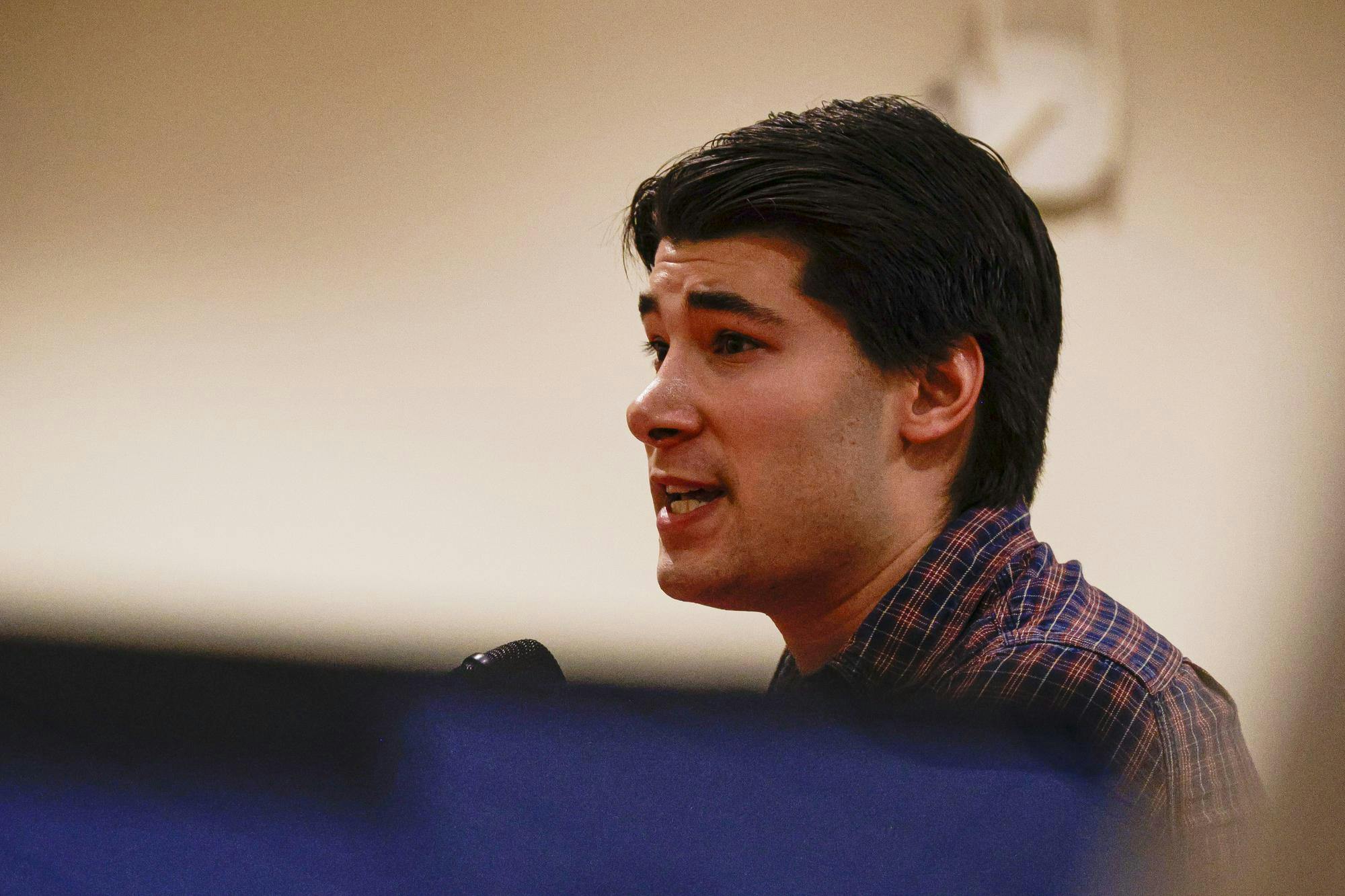
Brendan Klein J.D. ’26, a respondent codes counselor for the Office of Student Conduct and Community Standards, criticised the Office's disciplinary process. “I ask you, is that really the kind of process we want for our students," Klein said.
From his experience working with students, Klein gave a candid look inside OSCCS’s disciplinary process and criticized the office for its current procedures. He said that students "routinely" receive temporary suspension prior to investigation, are denied appeals and face months-long response times.
According to the Code’s procedures, during the period their cases are decided upon, students may be temporarily suspended only when “immediate action is necessary to protect the Complainant or the University community.” Temporary suspension can be from campus premises, class attendance and any or all other University privileges or services.
Upon notice of temporary suspension students are given the opportunity to appeal their suspension under the Code, according to Klein.
However, Klein told the Assembly that “in not one instance, [not] one case, of the dozens of students that [appealed their suspension], have we found that temporary suspension has been reduced.”
In a follow-up statement sent to The Sun, Klein wrote that this information was not entirely correct and that the office "discovered two instances where the Vice President modified a partial temporary suspension." He further stated that the office was not aware of any cases where the Vice President "departed from OSCCS’s position while reviewing an appeal of a temporary suspension."
Amid their temporary suspension, Klein reported that these students have to wait for months at a time before learning even the “basis evidentiary” of their case. The result, Klein argued, is that after weeks and or months of “OSCCS house arrest” the office will offer students an alternative dispute resolution, “allowing them to resolve the case with some kind of minor sanction” in lieu of waiting longer for a formal procedure of presenting evidence in front of a hearing panel.
“I ask you, is that really the kind of process we want for our students? Is that really an opportunity to be heard, an opportunity to present the evidence in your favor?” Klein said.
After Klein's presentation, Vallecillo presented Resolution 10, standing by the language of the resolution despite receiving critiques last week.
“We don't pass kindly worded resolutions hoping that our privilege of self-governance is respected,” Vallecillo said. “We pass strongly worded resolutions so that our rights are respected.”
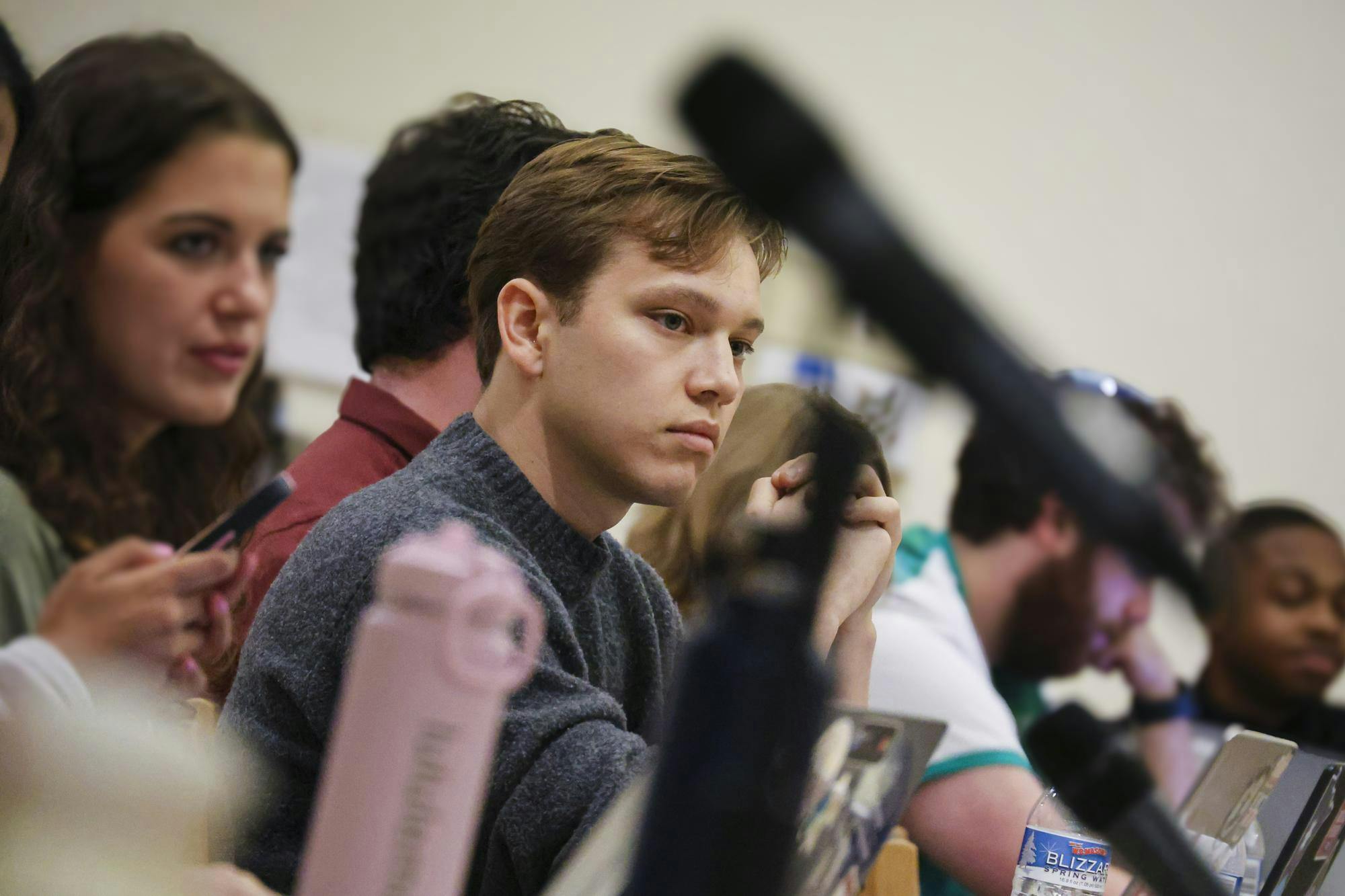
Aiden Vallecillo ’26, the author of Resolution 10 and Assembly worker’s representative, stood by the language of the resolution despite receiving critiques last week.
About 15 students spoke in an open comment period, expressing their discontent with ICE recruiting on campus, the current Code and the lack of shared governance influence on revisions to the Code.
Sumitra Pandit ’26, a protester who faced an interim suspension for protesting at the Statler Career Fest last fall, said that if she waited for a hearing and an official investigation weighing the evidence in her case, she would not be on track to graduate on time. She described the Code as using “coercive procedures” to encourage students to accept bargains, and that the Cornell University Police Department makes arrests liberally and can punish students for “alleged actions,” even though all the students she knows have had their charges dropped.
“They have no incentive to stop arresting students, even on charges that they know will not be prosecuted,” Pandit said. “The current procedures have created an extra legal judicial system where Cornell University's Police Department is always the winner.”
Another speaker, Sam Poole ’28, noted how the Code revisions come amid federal scrutiny of the University.
“Now, under pressure from the Trump administration to crack down further, the [Cornell] administration is trying to rewrite the code again,” Poole said. “And once again, they are trying to do it without any real input from the Student Assembly or any other shared governance body.”
In deliberations about the resolution, members debated amending the resolution to only request that the Code be approved by the Student Assembly, as opposed to all four shared governance bodies outlined in the resolution.
Representative-at-large Ameera Aftab ’26 pushed back against the proposed amendments, noting the constituents of the Student Assembly in the audience.
“Let me just remind everybody about what, like 10 or more people just came up and said that they want this resolution passed without any amendments,” Aftab said. “If you're going to support these amendments, just keep in mind the people who you're representing are here, and they don't support you for the amendments.”
Ultimately, the resolution was passed to the third reading calendar without amendments. While motions were made by Student Assembly members to vote on the resolution now, they were denied, as only executive board members can move to vote early with the resolution at its current stage of the second reading.
No members of the executive board moved to vote on the resolution early.
Audience members also spoke on behalf of Resolution 9.
Adriana Vink ’27, who co-authored and sponsored last semester’s Resolution 37: “Protecting Immigrant Students,” referenced the Student Assembly’s previous support of anti-ICE measures and asked them to double down.
“I think that this assembly made it very clear last semester that it stands with the Cornell community's most vulnerable members, our immigrant, international students at a time when they are under attack, and you need to continue to do so,” Vink said. “Immigration courts under the Trump administration have become a deportation and kidnapping machine.”
This resolution passed unanimously, but not without some pushback.
Representative-at-large Thor Waguespack ’28 noted that, while he does not support ICE, they still do offer work opportunities for students who seek “legitimate opportunities.”
“I hope this resolution does not begin a trend of excluding certain employers we deem as controversial,” Waguespack said.
Resolution 8: “Approving Transfer of Funds to the Executive Board,” which transfers funds to the executive committee for their annual trip to the SUNY student assembly conference, also passed.
Correction, Oct. 9, 8:20 p.m.: This article has been updated to clarify Brendan Klein's J.D. ’26 statement about temporary suspensions not being reduced.

Dorothy France-Miller is a member of the Class of 2027 in the College of Agriculture and Life Sciences. She was the managing editor of the 143rd Editorial Board and was a news editor for the 142nd Editorial Board. She can be reached at dfrancemiller@cornellsun.com.
Benjamin Leynse is a member of the Class of 2027 in the College of Arts and Sciences. He is a multimedia editor for the 144th Editorial Board and was a news editor for the 143rd Editorial Board. He can be reached at bleynse@cornellsun.com.