

From Rep. Zohran Mamdani (D-N.Y.) to New Orleans’ Helena Moreno, young progressive leaders around the country are making waves to rebuild the Democratic party in the wake of losing the 2024 presidential election.
Their opponents? Not Republicans, but incumbent Democrats whom they view as ineffective amid the adapting needs of the party and the working class.
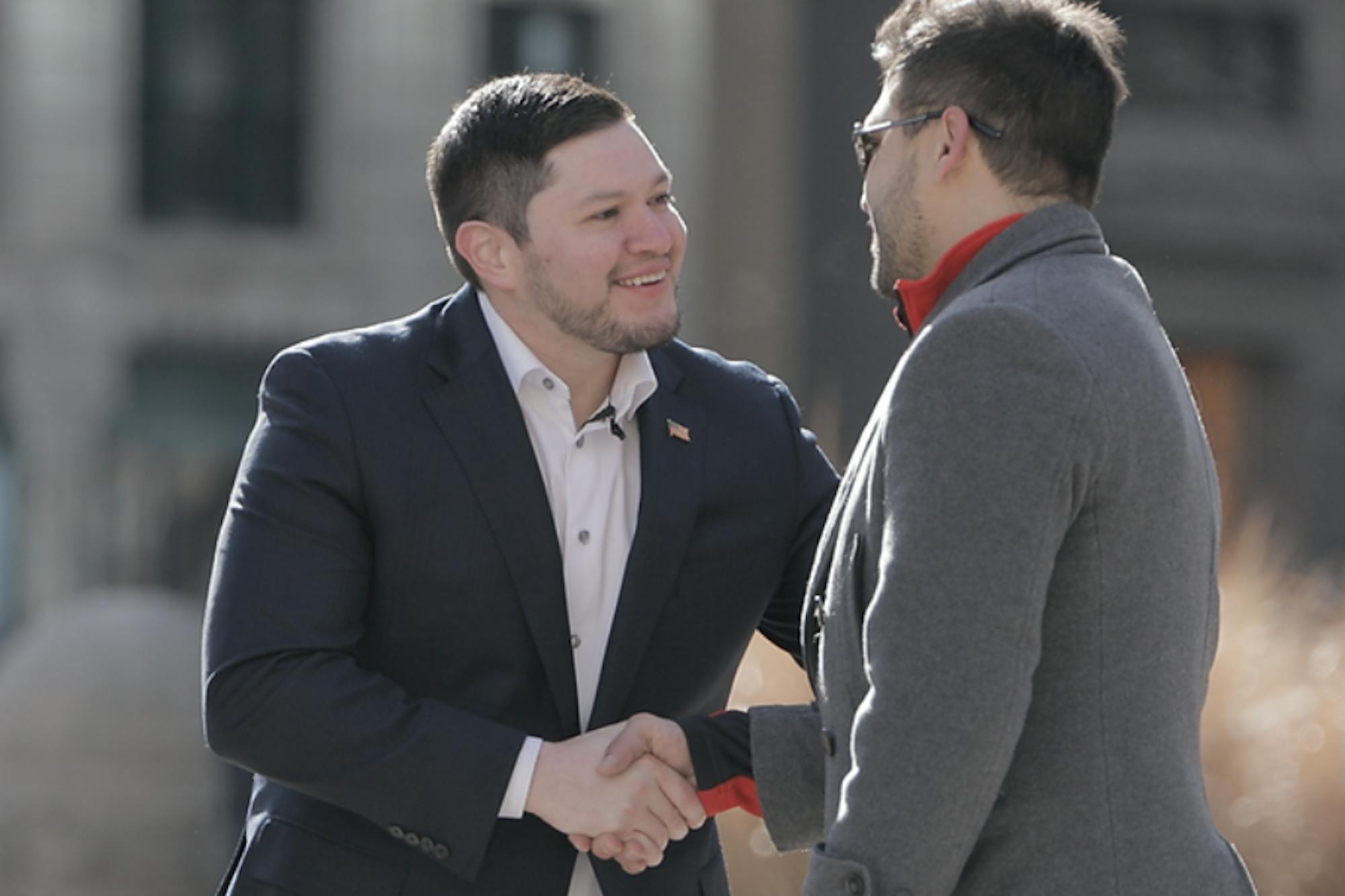
Democratic candidate George Hornedo B.A. ’13 launched his bid for Indiana's 7th Congressional District in April, joining the fight for new leadership in a race he describes as “one of the big Democratic upsets this cycle.”
“I’m not the rebel from outside throwing rocks,” he said. “I’m inside the house trying to tell everybody that it’s on fire and trying to fix it. If we keep doing things in the same ways … we’re going to lose and we deserve to lose.”
Hornedo, 34, will challenge incumbent Rep. André Carson (D-I.N.), who has held the seat since 2008. The two leading Democratic candidates will compete in Indiana’s Democratic primary, scheduled for May, to earn the party nomination for the November 2026 midterm election.
Hornedo grew up among the roughly 754,000 residents of Indiana’s 7th congressional district, which comprises Indianapolis and its surrounding suburbs. It’s a district that consistently votes 60 to 70 percent Democratic. According to Hornedo, his policies that include raising the minimum wage and expanding affordable healthcare will continue a legacy of left-leaning legislation while he executes his vision for party-building.
“We may be in a safe blue dot here in Indianapolis, but if we’re not turning out and pulling our weight as a community, then we’re a drag not just on ourselves, but on Democrats across the whole state,” Hornedo said. “The member of Congress out of Indianapolis has more influence, more of a platform.”
According to the Center for Effective Lawmaking, which produces legislative effectiveness scores for all members of Congress, incumbent Carson ranks No. 197 out of 220 House Democrats. Voter turnout has declined nearly 20 percent in Marion County, Indiana since 1988. Hornedo worries about these implications for Carson and other Indiana lawmakers.
“Under Congressman Carson’s tenure, we’ve been very hands-off [on] party building,” Hornedo said. “We’re in a state where unfortunately the Democratic party is just broke, disorganized and forgot how to fight.”
Hornedo says that his background in political strategy, including political appointments in the Department of Justice under Obama, coordinating campaigns for Pete Buttigieg and Texas Democrats and founding his own political consulting start-up, Hornedo Strategies, has given him the mobilization skills necessary “to rebuild the Democratic party.”
“We may not have a lot of power right now as Democrats — not just nationally, but in Indiana — but we still have our voice and we need to use it,” Hornedo said. “It’s [about] being a party leader that’s speaking out against a lot of the terrible actions and consequences of bad policy.”
Despite criticism from Indiana Democrats who oppose Hornedo’s campaign, Hornedo said he remains committed to running on a platform that aims to unify people.
“I’ve faced a lot of institutional backlash from the state Democratic party,” Hornedo said. “But there’s a disconnect between them and the actual voters on the ground [and] this is about people at the end of the day.”
While Hornedo says support from voters “far surpassed our expectations,” his race highlights new tensions in the party.
“[It’s] not left versus center, liberal versus moderate; I don’t even see it as young versus old,” Hornedo said. “The real divide in the party is between those like Congressman Carson who believe that our systems and institutions work for people and we need to protect them, versus those like myself.”
According to Hornedo, the next Democratic leaders must be willing to adapt to current Republican majorities and a post-Trump political landscape.
“When we come back into power, the government is going to look totally different,” he said. “The question then becomes do we rebuild back to what we had … or can we have the imagination to think about what it can be, and I just don’t think [that] the leaders that got us into this mess are the ones to get us out of it.”


