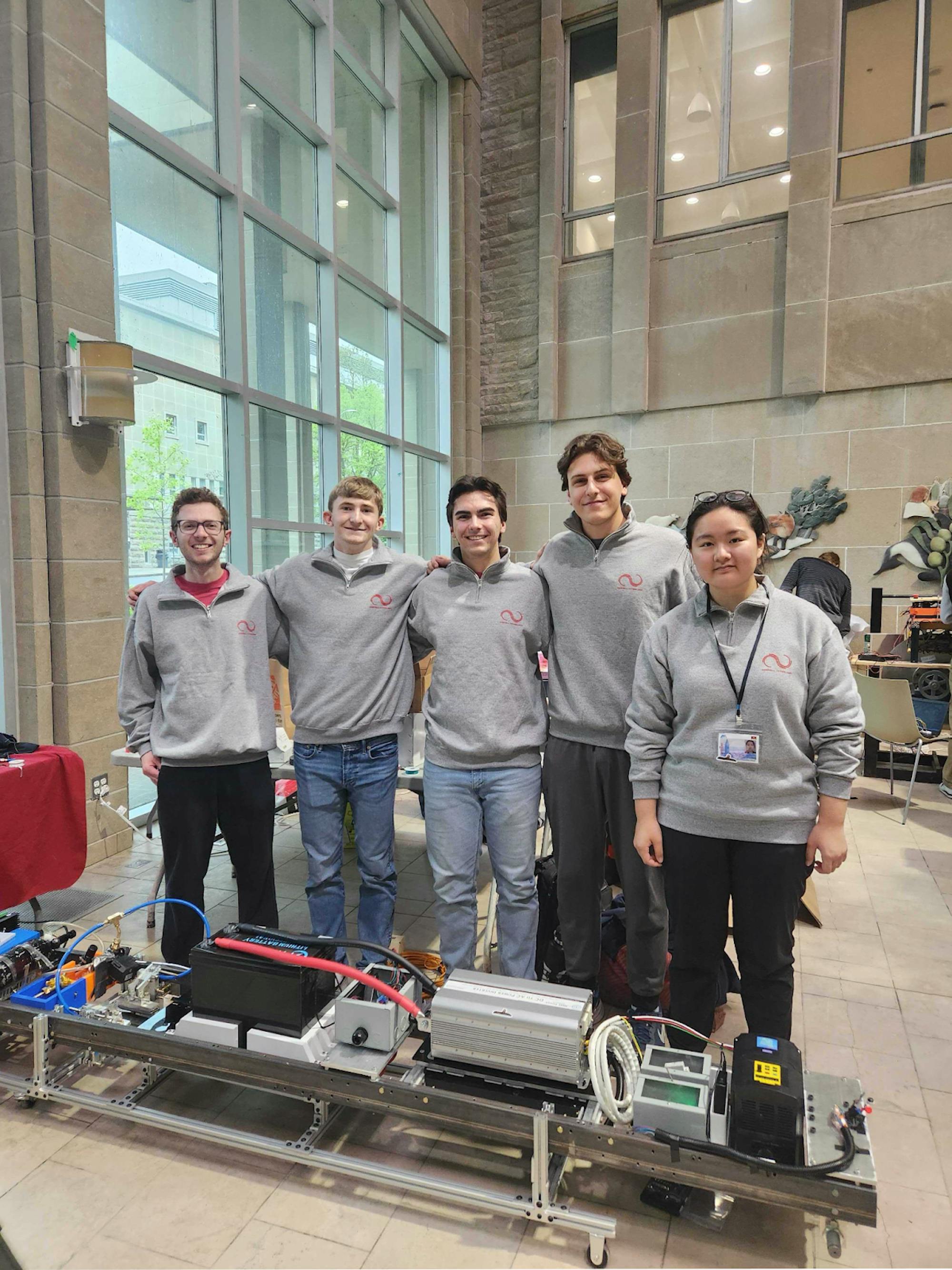
Five members of the Cornell Hyperloop project team competed at the 2025 Hyperloop Global Conference, hosted at Queen’s University in Ontario, Canada, this past summer.
Among top international teams, Cornell’s team earned distinction for their mathematical modeling of stable magnetic levitation, or mag-lev, control. Building on this recognition, the team is preparing to push the boundaries of hyperloop technology even further in the 2025-2026 academic year.
Founded in 2017, the Cornell Hyperloop project team seeks to advance the future of hyperloop technology by designing pods and researching the physics that make these systems possible. The idea for hyperloop technology was first popularized by Elon Musk in 2013. The concept behind the technology is to place a magnetically levitating train, known as a pod, inside a vacuum tube. This can reduce air drag, or resistance or an object’s motion.
“The idea is to reduce air drag to make it more optimal and efficient,” said Lalo Esparza ’26, Cornell Hyperloop’s power systems lead.
The vacuum technology would theoretically allow for pods to transport passengers between cities at speeds over 600 miles per hour. While the technology is still in development, team members see the potential to revolutionize transportation through their research.
“I think the potential for growth is one of the defining traits of our team,” said Claire Choi ’28, the team’s business development lead. “These types of technologies in our time could grow into something that could make people’s lives much better in the future. That’s one of the promises that I joined Cornell Hyperloop for.”
Esparza agreed. “The technology is really interesting and has applications outside of just Hyperloop,” he said. “Our goal is not to actually build a fully functioning pod that could get us from Ithaca to Syracuse, but more to develop the technology on a smaller scale to show proof of concept.”
Cornell Hyperloop is divided into three subteams — the electrical subteam, the mechanical subteam and the business subteam. As the team prepared for the Hyperloop Global Conference, members of all three subteams joined together to work on building the physical pod they would bring to the competition.
Attending the three-day conference was an opportunity for team members to network with other teams and share ideas, as well as present their own work. Choi and Esparza described the conference as both fun and informative.
“You get to transfer ideas and talk about different ways of doing things, which is something that we’re incorporating into our design moving forward. You also get to have fun with like-minded people,” Esparza said.
According to Esparza, the team was thrilled when they found out that they won an award for their modeling of mag-lev technology.
“A lot of that research was done by our graduating seniors, and so they were just ecstatic to hear that their work had contributed to us winning that award,” Esparza said.
The team hopes to build on their momentum from this summer’s accomplishments this academic year as they continue to improve upon their hyperloop pod design. Inspired by their trip to the Hyperloop Global Conference, one of the team’s priorities for this year is building their own motor and levitation systems for the pod.
“Previously, we had been using a motor that we bought from a company, but at the competition, we saw how other teams were building their own motors,” Esparza said. “So we’re trying to do that now, coming up with our own ways to make this design.”
The team is currently conducting physics research to understand how to build its own motor. They then hope to move on to manufacturing, building and testing the systems they design. The team plans to attend the Hyperloop Global Conference again this spring, as well as Maker Faires held in Syracuse and Rochester.
Recruitment of new members is also currently in full swing for the team. Both Choi and Esparza agreed that joining Hyperloop has been a valuable part of their Cornell experience and encouraged freshmen to apply for project teams. Choi described Cornell Hyperloop as having a “culture of care” and noted that she believes the team is “very helpful in developing your skills.”
“I highly suggest project teams if you’re interested,” Esparza said. “You get to know the people you’re working with, and you get to collectively problem solve.”
Allison Hecht can be reached at ajh356@cornell.edu.
Allison Hecht '26 is the Newsletter Editor for the143rd Editorial Board. She can be reached at ahecht@cornellsun.com.