


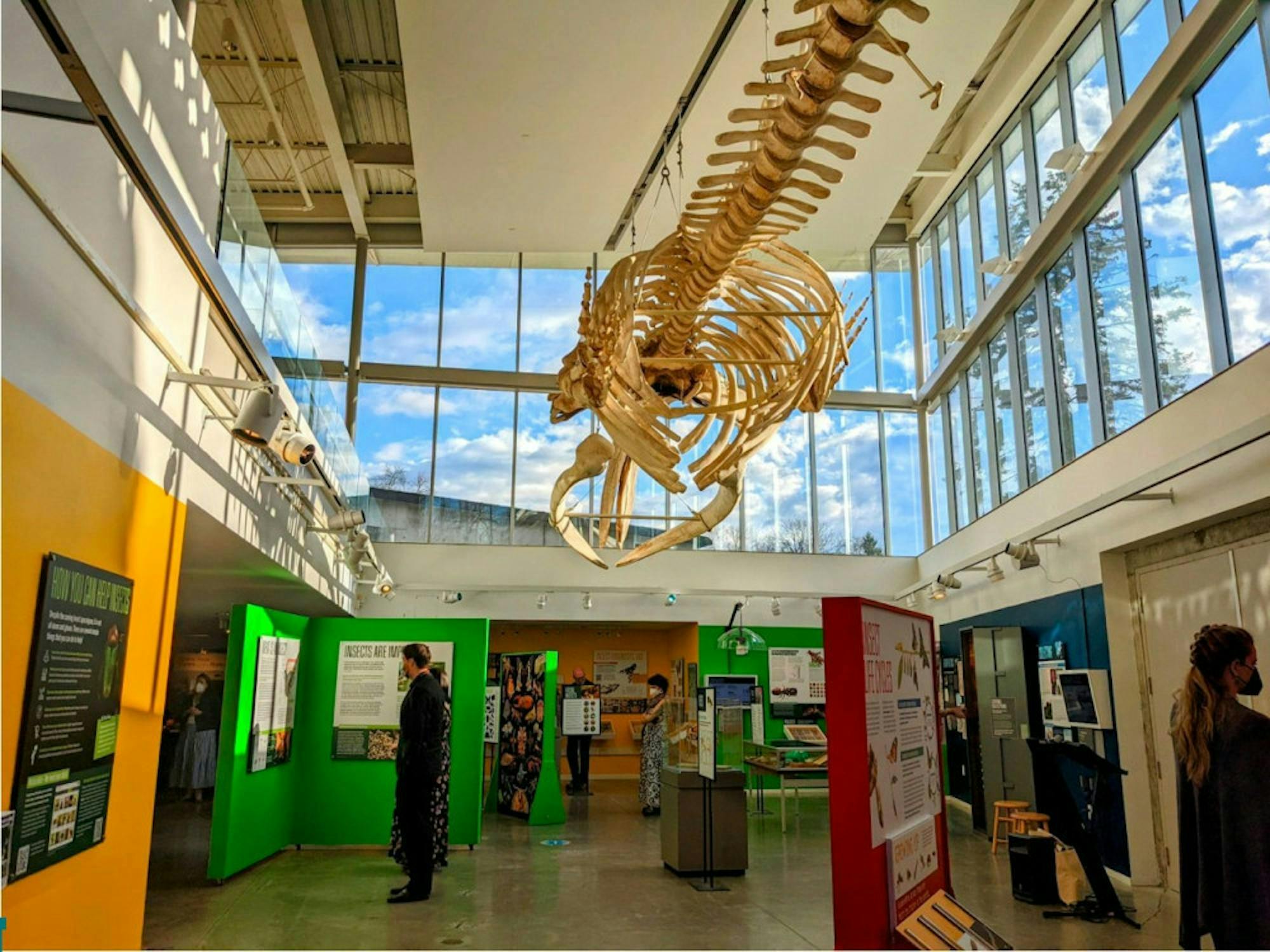
After a turbulent year of funding struggles, the Paleontological Research Institution reached its 2025 funding goal last month thanks to widespread support from the Ithaca community, Cornell faculty and students, as well as paleontologists across the country.
The institution has raised enough funds to cover payment of its mortgage in full, allowing both PRI and its public-facing counterpart, the Museum of the Earth, to remain open and fully operational, at least until July 2026.
The announcement comes after months of uncertainty — following a donor-caused financial crisis, PRI faced possible closure if it could not meet its mortgage obligations by the end of 2025. Prof. Robert Ross, mechanical and aerospace engineering, is the Associate Director for Outreach at PRI and described the period as a “rollercoaster ride.”
Overcoming a Rocky Road of Hardship
Founded in 1932 by Cornell Prof. Gilbert Harris, geology, and formally affiliated with the University since 2004, PRI serves as a natural history museum for Cornell and is home to more than seven million fossil specimens. PRI staff conduct research in paleontology and evolutionary biology, often in collaboration with Cornell faculty and students, and provide public outreach and science education programs.
In Ithaca, PRI is more well-known through its public-facing counterpart, the Museum of the Earth, which showcases its vast fossil collections and brings earth science exhibits to the public.
The PRI was plunged into a funding crisis in 2023, when its largest donor became unable to fulfill pledges to the institution. Over the next year, it became increasingly clear that PRI would not be able to pay off its mortgage and stay open without alternative funding sources, said PRI director Prof. Warren Allmon, earth and atmospheric sciences, in an interview with The Sun. The institution laid off half of its staff and began to prepare for potential closure.
In response to the crisis, PRI began to reach out to media outlets, including The Sun, and in January 2025, an article was published in The Ithaca Voice that “changed everything,” according to Allmon. The following day, PRI received a $1 million donation from a Cornell alum who remembered being inspired by former PRI director Dr. Katherine Palmer during her time at Cornell. A second donation followed several months later.
Despite this, PRI was still about $1 million away from paying off their mortgage by late summer 2025 and had to make contingency plans, packing hundreds of boxes of library books and specimen collections to move into storage.
But in the last few months of the year, an outpouring of community support, accompanied by both local and national media coverage, brought PRI to its funding goal of $4 million. The institution raised enough money to pay off its mortgage and remain open through June 2026.
An Outpouring of Community Support
Allmon credits individuals in Ithaca, as well as across New York State, nationally and internationally, for helping save PRI and the Museum of the Earth. He said that after hearing about the institution’s struggles, colleagues in paleontology across the country worked tirelessly to raise awareness and funds.
“That was really extraordinary because scientists themselves are surprisingly bad fundraisers,” Allmon joked. “And a lot of them really did amazing stuff that really surprised us, maybe surprised them too.”
At the same time, donations surged in from Ithaca locals who hold the Museum of the Earth close to their hearts. Alex Howard, a 14-year-old aspiring paleontologist and volunteer at PRI, raised $2,400 in donations for the museum, Allmon wrote, while a family in Syracuse donated $1,000 after their 8-year-old daughter’s only Christmas wish was for the museum to stay open.
“[It was] a real outpouring, not just of financial support, but of moral support and encouragement,” Ross said. “I think we have learned how many people, how many friends we have, and we hope that we can continue to provide the kind of service back that people seem to value so much.”
Looking Ahead
New initiatives are already underway as PRI looks ahead. In February, the institution will celebrate the 20th Darwin Days in Ithaca, an annual celebration of Charles Darwin’s birthday featuring panel discussions, film screenings, speakers and workshops.
PRI is also planning a coral-themed exhibit in collaboration with Prof. Leslie Babonis, ecology and evolutionary biology, supported by a National Science Foundation grant.
Beyond exhibits, PRI remains deeply embedded in the Ithaca community. The institution hosts workshops, produces online educational resources and interacts with local K-12 teachers. These projects help expand access to science education and strengthen connections within the community.
“I think that museums play an important role in improving science literacy in a community,” Ross said. “I think we also play a connective role in which we help tie different parts of the community to each other through science and nature.”
At Cornell, Ross teaches EAS 1700: “Evolution of the Earth and Life” to 300 students each semester and regularly brings classes to the Museum of the Earth. Cornell students also play an ongoing role in PRI’s work through volunteering, work-study positions and individual research projects, Ross told The Sun. Students from all majors contribute, from assisting with education programs to applying skills in social media or data analysis.
PRI still faces lingering issues at present, according to Allmon, including operating at a smaller size than before, searching for new donors and figuring out a financial model to stay open long-term while providing the public education and community service at the core of its mission. Still, the institution remains more committed than ever.
“We pulled off something close to a miracle in 2025,” Allmon said. “We're exhausted, but I think we all have a renewed sense of mission, and the importance of what we do is more obvious than it was before.”
Tania Hao is a member of the Class of 2028. She is a science editor for the 144th Editorial Board and can be reached at thao@cornellsun.com.
Susan Su is a member of the Class of 2029 studying linguistics and psychology in the College of Arts and Sciences. She is a staff writer for the science and technology department and can be reached at ssu@cornellsun.com.


