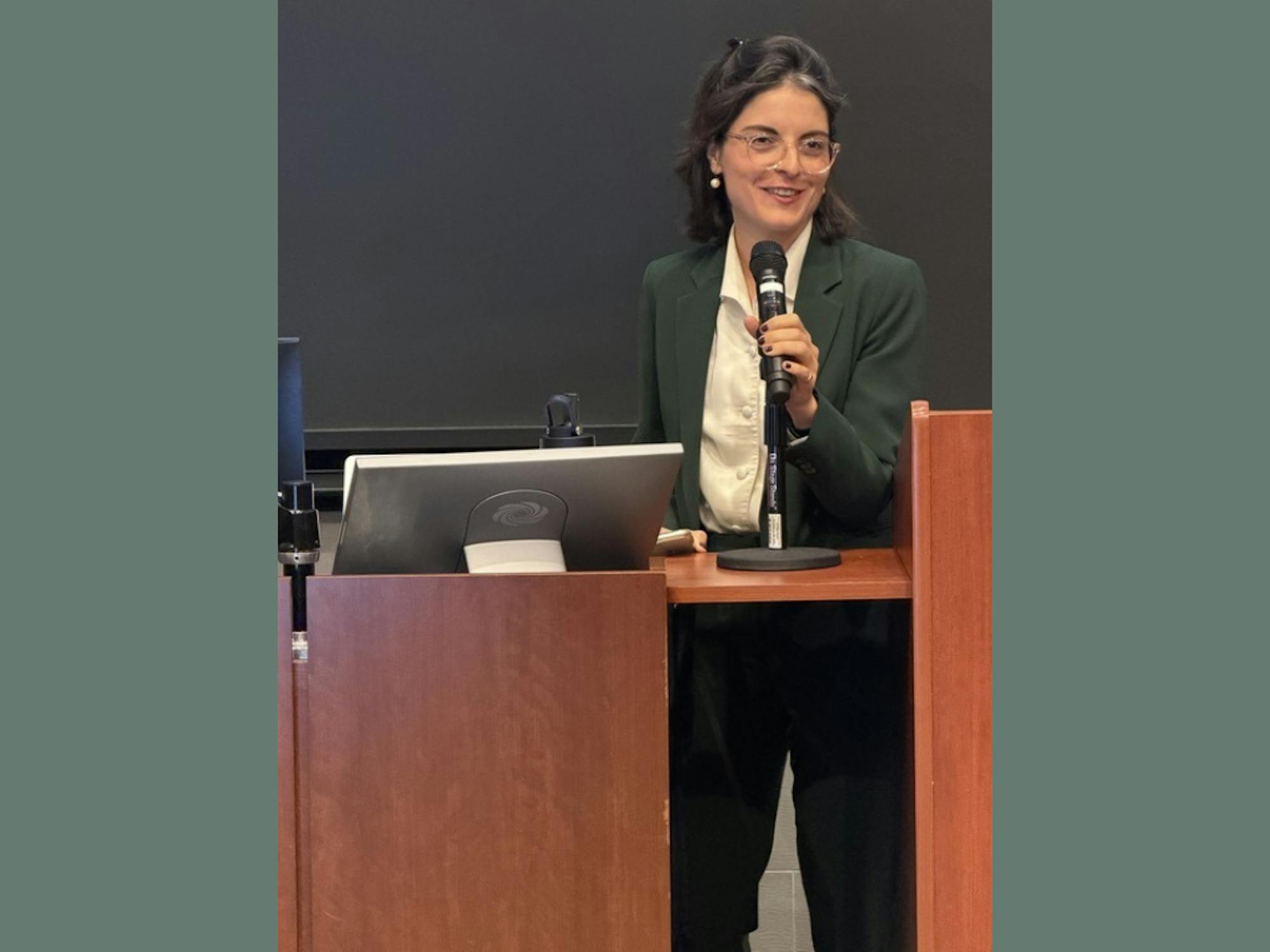
Cornell Law School hosted Charlotte Ruzzica de la Chaussée, LL.M. ’17 on Feb. 27 for a talk titled “The Power of Small Island Developing States in Shaping International Climate Change Law,” moderated by Prof. Allison Chatrchyan, law.
De la Chaussée is an international lawyer who has worked with the Commission of Small Island States on Climate Change and International Law. She is currently an attorney-at-law and a member of the New York Bar.
De la Chaussée is from France, and previously studied at Université Paris Nanterre, and obtained her Master of Laws degree at Cornell Law School. She was active in various societies such as the Cornell International Law Journal and the Clinic in International Human Rights Law, and was a founding member of the Cornell International Arbitration Society.
She explained that she was excited to speak at the Law School because of how important it was to her own career in international law.
“Cornell means a lot to me, and I hope this can give you the taste for studying environmental law and becoming advocates for our planet,”she said.
De la Chaussée’s talk revolved primarily around her work with the Commission of Small Island States on Climate Change and International Law as an attorney for the Federated States of Micronesia, an island nation made up of four states, consisting of 607 small islands in Western Pacific Ocean. COSIS is an organization made by island nations, including Antigua and Barbuda, St. Lucia, and Saint Kitts and Nevi.
COSIS states that their mission is “to take collective action to protect and preserve the climate system, including the marine environment, through the promotion, progressive development, and implementation of rules and principles of international law concerning climate change.”
De la Chaussée described COSIS as an “organization made by the island states, for the island states, that will become a leader because Western countries have failed.”
De la Chaussée explained that small island states often face the brunt of climate change impacts. Due to their low elevation, small landmass and reliance on marine ecosystems, they face greater exposure to extreme weather events that are increasing in frequency and density.
The Conference of the Parties is the supreme decision-making body of the United Nations Framework Convention on Climate Change that meets annually to review and progress global action on climate change. De la Chaussée explained in her talk that COPs are especially important to small island nations.
As much as they are vulnerable, small island nations “have the capacity to try and obtain things at [the COPs], especially loss and damages, and get financial assistance from developed countries because they’re facing difficulties with climate change,” De la Chaussée explained.
Prior to the establishment of COSIS, the United Nations Convention on the Law of the Sea was the primary organization aiming to protect marine environments from climate change. At the COP26 in Glasgow in 2021, COSIS was created because leaders of island nations felt that UNCLOS was not enough. COSIS requested an advisory opinion from the International Tribunal for the Law of the Sea, which is a judicial body that disputes the interpretation and application of UNCLOS.
De la Chaussée’s work with COSIS had a historic victory in May 2024, when ITLOS issued a groundbreaking legal advisory that clarified the legal obligations of countries to address climate change in terms of relations to the ocean and atmosphere.
Prior to the advisory opinion, UNCLOS had failed to explicitly address modern climate threats related to the ocean, such as ocean warming, acidification and sea-level rise, according to De la Chaussée.
After the opinion, ITLOS clarified the legal obligations of parties in UNCLOS. States would be required to go beyond only the Paris Agreement to protect the marine environment, and the ruling served as a precedent for holding high-emitting nations accountable. This would strengthen the legal footing for small island states in the future.
At the end of her presentation, De la Chaussée emphasized the need for more legal expertise in island states, which comes with more education opportunities for people living there.
“My job will be complete when they no longer need me, over there, to do the work,” De la Chaussée said. “I advocate for having more island students here at Cornell.”
As the event moderator, Chatrchyan also spoke on the importance of De la Chaussée’s work.
“[Island nations] are not just victims,” she said. “They’re acting with authority, raising their voices that other countries have to act and they’re using international climate law to make it happen.”
Students in attendance showed strong positive reviews of De la Chaussée’s talk.
James Ronayne ’28, a student in Chatrchyan’s course, LAW 4443: “International Environmental Law and Policy," shared his feedback on the event.
“I think it was interesting to come and hear the different perspectives, and have this firsthand speaker who could really share all of this with us,” said Ronayne.
Attendee Noa Greene-Houvras ’28 previously collaborated with the people behind the International Tribunal for the Law of the Sea’s advisory opinion when she was in high school, at the time it was formed.
“Now to be in a room three years later, hearing about how successful it was and how important that community endangerment was — it’s really meaningful,” Greene-Houvras reflected. “I got to watch it grow and become this landmark opinion at the International Court of Justice, and it’s amazing.”
Greene-Houvras also recognized the work of the island nations through COSIS and emphasized their importance in the climate conversation.
“They’re really facing the brunt of the climate crisis, and they’re taking it on with a vengeance. That is not something we are seeing our country, the United States, do,” Greene-Houvras said. “[The island nations] deserve so much credit, so much respect and so much allyship.”
Andrea Kim is a Sun Contributor and member of the Class of 2028. She can be reached at ack247@cornell.edu.