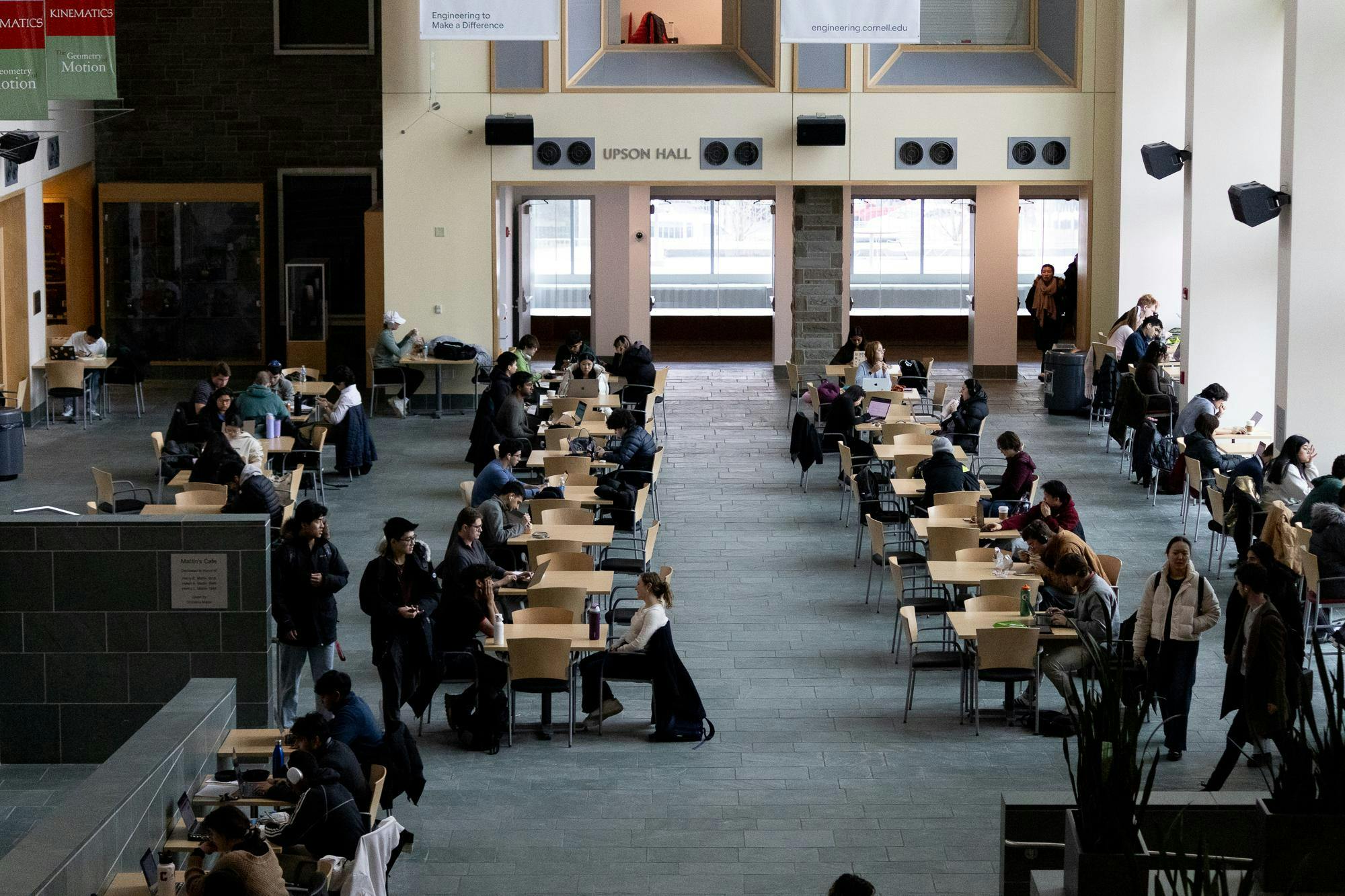
Finals season is once again around the corner, and it’s time to start getting ready. Study techniques may help reduce the stress and maximize efficiency during this time. The Sun compiled some science-backed final exam study strategies and stories from around campus.
Mike Chen, senior lecturer at the Learning Strategies Center, has observed a few principles that he said were universally effective after working with students at Cornell for 30 years. Before anything else, a routine must be formed to prevent procrastination and poor time management. Then, the key is all in starting the study flow.
“Choose a unit of time such as 30 minutes and try to focus on a specific part that was confusing. If you end up not doing anything, shorten the unit of time and try to start the flow for studying,” Chen said.
Chen’s recommended strategy is similar to the Pomodoro technique, a study strategy that separates a study period into shorter blocks of time with small breaks interspersed between each block. A comprehensive database analysis of randomized controlled trials comparing task performance between different study methods has shown that the Pomodoro technique lowered fatigue by up to 20% and improved concentration by up to 25%.
However, this is not always true. One study conducted by researchers in the Netherlands found no overall differences in fatigue or motivation between students who were randomly assigned to use the Pomodoro technique in a two-hour study session and students who chose the timing of their breaks. Despite there being no overall differences between the conditions, they found that the Pomodoro technique led to a faster decrease in motivation. Therefore, students should try out different methods and use what fits their style the best.
Nicole Chen ’27 and Lydia Lee ’27 are teaching assistants for BIOMG 3300: “Principles of Biochemistry.” They both agree on the importance of planning ahead and crafting a balanced schedule.
“I get at least seven hours of sleep and make intentional time for socializing with my friends,” Lee said. “I didn’t have this clear plan or discipline before college. It was during freshman year when I developed discipline and strategy to study for a longer period of time.”
Lee’s plan of creating intentional social time aligns with the “brief mental break” method, where quick switches from the main goal — in this case, studying — make people better at their tasks. In one experiment supporting this theory, one group of participants had to memorize a few numbers, then spontaneously recall these numbers at points during a tedious 40-minute task. Another group simply had to complete the task.
The group that had to switch back and forth between the task and the memorization showed no decline in accuracy in the main 40-minute task, unlike the group that only did the task — providing support for the efficacy of brief switches in work. At Cornell, this strategy might look like a brief walk on the slope or a quick visit to one of the many cafes on campus after a study session.
In addition to how time is managed, study tools also make an impact.
“I try to block out my schedule prior to finals week and sleep early. I also Anki most materials because I feel more secure with repeated review and I have everything in the back of my mind,” Chen said.
Anki is a digital study program for making flashcards to improve memorization. Anki is an example of the study technique of spaced repetition. It allows for short and frequent review of material, which has been shown in science education to be more effective than fewer chunks of studying at long term retention and concept comprehension.
Over time, students discover the techniques that work best for them.
Navin Kasemtanakul ’28, who is majoring in human biology, health and society, emphasizes the importance of practice problems.
“When it comes to finals, I try to focus more on practice problems and past prelims,” Kasemtanakul said. “A lot of the prelim questions follow a very similar style, so practicing with past exams helps me know exactly what to expect on test day.”
Solving practice questions is a form of active studying. An experiment in an advanced mathematics course found that the group that studied the learning material in an active, interactive way had a statistically significant higher score on exams than the group that studied passively. The active studying allowed more engagement and repetition for students, contributing to a higher retention rate of material.
Meanwhile, Alan Liang ’28, who studies biological sciences, believes in investing a longer time in each subject.
“Don’t be afraid to spend time to truly understand a topic because it makes the concept more robust and easier to remember in the long run,” Liang said. “I think this method is better than skimming through and then coming back multiple times.”
Ultimately, Chen believes that there is no definitive answer to which study strategy is the most successful, and that the true path to success is finding what one’s personal learning style is.
“I’ve seen students be successful in all kinds of ways. However, the important thing is to try out different methods and find the best way for you,” Chen said. “I’ve seen dramatic improvements in students after they changed the way they studied.”
Val Kim is a member of the Class of 2028 in the College of Human Ecology. He is a staff writer for the science department and can be reached at vkim@cornellsun.com.