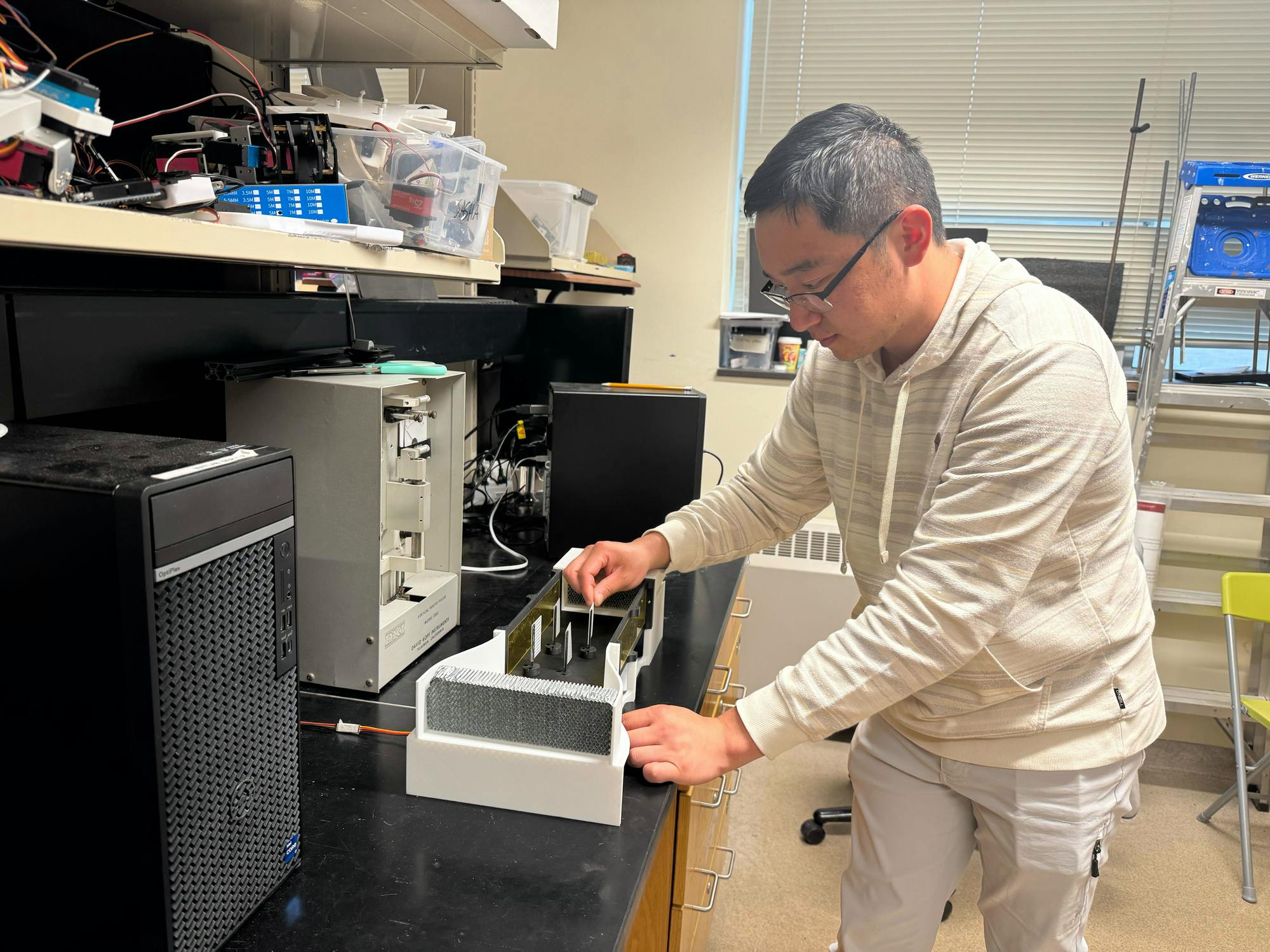
At the heart of biology and engineering, mechanical engineering doctoral student Yicong Fu brings to light the power of translating natural systems, from fish fins to human hands, into new technological innovations.
Fu, a first-year Ph.D. student, uses computational and experimental methods to understand how natural systems — fish gills, stingray fins and human hands — solve problems that continue to challenge engineers. His research has applications ranging from industrial filtration and biometric identification to the development of soft robotics.
Fu’s desire to study fluid mechanisms originated during his undergraduate studies, where he became fascinated with biology research through the study of fish physiology. His mentor at the time, University of Virginia professor Daniel Quinn, studied how the shape and physics of fish fins influence living habits. Building on this work, Fu developed a mechanism that uses a flexible structure to generate wave-like motions, mimicking the movement of a stingray’s pectoral fin in water.
Fu explained that this idea stemmed from comparing two types of ray-like fish. Manta rays have triangular fins and tend to swim near the surface, moving their fins up and down in a flapping motion (oscillation). In contrast, stingrays have rounder bodies and live closer to the ocean floor, relying on wave-like motions along their fins (undulation). This led Quinn to question whether these different shapes and movement styles are influenced by the environment that fish inhabit.
This early experience laid the foundation for Fu’s research trajectory, leading him to join Prof. Sungwhan Jung’s, biological and environmental engineering, lab. Jung, the principal investigator of the Bio-Inspired Fluid Lab, focuses on converting biological observations into sustainable engineering solutions.
One of Fu and Jung’s most recent publications investigated the physics of hand-clapping, using high-speed cameras and particle image velocimetry, a technique that tracks tiny particles in the air to visualize and measure airflow on millisecond timescales.
Their findings revealed that clapping faster results in the sound fading more quickly. The researchers saw that faster claps cause the hands to temporarily deform upon impact more and create stronger bursts of air, which leads to more turbulence. Instead of producing sound, more of the energy is lost in the movement and bending of the hands, so the sound dissipates out faster.
Looking ahead, Fu envisions integrating the lab’s findings from this study with advancements in artificial intelligence as machine learning is further being developed to recognize and respond to human-generated sounds.
“Our hand-clapping study provides the fundamental mechanism, so when you feed machine learning models sound data, you don’t have to rely only on data,” Fu said. “You can do more physical learning by using our model with the data together.”
Fu is committed to focusing on practical applications of his work. As a trained mechanical engineer, he approaches each problem with real-world use in mind, considering this even when first selecting a research topic to pursue.
“I focus on the needs of human beings first. Are there engineering problems that exist? What are the solutions right now, and can we improve these solutions using whatever I want to study?” Fu said.
Then, Fu determines whether it is possible to find something in nature, in order to learn from it and intertwine its function into engineering designs.
In addition to acoustics, Fu is currently exploring another fish-inspired project: translating the function of the suckermouth catfish’s mouth, which the species uses for underwater adhesion, into robotic applications.
Applying these fish-inspired movements to soft robot designs, “these robots would provide another mode of operation in aqueous environments,” Fu explained. “They could be used as underwater cleaning devices, and if we can miniaturize them, we could use them inside the human body for biomedical purposes like drug delivery.”
Reflecting on his own path, Fu encouraged undergraduate students to “be brave,” “reach out,” and pursue projects they’re genuinely passionate about — a mindset that will continue to drive the next generation of ingenuity and innovation.