In July 2021, climate scholar and activist Leah Stokes was busy preparing to testify in front of Congress, managing a grassroots call campaign and making television appearances on Democracy Now at five in the morning.
She was also being hospitalized for a high-risk twin pregnancy.
“When you go to the hospital, you’re told you can’t leave until you have a car seat that they make sure it’s safe for the kid to go home in,” Stokes said. “But they don’t say that they have to have a safe planet to go home to as well.”
For Stokes, a sense that she was contributing to a brighter future for the planet kept her motivated to keep advocating in spite of personal challenges.
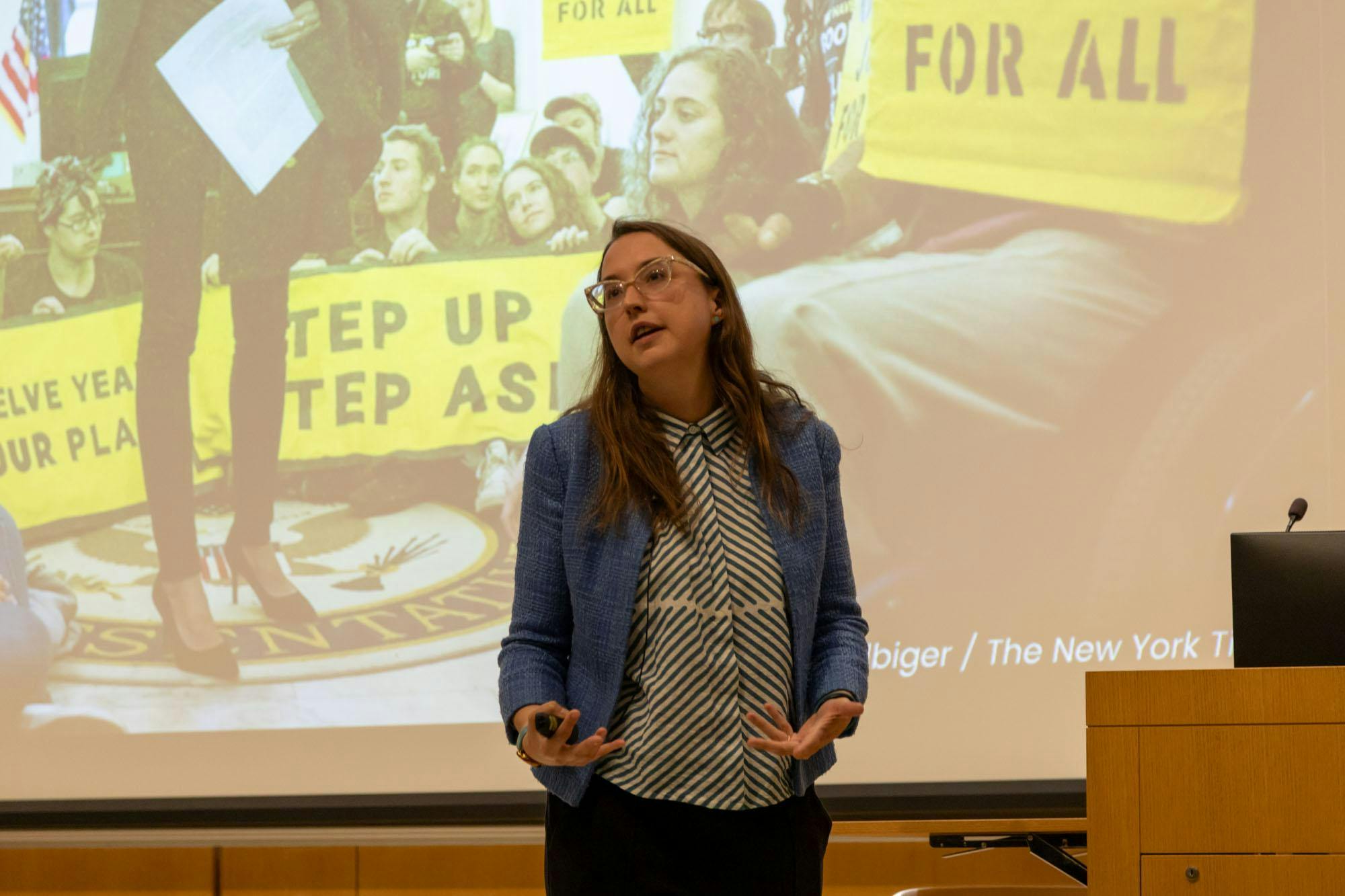
Stokes spoke to an audience of Cornell students and faculty in the latest installment in the Cornell Center for the Social Sciences’ annual Distinguished Lecture in the Social Sciences on Thursday. The talk, held from 5-6 p.m. in a packed lecture hall in the Physical Sciences Building, was co-sponsored by the Cornell Jeb E. Brooks School of Public Policy, the Cornell Atkinson Center for Sustainability, the Climate Jobs Institute at the School of Industrial and Labor Relations and the 2030 Project, a Cornell climate initiative.
Currently an associate professor specializing in energy and environmental politics at the University of California, Santa Barbara, Stokes is also a co-host of popular climate podcast “A Matter of Degrees” and has been recognized as among the most influential climate activists by Forbes Magazine, Business Insider and Time Magazine.
Stokes’s talk blended personal anecdotes about her role in the passage of environmental legislation in the Inflation Reduction Act of 2022 with a broader case for a type of collective climate advocacy she called a “carbon wave.”
As opposed to a focus on reducing individual carbon footprints, which encourages individuals to “have the smallest impact on the Earth,” Stokes’ conception of a carbon wave emphasizes “a group of people joining together to have the biggest impact that they can have.” This theory of climate advocacy has been developed over her more than two decades working in climate advocacy.
Stokes opened the talk discussing the origins of the term “carbon footprint,” which refers to the carbon emissions generated by each individual and implies that individuals should do their best to mitigate their personal impact on the environment. The concept of the carbon footprint, she said, did not emerge organically from the environmental movement but rather was popularized by the British oil company BP as part of a rebranding effort in the early 2000s, backed by $100 million in annual advertising.
“Carbon footprint was named Oxford Dictionary’s word of the year,” Stokes said, “because it was advertised by the fossil fuel industry with a lot of cash.”
Rather than focusing advocacy efforts on “marginal improvements on a fossil fuel-based energy system” — such as encouraging people to buy energy-efficient appliances, be mindful of how long their lights are on and recycle — Stokes argued that the real solution lies in more widespread adoption of clean electricity generation and electrification.
“If we want to change the structures of society… that takes groups of people,” Stokes said. “So the movement is away from individual action towards a collective action, and I call that idea a carbon wave.”
An example of such a collective action was Stokes’ own work towards the climate legislation that would eventually be incorporated into the Inflation Reduction Act. Together with climate campaigner Jamie Henn, she launched Call4Climate in 2021, a call campaign that directed concerned constituents to their representatives’ phone numbers and provided callers with a script expressing support for climate legislation. With no outside funding, the campaign got over 15,000 people to call Congress and inspired several similar campaigns, Stokes said.
Beyond publishing a policy paper on clean electricity whose recommendations were incorporated into initial drafts of what would become the Inflation Reduction Act of 2022, Stokes served as an organizing force for climate advocates during the bill’s difficult journey through the Senate.
After a difficult road through the Senate, Stokes’ and other activists’ efforts culminated in the passage of the Inflation Reduction Act of 2022, which contained some of the largest climate investment provisions in U.S. history, according to Stokes.
The act’s main environmental provisions included tax subsidies for clean and efficient energy projects, as well as designated funds for community-based environmental justice projects.
While the law has faced some rollback in recent years, Stokes said that less than 8% of clean energy manufacturing facilities opened under the act have been cancelled.
Stokes concluded her talk on a note about smaller-scale actions.
“Of course, I told you what [activism] can look like on the 10,000-foot level of trying to change the law in Congress,” she said. “But [activism] can look like many different things in your personal communities.”
While much of CCSS’s programming is aimed at faculty researchers, the annual distinguished lecture is aimed at a wider audience, including undergraduates and the Ithaca community.
“We wanted to make this [event] as broad as possible,” said Katie Anderson, executive assistant at CCSS and the organizer of Stokes’ talk.
Second year master’s student Anya Gowda heard about the talk through her comparative environmental policy professor. For Gowda, the timing of the event felt especially prescient, given recent rollbacks of portions of environmental policies included in the Inflation Reduction Act.
“I felt a lack of hope… I was kind of like, what’s happening with this bill? Is it still being implemented?” said Gowda. “I was really interested to see [what] someone who worked on it actually thought.”
Vanessa Alcocer, also a second year master’s student, was inspired by how research could directly shape policy. Alcocer referenced Stokes’ account of how her friend, scholar-turned-White-House-advisor Sonia Aggarwal, had used an emissions modeling tool she originally built for policymakers once she became one herself.
“It was really interesting to see how science can translate into policy,” Alcocer said.
Stokes, who was not a U.S. citizen when she began her climate advocacy work, was sure to emphasize that impactful policy activism was not exclusive to those with established platforms or large amounts of resources. She cited a local Santa Barbara advocacy effort aimed at banning new oil drilling in the county.
“This is the kind of activism that you can do, and it’s amazing,” Stokes said. “You can have a really outsized impact with your dreams.”