


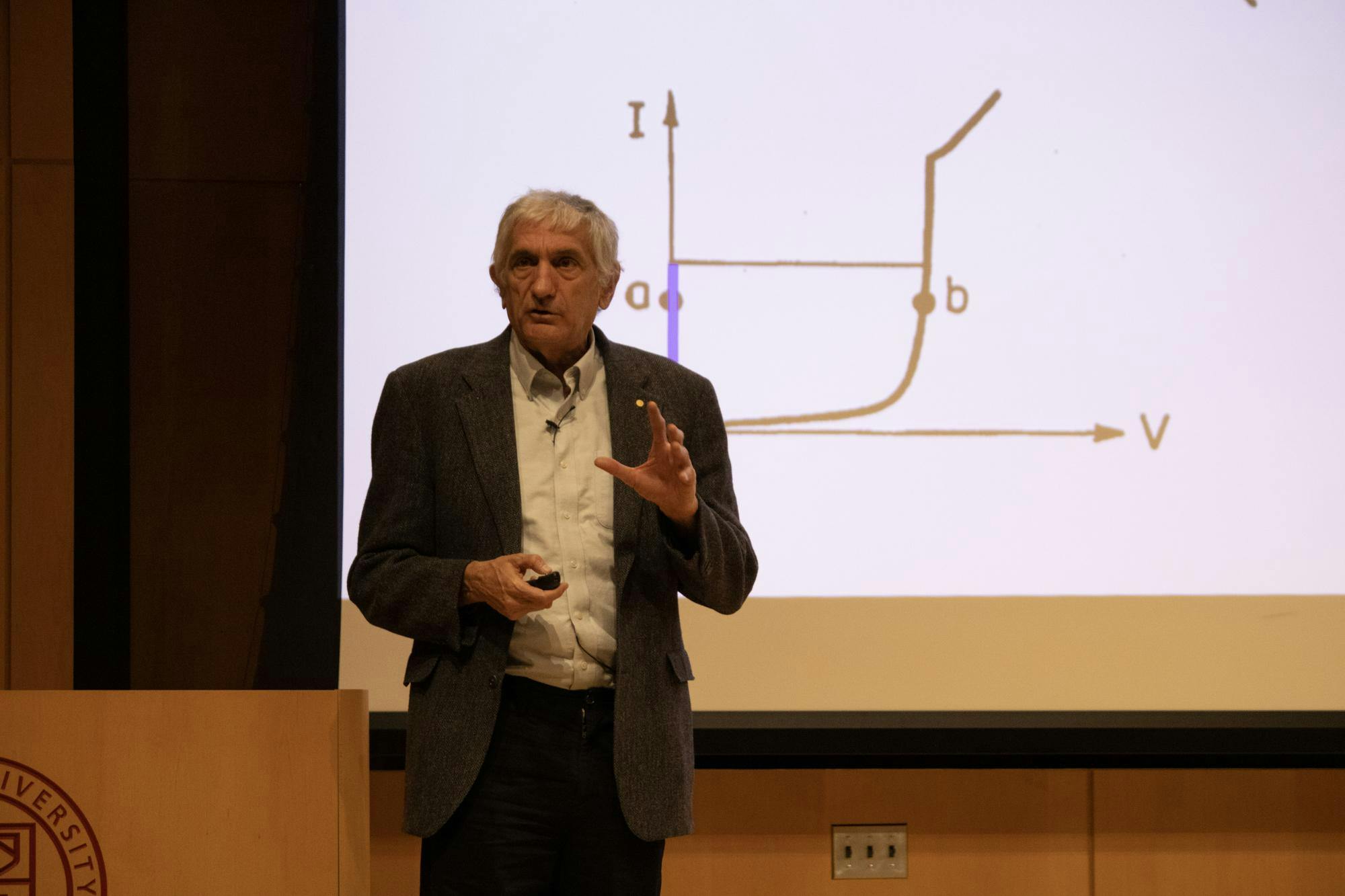
Nobel laureate John Martinis told a packed Rhodes-Rawlings Auditorium on Tuesday that the secret to understanding quantum tunneling in physics is to think of nature as a nervous banker.
"Quantum mechanics — you can think of it as a very nervous banker," Martinis said during the inaugural Frontiers of Discovery Lecture, hosted by the Cornell Undergraduate Research Board.
In classical physics, a particle trapped behind an energy barrier — like a ball stuck in a valley between two hills — simply cannot escape without enough energy to climb over. But quantum mechanics allows for something stranger: nature briefly lends the particle just enough energy to slip through the barrier entirely, as if tunneling through the hill rather than climbing it.
Nature will lend particles a burst of energy so they can pass through a barrier, he explained, "but only for a short period of time, so it wants to recall the loan very quickly."
The lecture, held from 5-6 p.m. in Klarman Hall's KG70, marked the first installment of CURB's new “Frontiers of Discovery Lecture Series” which brings distinguished scholars to campus. The College of Arts & Sciences co-sponsored the event.
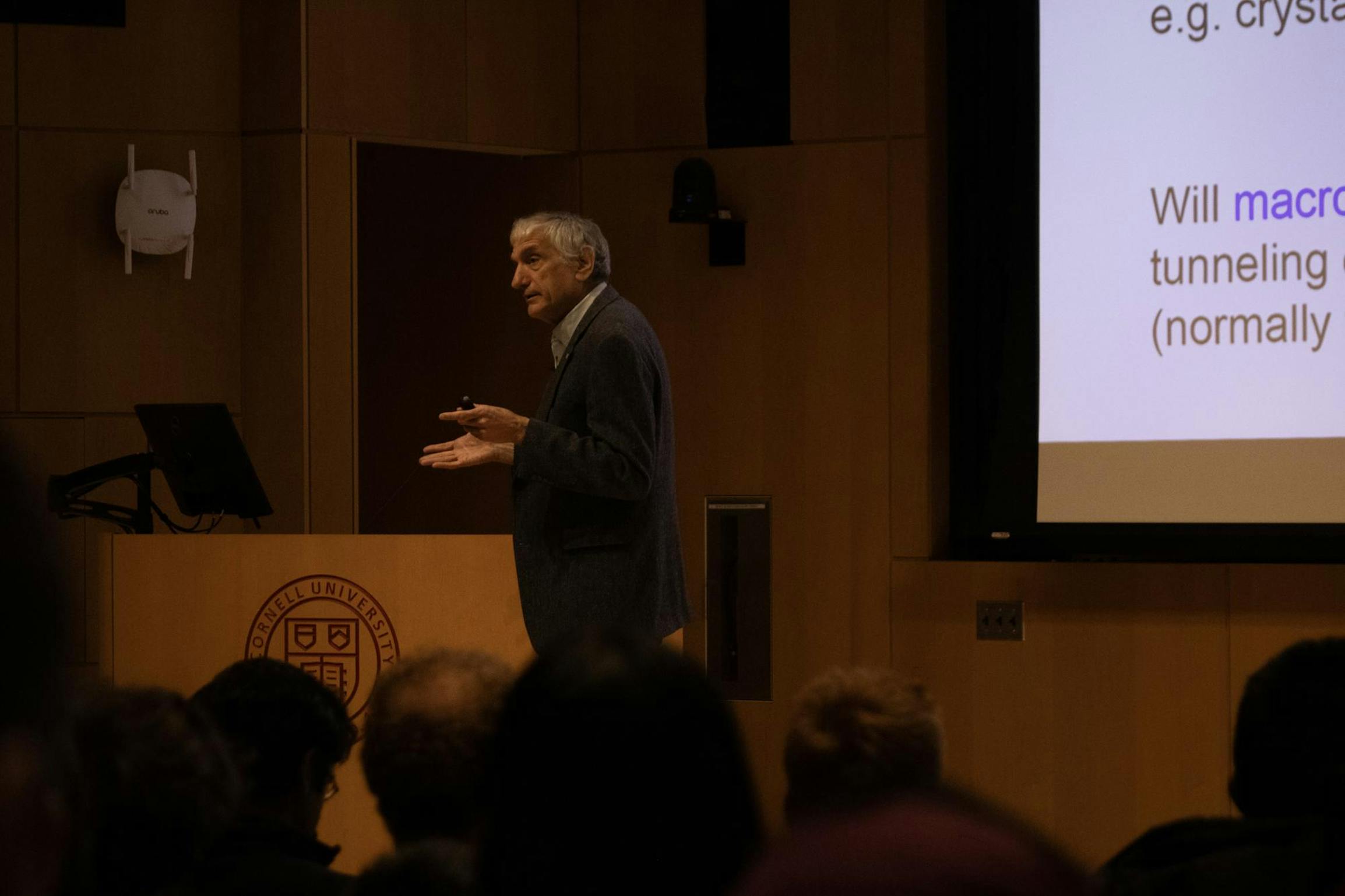
Martinis, professor emeritus of physics at the University of California, Santa Barbara, and co-founder and chief technology officer of Quolab, shared the 2025 Nobel Prize in Physics with John Clarke and Michel Devoret. Their work showed that quantum mechanics — long thought to govern only the invisibly small — could be observed in everyday-scale electrical circuits, opening the door to quantum computing.
Before the lecture, Prof. Rachel Bean, astronomy, associate dean for math and science, introduced Martinis by underscoring the significance of student-driven research. Bean noted that Martinis conducted the Nobel Prize-winning experiments as a graduate student at U.C. Berkeley in 1985 — research that became the basis of his doctoral thesis.
"Undergraduate research has yet to win a Nobel Prize, but as it's become more prevalent over the years … perhaps time will tell," Bean said. "And maybe you could be the first."
A Career Built on Building Instruments
Martinis structured his talk as a personal journey, beginning with his 1985 thesis experiment at U.C. Berkeley. Working with Clarke and Devoret, he set out to test whether quantum mechanics — the physics of the very small — could govern the behavior of an entire electrical circuit, something visible and tangible on a chip.
He was candid about the difficulty. The first attempt, he said, "was a disaster" — the data made no sense. The team eventually realized they had failed to account for stray microwave signals leaking into their equipment from the environment. Once they redesigned the experiment with proper filtering, the results fell into place.
"That experiment really set me up for my career — [it] explained to me how to do good science," Martinis said.
Throughout, he paused to offer practical advice. He urged students never to open a paper with "recently, there has been great interest in" — calling it a lazy introduction — and emphasized the importance of plotting data so that agreement with theory shows up as a straight line.
"If it's not on the line, something's wrong. Or maybe you discovered something important. Either way, that's good," Martinis said.
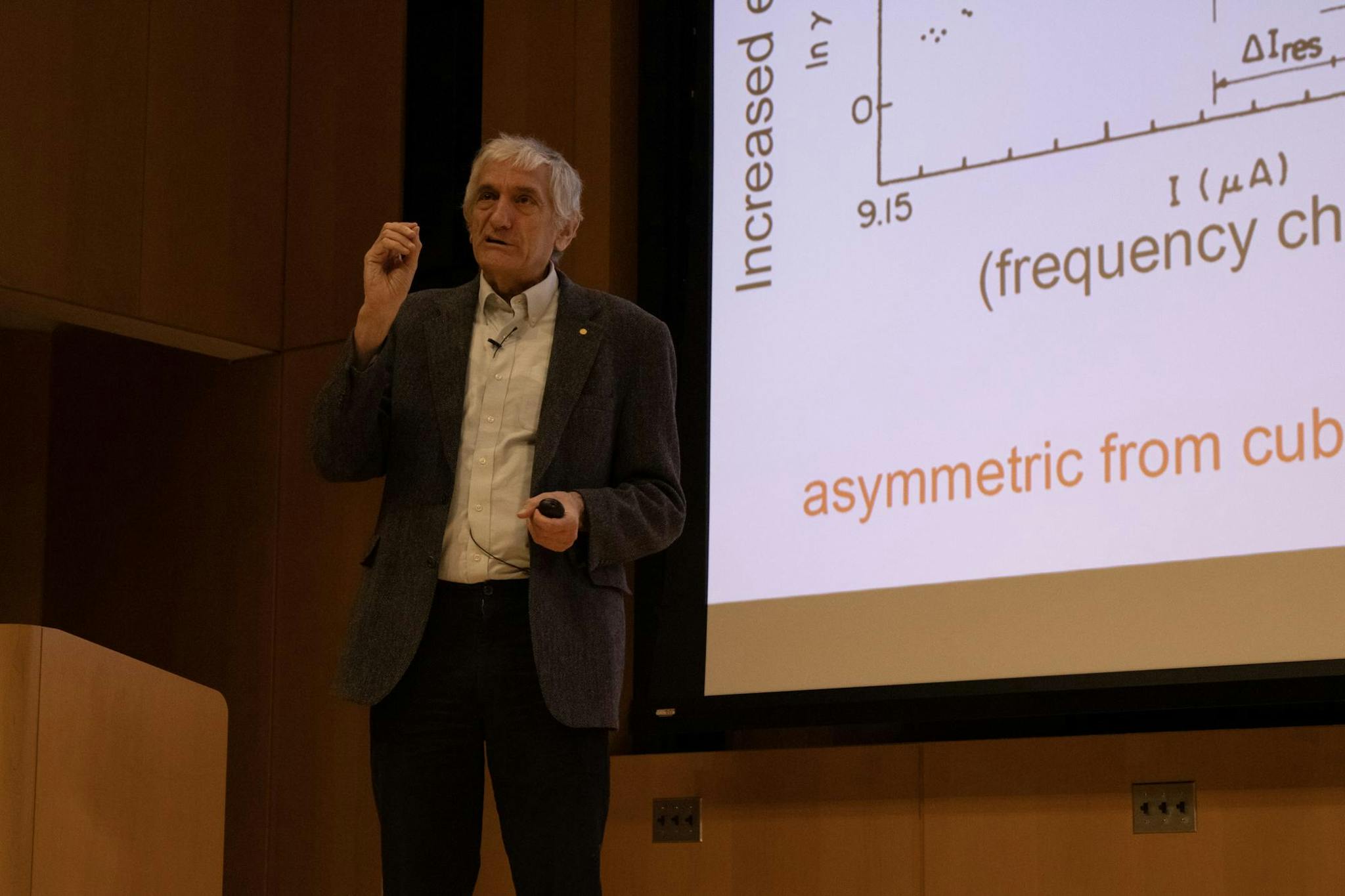
His early experiment set the stage for decades of progress. By 2019, Martinis was leading a team at Google that built a quantum processor capable of outperforming the world's most powerful classical supercomputers — a milestone known as quantum supremacy. He showed the audience side-by-side images of the simple 1985 chip and the intricate 2019 processor to illustrate just how far the technology had come — and how much further it still needs to go.
"If we want to scale this up from 53 to, let's say, a million qubits, you're going to need a similarly large change in technology," Martinis said.
That change, he argued, will not come from university labs. Through Quolab, a quantum computing startup he co-founded, Martinis is partnering with major semiconductor manufacturers to build quantum chips the same way the industry already builds the processors inside laptops and phones — swapping out the improvised methods of university labs for the precision of billion-dollar fabrication facilities.
The goal is to create and scale up a quantum computer powerful enough to tackle problems no classical machine can touch, at a cost comparable to what governments and companies already spend on supercomputers.
"We're going to do something very unusual for a physicist — really thinking hard about manufacturing." Martinis said.
“It gives you the inspiration”
After the lecture, students lingered to reflect on the experience.
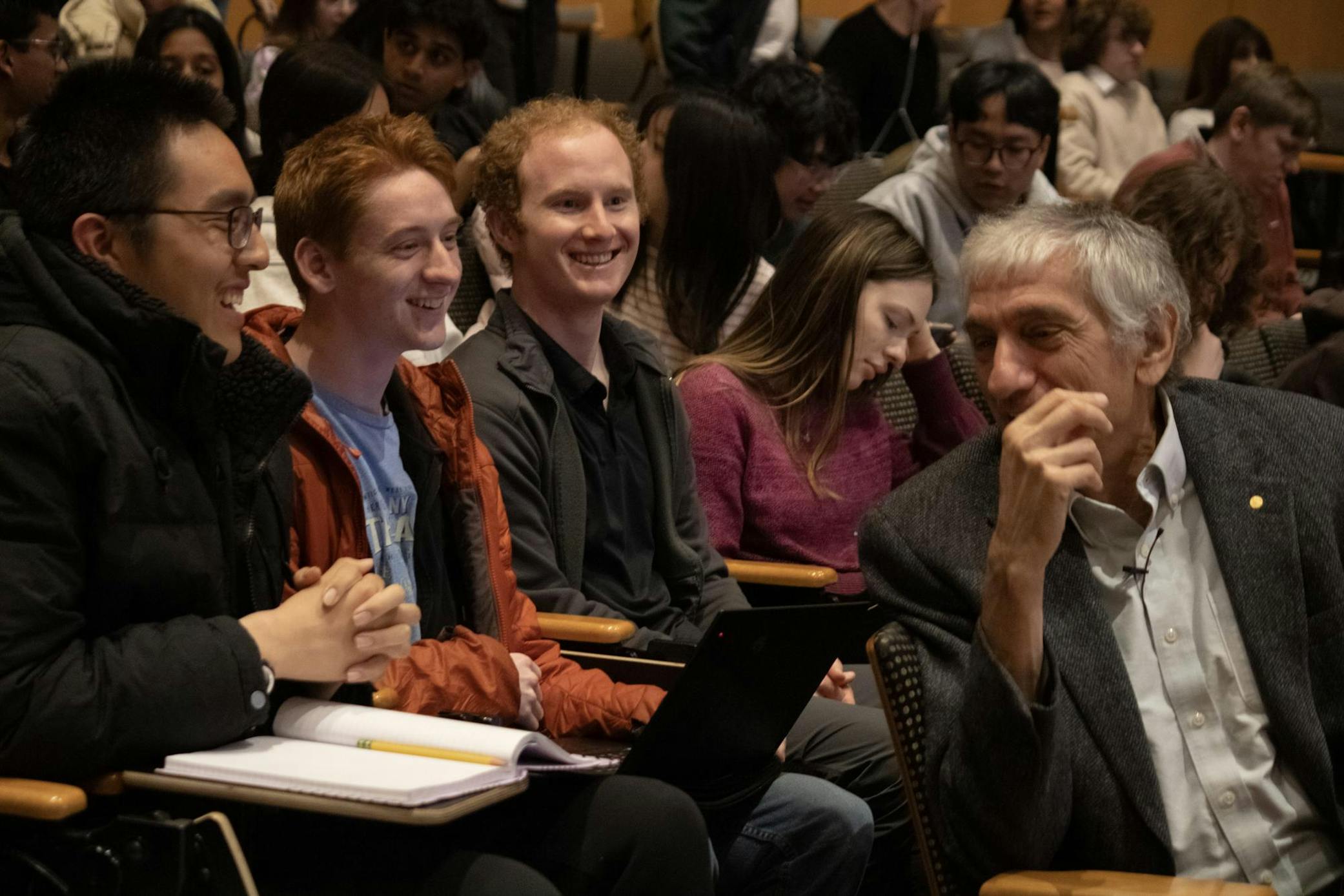
John Martini sitting in the audience, turning around to talk to students sitting behind him, before giving the inagural lecture for the Frontiers of Discovery Lecture Series on Apr. 8.
Varvara Barseghyan ’28, a student in electrical and computer engineering, said the talk felt personal. One of her own lab advisors works on the same kind of scaling challenges Martinis described, and hearing a Nobel laureate validate that direction reinforced her sense of purpose.
"It's just so interesting because that's one of the things I want to do within engineering," Barseghyan said. "It was really nice."
For David Hu '26, a student in applied and engineering physics, the connection was more immediate. Just last semester, he had been learning in class about the very phenomena that earned Martinis the Nobel Prize. Seeing the person behind the science made it feel real.
"It gives you the inspiration that you want to go right back to the library and study," Hu said.
Ashley Kim is a member of the Class of 2028 studying physics and statistical science in the College of Arts and Sciences. She is a staff writer for the science and technology department and can be reached at askim@cornellsun.com.


