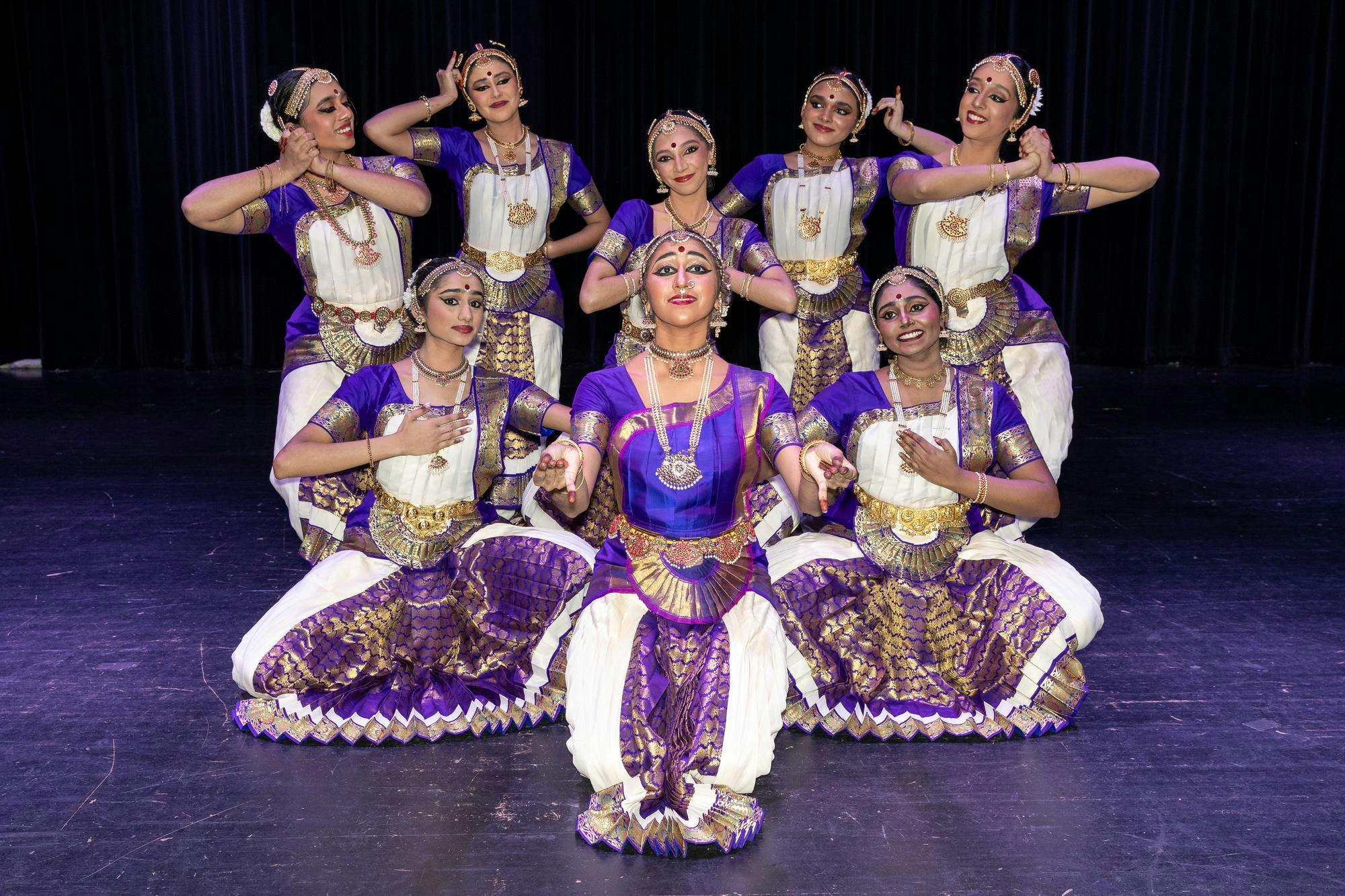
From the sound of the first drum beat, the dancers matched each movement precisely. Every footstep echoed forward carefully, their ghungroos, traditional anklets with brass bells, following each movement.
Through synchronized choreography, the team of eight told the story of a dancer regaining her ability to dance after losing her hearing. Adorned in traditional outfits and jewelry, each dancer played a part in conveying this story of persistence and bravery.
Anjali at Cornell performed this piece among many others at their end-of-year showcase event on May 3 in Anabel Taylor Hall.
Anjali at Cornell is Cornell’s premier competitive South Asian classical dance team. The team “aims to spread awareness of South Asian classical dance forms” through on-campus events, cultural showcases and national competitions, according to the team’s website.
Since the team’s founding 15 years ago, Anjali has earned recognition at several national competitions, gone viral on TikTok, collaborated with award-winning artists and, earlier this year, reached a top-ten ranking in a national competition for classical South Asian dance groups.
Classical South Asian Dance Background
When choreographing pieces, Anjali aims to draw elements from a variety of classical dance forms, including Bharatnatyam, Odissi, Kuchipudi and Mohiniyattam, according to the team’s website. All the members joined the team with extensive dance experience from before college, using their formal training to help them choreograph, practice and perform with Anjali.
“I tried out [for Anjali at Cornell] because trying out for a dance team was non-negotiable for me,” said Public Relations Chair Ribhya Saraf ’26. “I had to be dancing, because I’ve never not been dancing all my life.”
Co-Captain Neha Asuri ’28 shared a similar sentiment to Saraf, noting that continuing dance in college was always her plan.
“I think I’ve been doing dance for so long that I don’t know who I am without it,” Asuri said. “When it came to continuing in college, it wasn’t really a question of ‘if’. It was just ‘how’.”
Bharatnatyam, the dance form most team members have prior experience in, is considered to be the oldest dance tradition from the South Asian subcontinent that originated over 2,000 years ago in the Indian state of Tamil Nadu.
Bharatnatyam is characterized by its emphasis on rigid body movements, intricate footsteps and rhythm and expressive storytelling.
“If you think of Avatar[: The Last Airbender] elements, Bharatnatyam is very earth-coded. It’s very grounded,” said Anjali member Srinidhi Raghavan ’29. “You have a lot of emphasis on a stiff body and solid movements.”
In addition to Bharatnatyam, some team members came into the team with experience in other dance forms like Odissi — a classical dance form originating from the eastern Indian state of Odisha characterized by graceful movements — and Kuchipudi — a dance form originating from Andhra Pradesh, India which is characterized by quick rhythms.
In addition to complex footwork, these different dance styles are all known for their expressive storytelling through symbolic hand gestures and poignant facial expressions.
“I really love how through classical dance you can share your interpretation of a story that has been passed on over and over through generations,” Saraf said.
For Co-Captain Abhinaya Mukundan ’25, classical dance has served as a mechanism to connect with her family and culture.
“[Dance] allows me to keep in touch with my culture,” Mukundan said. “Especially being in America when my parents are from India, it’s nice to have something that I have more in common with family from there, and something I can relate more to and also learn more about my culture.”
Entering the Stage
This school year, Anjali qualified for and competed at three different competitions on the intercollegiate national circuit. The team traveled to Michigan, Florida and Pennsylvania to compete.
This competition season marked a historic milestone for the team. The team placed top three at two national competitions, Motor City Dhamaal in Michigan on February 21 and Akshara at the University of Central Florida on February 28. As a result of consistent high placements at individual competitions, the team reached a top-ten national ranking in classical South Asian collegiate dance teams in February.
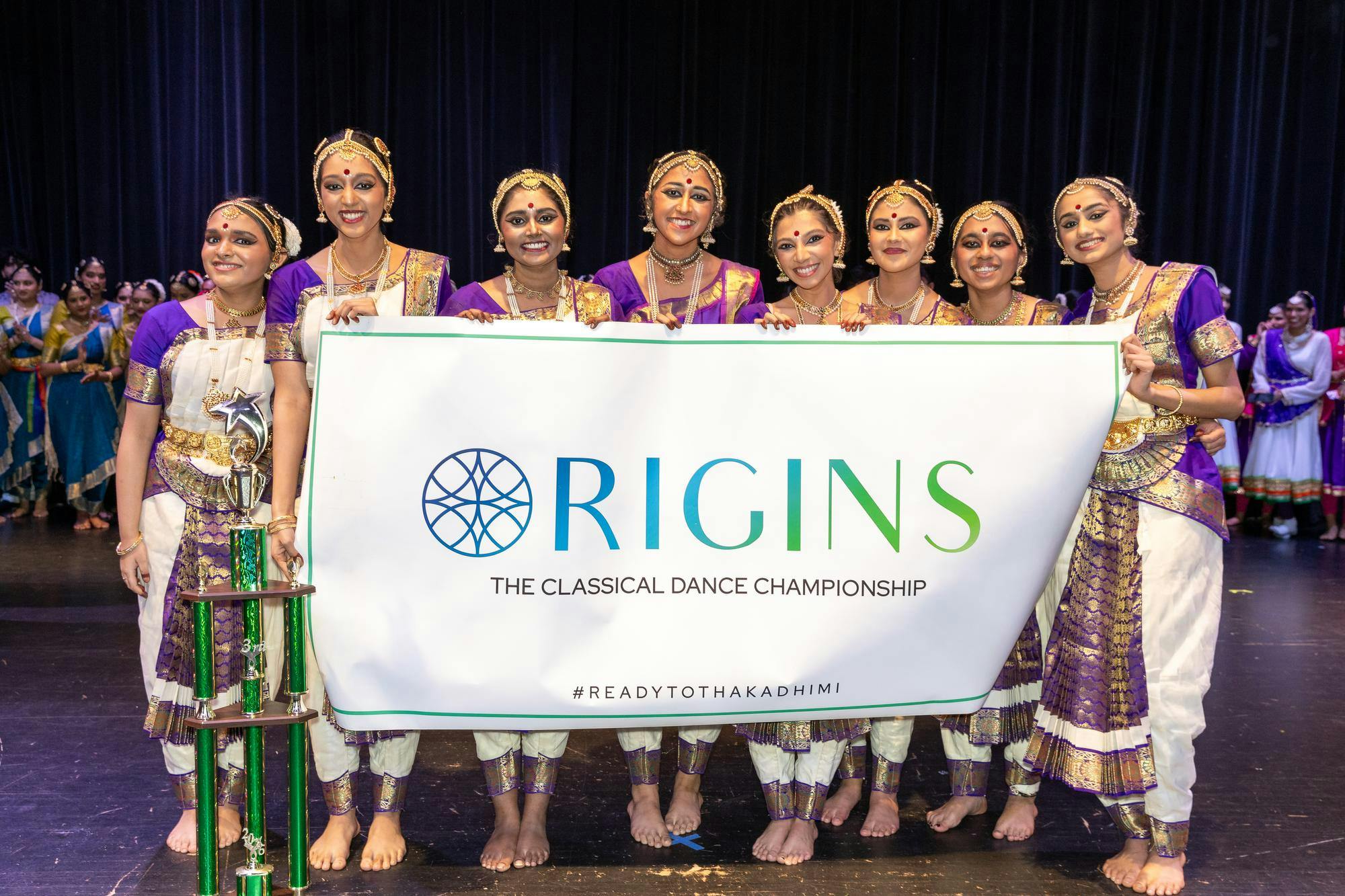
After the competition season ended, the team shifted their focus towards preparing for their annual showcase. This year’s showcase, titled “Alaiyosai” after the Tamil term referring to the phrase “sound of waves,” took place on May 3.
Compared to previous showcases that Anjali has organized, this one is particularly special to the team because of its advocacy focus. A portion of proceeds collected at the showcase were donated to support the Hearing Loss Association of America’s research efforts.
“While we're super invested in advocating for our dance forms to be known and preserved on campus, we also want to equally advocate for the accessibility and the mentorship that comes with the dance form,” said Co-Captain Tulasi Vithiananthan ’26.
In addition to their award-winning competition piece, the team presented a series of smaller, member-driven pieces at their showcase.
“I think the showcase is really unique, because it's not just captains saying, ‘we're going to do X, Y, Z,’” Asuri said. “Everybody can kind of choose ‘do I want to use this chance to choreograph something new?’”
This year, for example, the team performed a piece accompanied by live vocals by Saranya Pammi ’29, veena — a traditional Indian string instrument — played by Ananya Karunakaram ’29 and nattuvangam — the rhythmic vocalization of musical beats — performed by Asuri. Towards the end of the showcase, a group of new members — Karunakaram, Pammi, Raghavan and Nandini Venkatesh ’29 — performed their own classical-western fusion piece set to “Dracula” by Tame Impala and “Stateside” by PinkPantheress.
While the team does typically perform traditional pieces, fusion pieces are nothing new for Anjali. In September, a few members of the team quickly choreographed a TikTok set to KATSEYE’s “Gnarly.” Within one day, KATSEYE’s Lara Raj commented and reposted the video, garnering over 15 million views.
“I feel like I’m not used to seeing Bharatanatyam on such a big national stage,” Mukundan said. “So, seeing people really appreciate our dance, our outfits, our jewelry and our choreography … made me feel … excited that Bharatanatyam was getting recognition.”
Later in the fall, Spanish singer-songwriter Enrique Iglesias’s team reached out to Anjali to film a promotional video for his Mumbai tour.
“I found it really exciting that something that we're doing here at Cornell to represent Indian culture is being portrayed so proudly at such a big scale,” Saraf said. “It also makes our art form seem more accessible to people that are not from the same cultural background.”
“Sound of Silence”: Behind the Scenes of Choreographing
Every year, the team choreographs a ten-minute-long piece to perform at their competitions. Even though the team only begins practicing in the fall semester, the captains begin drafting story and choreography ideas in the summer.
This year, the team’s competition piece was titled the “Sound of Silence” and followed the story of a young dancer who suddenly lost her hearing after an accident. The piece highlights the main character’s experience learning how to use vibrations to feel the music and regain her dance abilities.
Vithiananthan spent her commute time in between her summer internship at the hospital listening to songs and writing down possible story ideas. The idea to cover hearing loss was partly inspired from a movie trailer she stumbled upon.
“I was like, ‘wow, this is such an interesting concept, and I wonder how it applies to dance,’” Vithiananthan said. “That’s when I started doing research about how dancers can find accessible avenues of learning how to dance without maybe being able to hear the sounds of the music and internal rhythm.”
When Vithiananthan presented this story idea to the team, the team immediately jumped onboard and began to bring her vision to life.
“When we first heard the audio, all of us gasped,” Mukundan said, referring to the instrumental they would be dancing to. “We were talking about how we had chills from the first time we heard the audio.”
Over the fall semester, the team dedicated many hours each week — from late night practices near Barton Hall’s main entrance to rehearsal sessions in the Anabel Taylor Hall — towards perfecting every step, hand gesture and facial expression. The team emphasized counting and rhythm while practicing, drawing inspiration from the main character in their piece who is experiencing hearing loss.
“We really emphasize counting and thaalam [a rhythmic framework] this year,” Vithiananthan said. “We spent practices really understanding it, and it was almost as if they were learning the same techniques that the dancer [facing hearing loss] … was learning.”
Looking back, members were able to see a direct improvement in not only their individual skills but also the group’s coordination and flow from the hours of dedicated practice.
“We could see a difference from our first practice video to our last practice video,” Karunakaram said. “The amount of sync that we had, and the amount of control that was emphasized helped us a lot.”
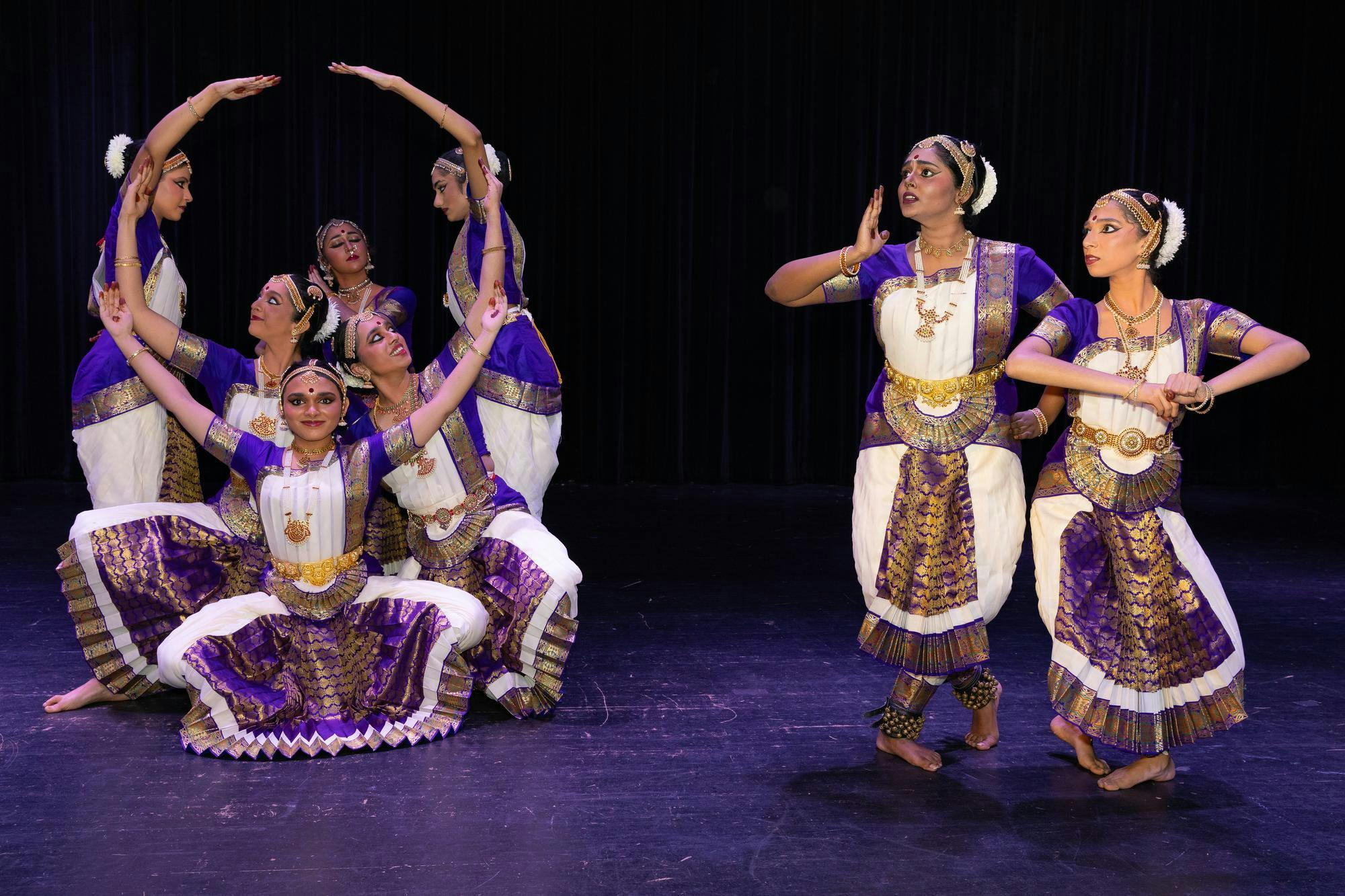
The team’s intense emphasis on control and coordination all comes together in one scene where the main character tries to prove that she is capable of dancing despite her hearing loss.
“The climax of the piece is when all the dancers are dancing, and then one by one, everybody drops out, and then she's the last one dancing until the end,” Asuri said. “I love to dance [this part], because I like the heavy, fast footwork.”
Finding a Family on Campus
No matter the project, from spending months preparing every detail of the competition piece or creating viral TikToks, the team emphasized their close-knit community and the strength of their bond
For Raghavan, the small moments of emotional connection and trust before performing stand out as memorable.
“We always do little speeches before we go up. She ends up crying,” Raghavan said, referring to Vithiananthan. “That would be one of my favorite moments, not because of everybody crying, [but] because it just shows how invested we are in the outcome of our piece.”
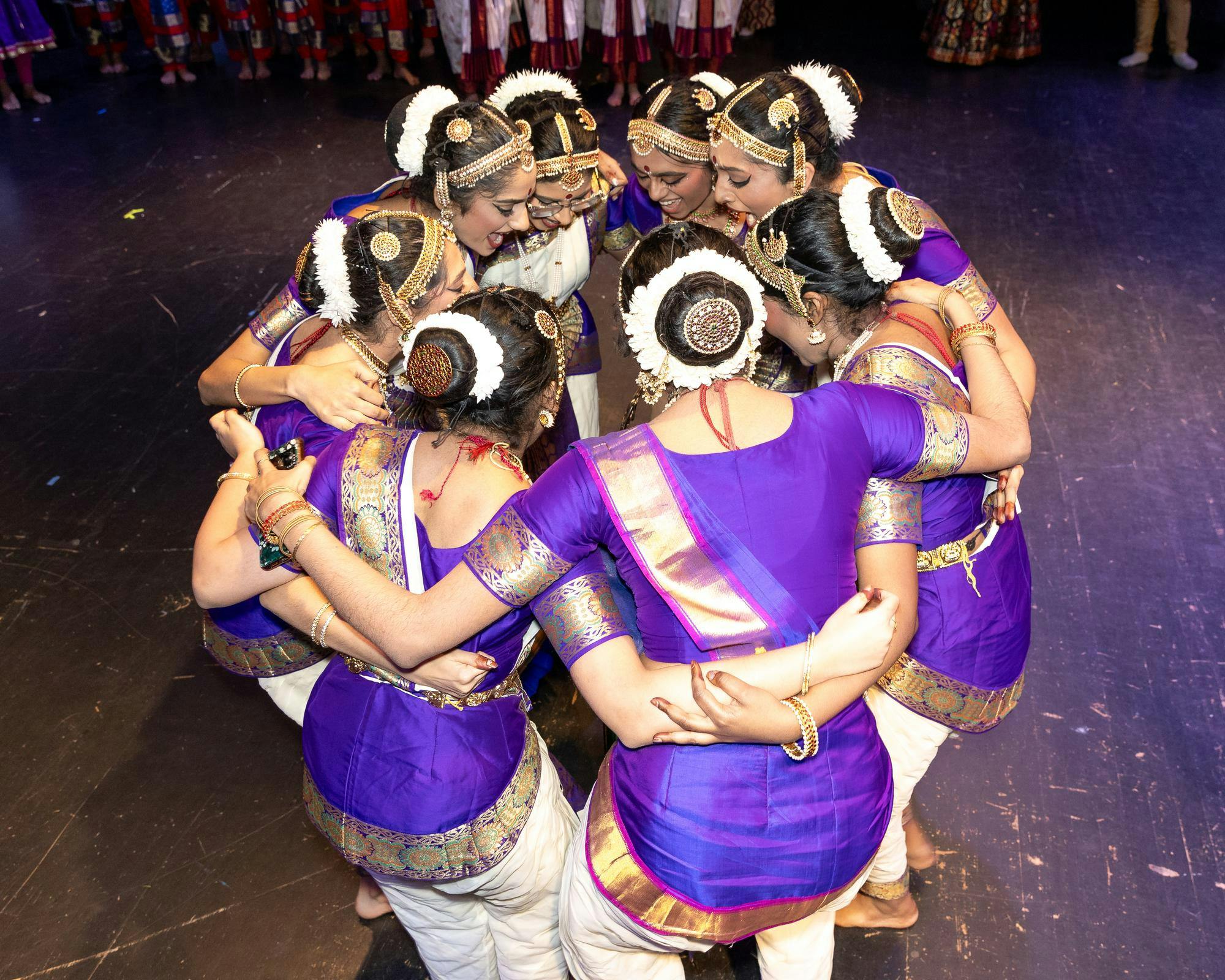
“When you meet each other so frequently through the week to practice and experience the competition life, it is hard not to be so close,” Vithiananthan said. “Apart from being each other’s peers, we are each other’s sisters.”
Asuri shared a similar sentiment, highlighting how special it is to be a part of such a tight-knit community.
“I think that performing solo, that’s something that you can do anywhere or anytime. But, performing as a group, you need a group of like-minded people who are willing to coordinate and work together,” Asuri said. “Finding a group that you can do that with is very rare, and I'm really lucky to have found that on this team.”
Teju Vijay is a member of the Class of 2029 in the College of Arts and Sciences. She is a staff writer for the news department and can be reached at tv95@cornell.edu.