
The KensaGroup started, like many things in science, with something that didn’t quite work. An early attempt at commercializing a promising paint fell through due to a company’s internal preferences. Since its initial failure, the Cornellian-founded group has launched several successful products that originated in university labs — ranging from foods to medical equipment — and revolutionized the invention-to-industry pipeline for U.S. universities.
Founded by Tony Eisenhut ’88 and Prof. Bruce Ganem, chemistry and chemical biology, the KensaGroup is celebrating 25 years of successes and the initial failure that brought them together. The Sun sat down with its founders to learn more about the group.
A Businessman and a Chemistry Expert Team Up
In 1998, a chance introduction through the Cornell Center for Technology Licensing brought together Ganem, a synthetic organic chemist by training and long-time professor of Cornell’s CHEM 3570: “Organic Chemistry for The Life Sciences,” and Eisenhut, who studied animal science, was a member of the men’s hockey team at Cornell and at the time was a vice president of sales at Aldi.
Ganem recalled receiving a call from the CCTL office stating that an alumnus, Eisenhut, was interested in his inventions and wanted to chat. The two met in person later — a meeting Ganem recalled as a “life changing event” and the chance for his own "technical chemistry expertise” and Eisenhut’s “business acumen” to work together.
For Eisenhut, the meeting marked a point in his career where he wanted to “pivot” and start his own business centered around scientific discovery. Eisenhut stated that he and Ganem “hit it off” during their meeting, discussing their shared Lebanese descent, love for hockey and "entrepreneurial spirit.”
“Bruce [Ganem] has the international reputation for excellence, which is really important to opening doors, and [he] knows the academic process so well,” Eisenhut said. “In conversations with Bruce even 26 years ago, I knew together we could build a business model together focused on the chemistry market.”
The two began their business based on an idea for an anti-fouling paint — one that would prevent the accumulation of unwanted biological organisms, such as barnacles, on surfaces, such as ship hulls.
At the time, scientists were studying sponges that live on the bottom of the seafloor — who are constantly surrounded by falling debris — to try to find a way to protect ships from debris similar to how sponges protect themselves, and how that could be applied to protecting ships.
Ganem had a research group at Cornell that had already worked on synthesizing compounds from the sponges.
“My group had synthesized some of the compounds from these sponges,” Ganem explained. “Instead of taking eight or 10 steps, we could build fragments [of these molecules] in a couple of steps, and we had isolated the part of the molecule that displayed the anti-fouling property.”
What Ganem described as “simple molecules” became the basis of the marine anti-fouling paint that caught the attention of Eisenhut, who, according to Ganem, was able to take the patent out of the CCTL office and to the Rohm and Haas company, which developed and produced the paint for a total cost of $10,000 in just six months, which Ganem told The Sun was “considerably cheap” at the time.
Despite the paint’s success at preventing the buildup of biological organisms, the company ultimately went with a similar product created “in house” to “reward their own researchers,” rather than sourcing externally through Ganem and Eisenhut’s patent, according to Ganem.
Both Ganem and Eisenhut viewed the experience as a “lesson” that opened the doors for business in science. From the experience, Ganem and Eisenhut came out with a clear goal — working alongside research groups at universities across the U.S. to streamline the process of bringing academic discoveries to industrial applications.
“Through this experience we learned that the commercialization process coming out of these universities wasn’t efficient,” Eisenhut said. “We decided that something our business could capitalize on was commercializing scientific discoveries across the entire country.”
KensaGroup’s Process and Successes
The two founded KensaGroup, a company designed to take scientific discoveries out of university laboratories and turn them into startups. One of the keys to the company's success, Eisenhut detailed, is the Academic-to-Industry Process, an investment model that the group uses to evaluate inventions it comes across.
The A2I Process, Eisenhut explained, asks questions centered around the concepts of markets, people and process. KensaGroup evaluates what the markets will need in the future and what research groups are contributing to that need. Then, the invention is patented and released to a market that needs it.
“Using the A2I process, we went out and looked at different university research programs to source the intellectual property and know how to meet the market,” Eisenhut said. “It was a market-driven process as opposed to a technology-driven process at the onset.”
Ganem highlighted Eisenhut’s “ability to connect people together” and push researchers to pursue business applications as a key factor in the group’s success.
“This is a guy who genuinely seemed interested in science, and he engendered a sense of trust when you talked to him,” Ganem said in reference to Eisenhut.
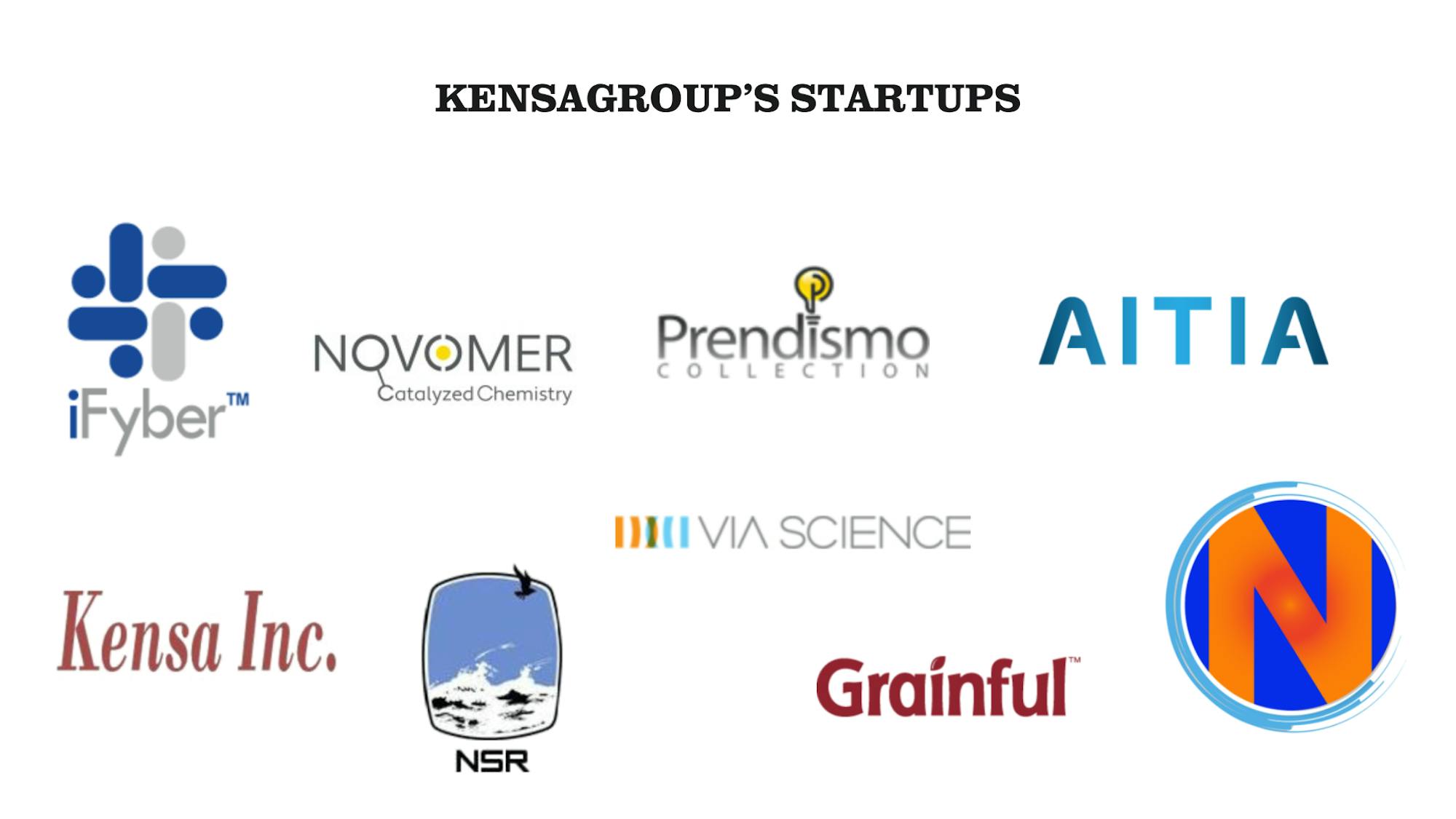
KensaGroup has since evaluated over 3,000 technologies for commercialization within several industries including energy, medicine, agriculture and more.
KensaGroup is also behind NovaSterilis, which uses supercritical carbon dioxide to sterilize medical materials and has been used in over 500,000 surgeries worldwide, according to its website.
The KensaGroup’s partnerships include Novomer, a sustainable chemistry organization that developed catalyst technology to turn carbon-based gases into sustainable synthetic materials.
Prof. Geoffrey Coates, chemistry and chemical biology, co-founded Novomer and is one of four members on the scientific advisory board for the KensaGroup. Coates recalled that Ganem “went out of his way” to introduce him to Eisenhut because of the knowledge he and his group had about polymers and energy applications.
With Novomer eventually being sold for approximately $350 million, Ganem called it “one of Ithaca’s most successful startups.” Novomer’s Vice President, Scott Allen, Ph.D. ’04, was one of Coates’s students and worked “tirelessly” to make the company successful, Ganem said. Coates also credited the company’s success to Eisenhut’s “motivation” to help.
Coates joined the KensaGroup’s advisory board during the process.
“I remember thinking during our initial meeting, ‘I don’t know where this is exactly going, but this guy seems like a lot of fun,’ and so I started working with the KensaGroup as an advisor,” Coates said.
The four members of KensaGroup’s scientific advisory board bring a wealth of scientific expertise and background to the business table, according to Ganem. Joining Coates and Ganem are Dr. Robert Langer, an Institute professor of biotechnology at the Massachusetts Institute of Technology, and Prof. Richard Turner, the director emeritus of the Macromolecules Innovation Institute and research professor at Virginia Tech.
Inspired by his experience, Ganem created a Cornell course open to anyone interested in STEM and business, CHEM 4040: “Entrepreneurship in Chemical Enterprise.”
Ganem’s advice to young people hoping to pursue entrepreneurship is to "nurture" their ideas. He joked that while he was roughly 50 years old when he became “smitten” with the idea of pursuing a career in business, he thinks that age is not as important as connecting with others and pouring energy into an idea.
“It is always so exciting to see raw discoveries being brought to the marketplace to benefit people,” Ganem said. “So when I met Tony [Eisenhut], it was thrilling to be given the chance to be on the ground floor of the work.”
Zeinab Faraj is a member of the Class of 2028 in the College of Arts and Sciences. She is a senior editor for the 144th Editorial Board. She was a features editor and an assistant sports editor on the 143rd Editorial Board and can be reached at zfaraj@cornellsun.com.