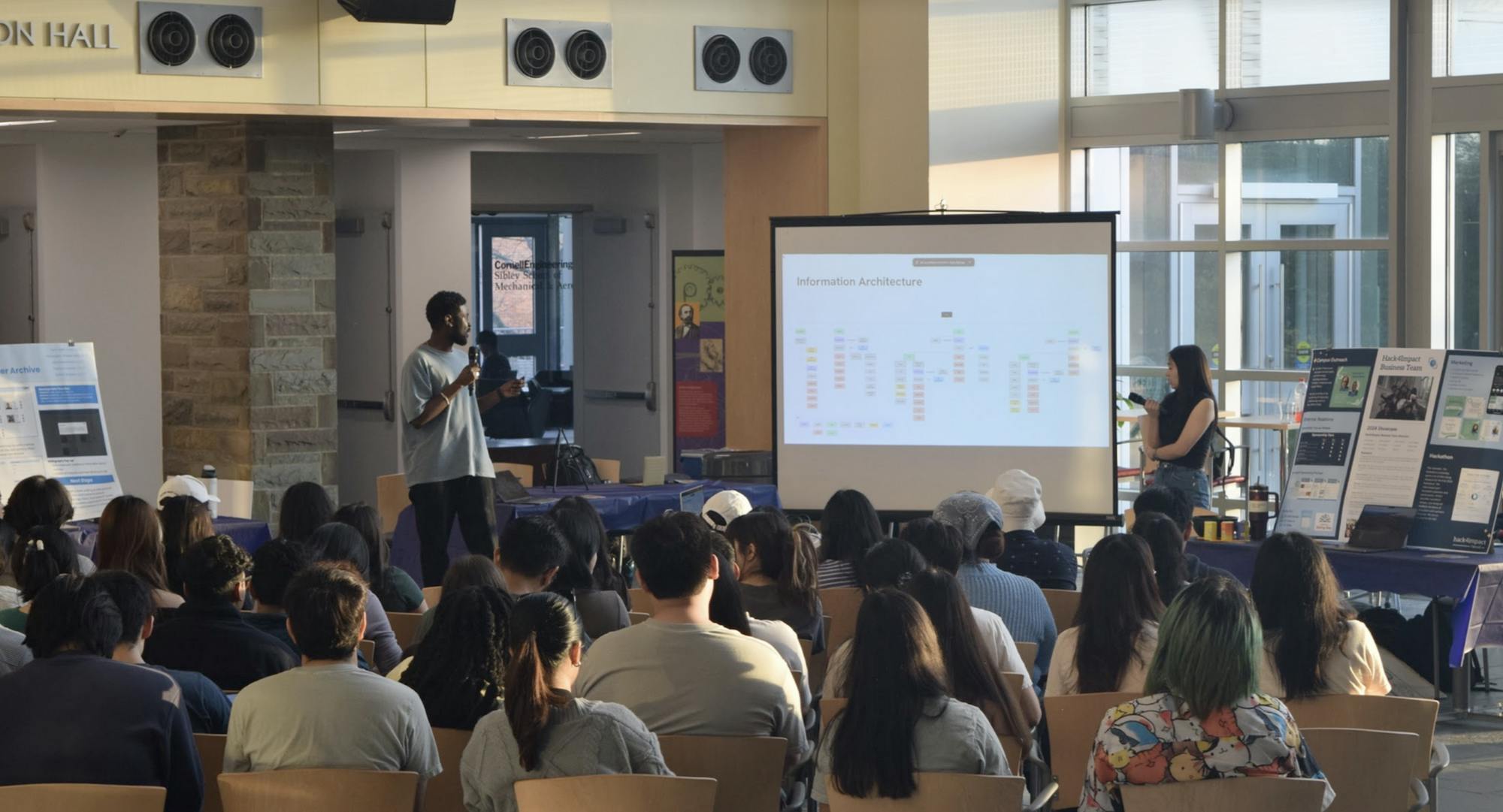
Cornell Hack4Impact, a student-run project team, partners with nonprofits to develop free software ranging from mobile apps to data visualization platforms — work that its members say saves organizations hundreds of thousands of dollars in development costs.
The organization is part of a national Hack4Impact network spanning 12 chapters internationally, with projects reaching 15 cities across four continents. Cornell's chapter alone fields roughly 90 members across development, design, business and product management subteams.
This year, the Cornell chapter worked with five nonprofit partners across areas including healthcare, food insecurity and financial literacy, saving those organizations an estimated $550,000 in development costs, according to the team's 2025 annual report. A standard web product can cost nonprofits upwards of $110,000 in design, development and deployment costs alone.
"[Hack4Impact is] the only project team that makes software for nonprofits and also for no profit at all," said Ashlie Zhang '26, the team's engineering chair. "It's straight up just being able to create technology that will create impact, not only inside of your community, but also in communities around the world."
Funding for Hack4Impact comes from the College of Engineering and crowdfunding initiatives like Giving Day, through which the team raised $8,000 this year. Because nonprofits receive services at no cost, the project team’s business subteam handles outreach, sponsorship and finances so developers and designers can focus entirely on building.
Arshia Chakrabarti '28, a member of the business subteam, said that division of labor reflects the team's broader philosophy.
"We make sure that everything each member of the team [does] — client or developer or designer — is supported to the fullest extent," Chakrabarti said. "We worry about the finances, so our clients don't have to worry about paying for our services.
Among this year's most prominent projects is a mobile app built for Alaska Children's Trust, a statewide nonprofit focused on preventing child abuse and neglect. Hack4Impact digitized the organization's physical Safety Deck — a set of conversation cards designed to help parents talk to children about online safety — and turned it into an interactive app accessible to families nationwide.
The team also built a map-based web application for Rethink Food, a New York City nonprofit that connects restaurants with community-based organizations to address food insecurity. The new tool replaces scattered spreadsheets with an interactive interface that visualizes the flow of meals across neighborhoods, supporting an estimated 40,000 meals per week.
Nathnael Tesfaw '26, the team's maintenance lead, served as the technology lead on the Rethink Food project. He said leading a product from scratch to near-deployment reshaped how he thinks about his work.
"Working with that initiative — knowing that people will be able to live better lives just because of the product we made — that in itself was really special for me," Tesfaw said.
Justin Eburuoh '26, a co-director of the project team, said this mission of helping the community is what keeps members engaged across roles and semesters.
"I think it just brings a sense of fulfillment to be able to help people who need the help," Eburuoh said. "That's something cool about Hack."
Ashley Kim is a member of the Class of 2028 studying physics and statistical science in the College of Arts and Sciences. She is a staff writer for the science and technology department and can be reached at askim@cornellsun.com.