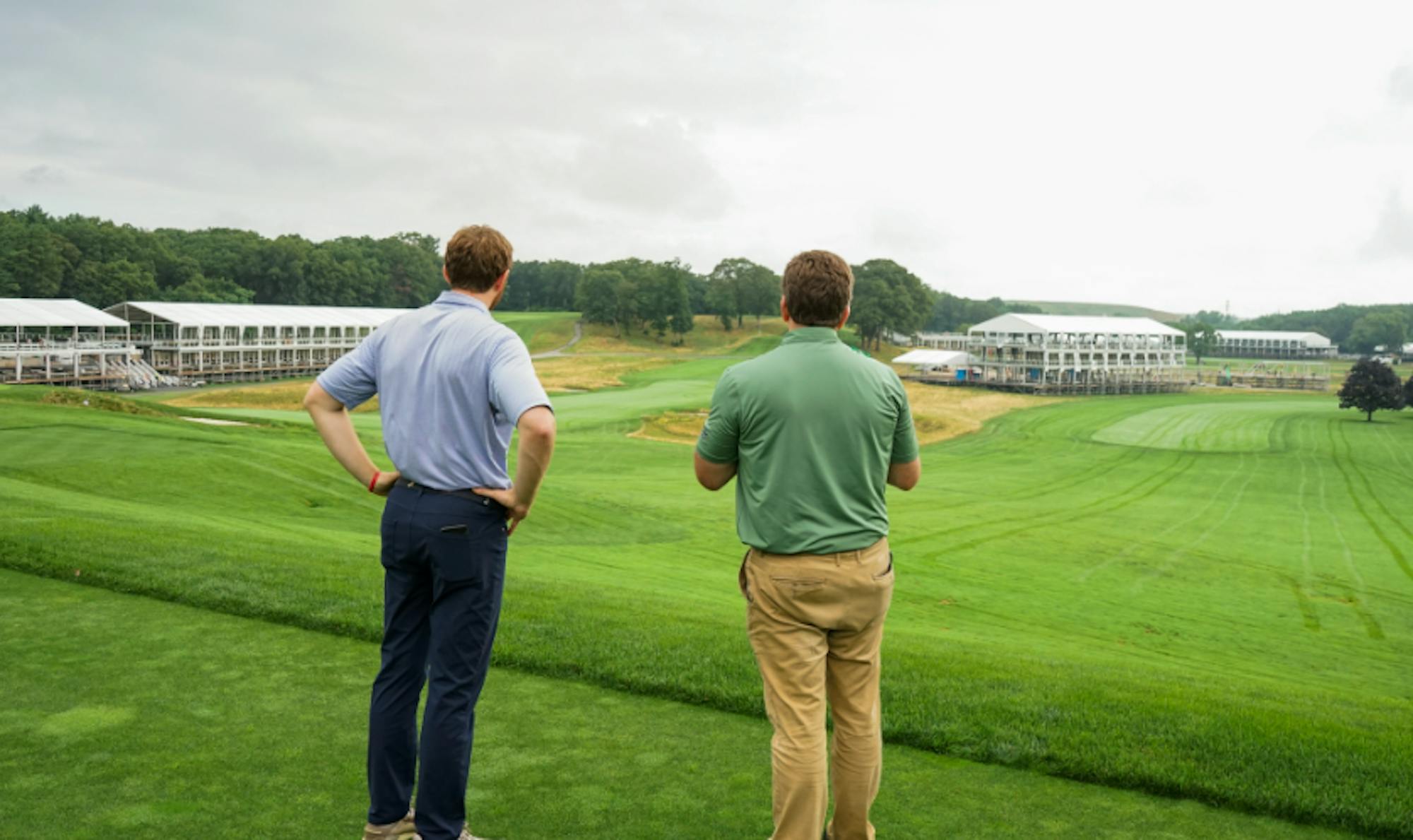
With cutting-edge innovation at the forefront of their work, members of the Cornell Turfgrass Program will be performing on-site research at the upcoming Bethpage Black State Park Golf Course — where top golfers will be competing in the Ryder Cup.
Building on their robust relationship with Bethpage established in 1999, Cornell and the New York State Parks are collaborating as leaders of the turfgrass industry on this momentous occasion to transform the way surfaces are sustainably managed to promote water conservation, chemical reduction and safety for this prestigious playing experience.
Under the Surface
From caddy camp to working on the grounds crew, Chase Skrubis’ fascination with turfgrass stemmed from summers spent in Nantucket since he was 14 years old. He began studying landscape architecture at Pennsylvania State University but earned his degree in turfgrass science after recognizing that was where his deeper interests lay.
After managing golf courses over the years, he realized that he wanted to be involved in research and development. When an opportunity to join the Cornell Turfgrass Program opened up, it seemed to be the perfect fit. As an Extension Support Specialist and State Park Agronomist,Skrubis now spends his summertime traveling with the team to meet with golf superintendents and collect data for putting greens.
In the winter off-season, information is gathered for number crunching, trend analysis and providing superintendents with presentations and training. The Environmental Impact Quotient measures any chemicals sprayed onto the course, like pesticides, herbicides and insecticides. Beyond using soil compaction as a traditional benchmark, toxicology profiles are assessed to examine how chemical sprays are applied in relation to water quality. EIQ is a primary metric used to determine the extent to which courses are using Best Management Practices aiming for successful functionality and resource conservation.
As a former student-athlete on the Cornell Men’s Golf team, Ithaca native Carl Schimenti ’14 has been a strong asset to the turfgrass research team, bringing forth playing experience and environmental engineering knowledge. Returning to Ithaca after two years in professional golf, he connected with award-winning researcher and professor, Frank Rossi ‘91, who was interested in applying Schimenti’s “engineering mindset” to turf concepts.
According to Skrubis, the Cornell Turfgrass Program is uniquely positioned to study many things in the turf realm that individual golf superintendents would not have the opportunity to. Hooking up remote sensors to mowers, looking at soil types with electromagnetic induction devices, and monitoring plant health through Normalized Difference Vegetation Index, are examples of the technology being utilized to make detailed improvements on the field for the modern-day climate.
“We have this resource of time in our favor where we can step back and work on trial plots or we can do research funded grant projects and we can look at specific aspects of turf,” Skrubis said.
Ryder Cup Research
Setting a new precedent, Bethpage State Park, located on Long Island, is the first public host for the Ryder Cup. As the most regulated and managed golf course in the state park system, this presents a unique platform for the Cornell Turfgrass Program to conduct cumulative research at a highly-recognized international stage.
“The Ryder Cup being at Bethpage is a really good example for Cornell’s research and work on the back end of turfgrass to shine through,” Skrubis said.
Since partnering with Bethpage over 25 years ago, Cornell has been collecting input data by recording everything applied to the course as well as cultural and management practices performed. For the Ryder Cup, researchers are sharing expertise on putting greens to unify all 18 greens to perform at a consistent level for all players.
Shifting from clay-based soil in Ithaca to sand-based soil on Long Island, the team faces stronger regulations with spray limitations. These different growing conditions create a higher susceptibility to chemicals entering groundwater and to water bodies typically not present upstate.
“Certainly makes me think differently about the pun intended ‘downstream effects’ of how we manage grass and what gets into the water,” Schimenti said. “We are connected to water in a variety of different ways.”
The recent formation of the New York State Golf Coalition has brought superintendents, lobbyists, lawmakers and other experts together to build a comprehensive bridge of communication through multidisciplinary conversations. While these individuals are each professionals in their own respective fields, creating this alliance facilitates the management of different facets to various groups.
“New York is on the right track with that,” Skrubis said. “The fact that it’s coming to fruition is a good thing.”
Turfgrass and Beyond
For aspiring engineers and researchers, Skrubis and Schimenti emphasize the importance of asking questions and embracing curiosity in a wide range of topics.
“If you can ask good questions, then you can find good answers,” Skrubis said. “With that being the backbone of research.”
Whether it is youth sports or professional athletes, the team is also exploring ways to promote a safe surface for injury prevention. It is crucial to consider factors such as unevenness for weedy natural grass, as well as hardness and heat for synthetic turf. Despite challenges faced with the gap between limited education budgets and costs of implementation and maintenance, researchers are working on a project concentrating on governance and stewardship decisions for K-12 schools in New York.
Combining innovative practices, environmental sustainability and interdisciplinary engagement, the Cornell Turfgrass Program is paving the path for courses and fields in New York and beyond to sow seeds for the next generation of golfers and researchers.
Leah Chang is a member of the Class of 2028 studying environment & sustainability in the College of Agriculture and Life Science. She is a staff writer for the science and technology department and can be reached at lchang@cornellsun.com.