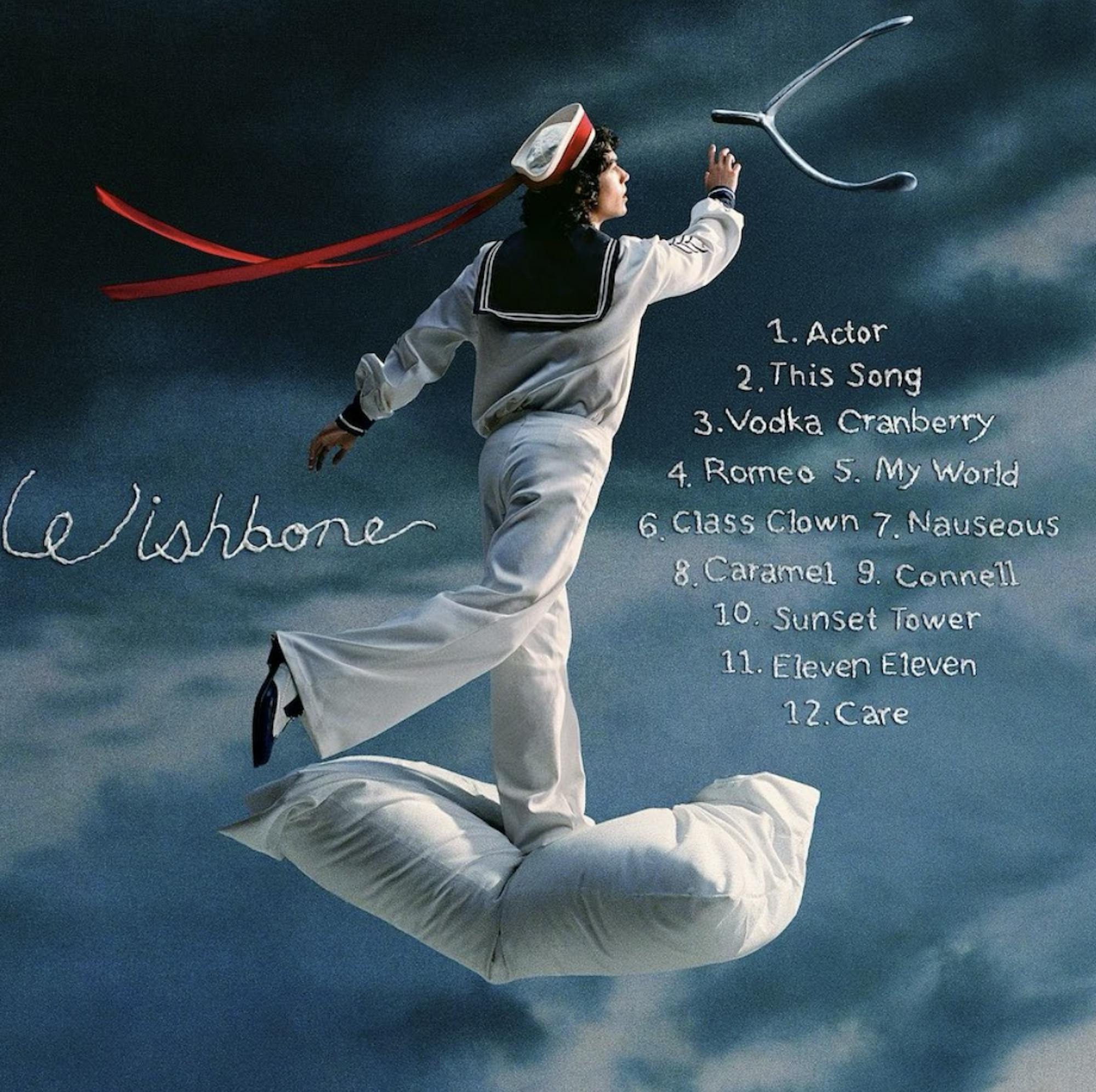
On May 22, Conan Gray took to Instagram to announce his fourth studio album, Wishbone, coming out on Aug. 15. Alongside the lead single “This Song” coming out a week after the announcement, Gray revealed the 12-song tracklist and mystical album cover. The cover is pure whimsy, depicting a leaping Gray in a sailor costume holding a giant wishbone with a red ribbon. The color scheme is cool-toned and a bit sad, yet, the vibrant red of the ribbon and Gray’s white-and-red sailor cap bring a passion to the image that is synonymous with the sonic and lyrical arrangements of the album — sometimes sorrowful and cold, but never not cathartic.
In the announcement post, Gray included a brief reflection on his experience writing the album, confessing that he’s been secretly writing this album for two years. He said, “[I was writing] after shows in the basements of the venues, in the sheets of my hotel beds, in narrow gaps between tours — I’d come back home and write all the things I felt nobody wanted to hear. Maybe even the things I didn’t want people to hear.” This truly speaks to the intimate nature of Wishbone, the songs feel like an emotional journaling session where words are relinquished to the page with no filtered concerns of who may read it, or in Gray’s case, hear it. He continued, “I didn’t know what story I was telling. [...] slowly I started to see myself in full picture. The slivers of myself I’d always been, but never faced. The songs I’d always been writing, but never singing.” Wishbone holds a mirror up to Gray’s identity and asks him to unveil himself and take it all in, no holding back — it’s through this exploration of himself that we get some of his best lyrics to date, a resonant emphasis on introspection results in lyrics like “But deep in my bones I know pain is what I earned / And you remind me of how good it feels to hurt / Yeah, you remind me of how little I deserve” in Track 9, “Connell.”
I first heard this album on a long rainy drive home — arguably the superior way to listen to any kind of music ever — and was surprised by how much I thoroughly enjoyed it on my first listen. Having not loved his past album, Found Heaven, except for a few hits such as “Alley Rose” and “Never Ending Song,” I was hesitant when he announced the lead single “This Song.” While I didn’t fall in love with “This Song”’s lyricism, I adored the magical strings that fill this song with an infectious life of its own. However, what proved to me that Gray’s lyrical genius we know and love was back, was the release of the album’s second single, “Vodka Cranberry.”
“Vodka Cranberry” revives the purgative, scream-sing nature of Gray’s songs— some prominent examples being “Alley Rose” and “The Cut That Always Bleeds.” The chorus reads: “Speak up, I know you hate me / [...] / Speak up, don't leave me waiting / Got way too drunk off a vodka cranberry.” Haven’t we all, Conan … Now knowing that Gray wasn’t playing around with his fourth album, I opened myself up to the rest of the album and pressed play.
The album opens with “Actor,” a song that reflects on a secret relationship that ended in disconcerting failure. The vibrant chorus has what is probably my favorite lyrics from the album as a whole: “But the church bells won't stop ringing / For an undead wedding day / And you've spent the summer drinking / While I spent it being erased.” He ends the chorus with a sly and petty “Let's pretend nothing happened, I agree / But you're a much better actor than me.”
“Actor” is followed up by the singles “This Song” and “Vodka Cranberry.” After comes “Romeo,” a song filled with references to Shakespeare’s Romeo and Juliet, shrewdly sings “You’re no Romeo” and “Where art thou? I'm all alone now / [...] / Where art thou? Fuck if I care now.” “My World,” the song following “Romeo,” matches “Romeo”’s unserious and dramatic energy with a hilarious bridge that doubles down on how “over it” he is: “A full year later, you're calling me back / You say you're sorry for treating me like trash / It's totally okay, dude, I really don't mind / You got your revenge by being stuck with your life.”
After going through the pettiness and theatrics of a breakup, Gray breaks all our hearts with “Class Clown” and “Nauseous”. “Class Clown” brings back Gray’s gift for writing about his complicated childhood and how it affects his personality and perception; He sings, “Everything comes back around, I still feel like the class clown.” In “Nauseous,” my favorite, he speaks to his visceral fear of falling in love for he fears that it puts him in a vulnerable position to get hurt — lyrics such as “Behind every kiss is a jaw that could bite” and “Your love is a threat, and I'm nauseous / [...] / I'm haunted / By people who've left, so you scare me to death” explore this debilitating fear.
To bring the energy up, “Caramel” is an upbeat song that insists on a broken relationship and embraces the duality of hating an ex yet having them “burnt into your memory.” The penultimate track, “Eleven Eleven,” makes a callback to “This Song’s” pre-chorus “11:11s, they all hear your name,” dissecting Gray’s superstitious desire for his lost lover through “wishbones and clovers and numbers from Heaven.” “Sunset Tower” and the album’s concluding track, “Care,” flip between physically not being able to hear any news regarding an ex-lover, yet finding yourself in a position where you can’t seem to stop wanting to know about their lives.
Wishbone is Conan Gray’s greatest achievement to date. It contains unparalleled lyricism that encapsulates the introspective, vulnerable time Gray was going through while maintaining relatability and that validating nostalgia his earlier work embraced.
Paulina Delgado is a sophomore in the College of Arts and Sciences. She can be reached at pmd99@cornell.edu

Paulina Delgado-Umpierre is a member of the Class of 2028 in the College of Arts and Sciences. She is a staff writer for the Arts & Culture department and can be reached at pdelgadoumpierre@cornellsun.com.