

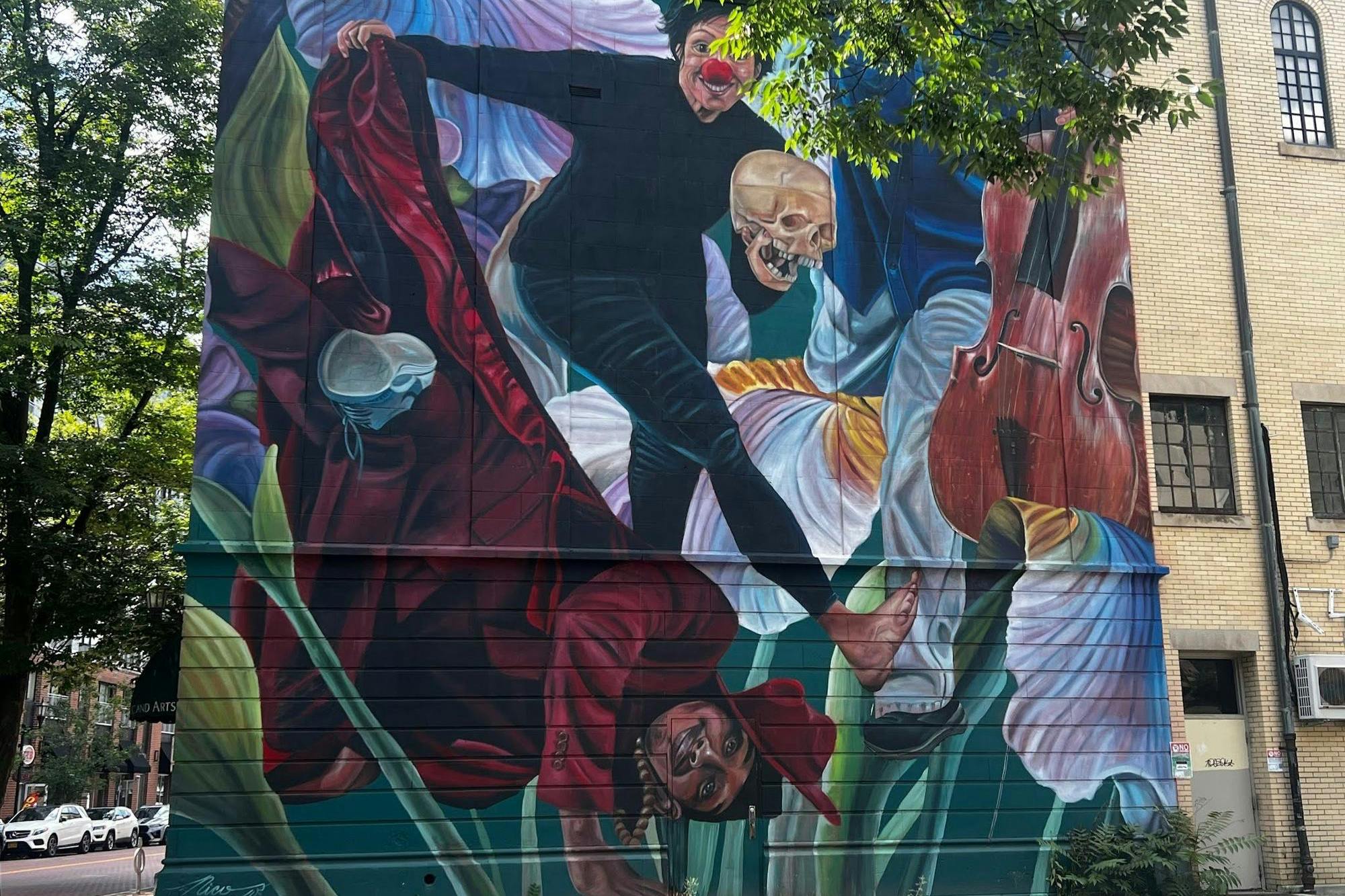
Nowadays, it is difficult to miss the cacophony of colors that dress electrical boxes, alleys and other formerly bare spaces in Ithaca. But Ithaca has not always hosted such a diverse array of art.
Since 2009, the nonprofit Ithaca Murals has facilitated public art around Tompkins County. What began with 15 murals in 2009 has grown to over 400 across Ithaca today.
There is no official New York ranking, but according to Dorothy Lovelace, board chair of Ithaca Murals, Ithaca has the most murals in the state outside of New York City. Buffalo also claims to be a contender for most murals per capita.
The subject matter of the Ithaca pieces range from larger-than-life animals, to local activists, to community-designed pieces that reflect the values of a neighborhood.
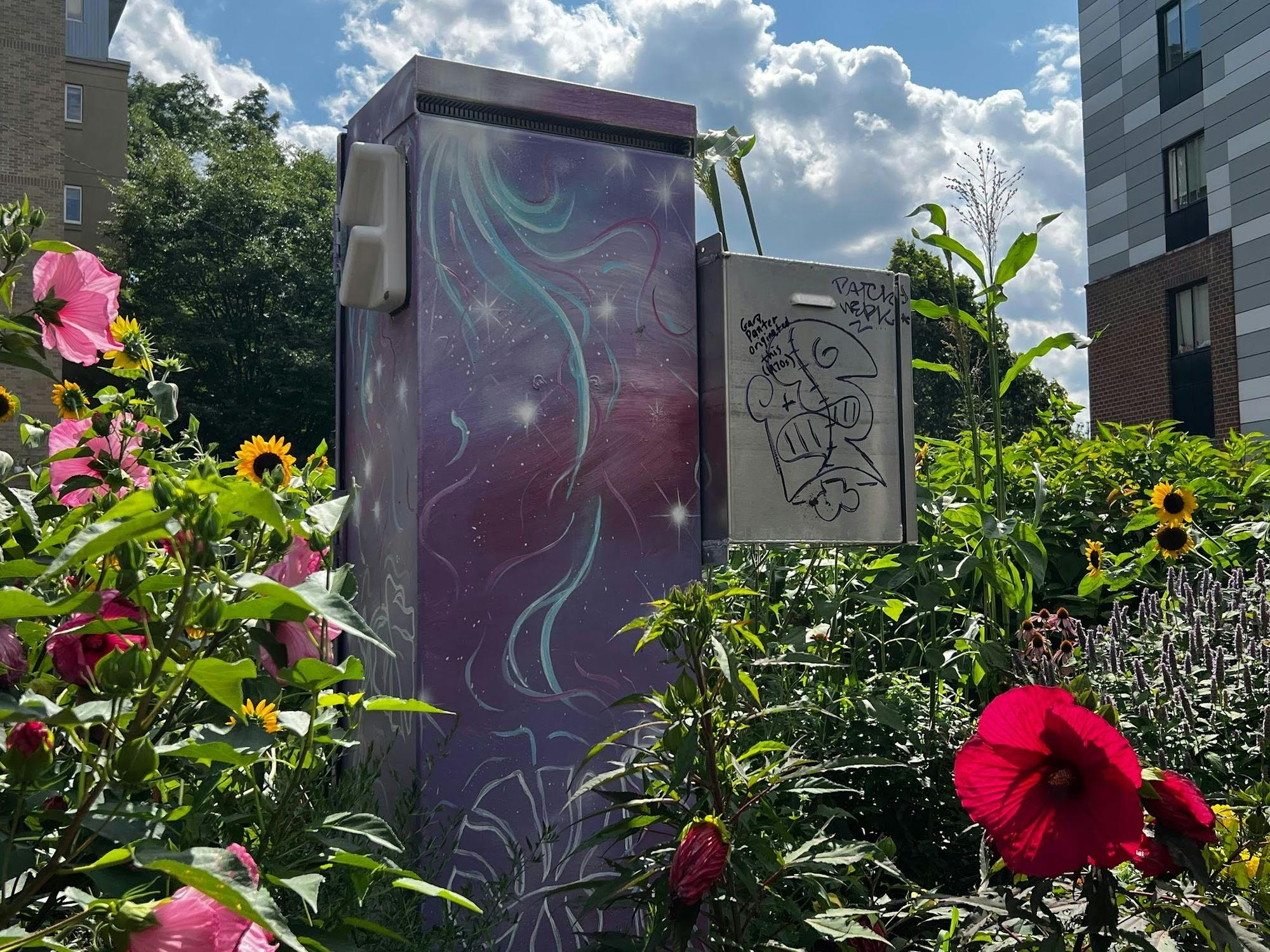
An abstract mural on an electric box depicts a purple and teal illustration surrounded by flowers at the intersection where Green Street merges into State Street.
Ithaca Murals “considers itself less of an arts organization and more a social justice organization that is using art to meet those objectives,” Lovelace said.
‘Spurring the Conversation’
Some of the downtown murals take stances on political issues such as black history, pride and Palestine, receiving mixed responses from the community.
One mural, an electrical box depicting Kermit the Frog waving a pride flag on Stewart Avenue, has been vandalized numerous times. In response, community members have taken to restoring the mural.
“People are coming together and having these little community paints,” Lovelace said. “It keeps getting redone again and again. [It is] an ongoing living art project.”
Other murals, including one depicting the Underground Railroad that was updated in 2025 by local artists Terrance Vann and Maryam Adib, have faced vandalism as well. In this mural, the word “Black” was crossed out in “Black Lives Matter” and, in a phrase that originally read “Free Gaza,” the word “Gaza” was painted over with “Love”.
Vann and Adib’s mural was a point of controversy at the March Ithaca Common Council meeting, where council members debated whether “Free Gaza” should be kept on the wall, as some considered it politically charged.
Vann accepted backlash as part of making his art, saying “when you put things out in the public, you’re gonna get responses.” He said art is responsible for “spurring the conversation [and] spurring a challenge” besides being aesthetically pleasing.
Another part of Vann’s art is embracing his identity.
“I used to just call myself an artist, but now I lean into being known as a Black artist,” Vann said, adding that he sees it as “part of [his] responsibility.”
For Caleb Thomas, founder of Ithaca Murals, mural art is “an inclusive movement to shift our cultural cityscape” from one that is “dominated by … buildings named for white privileged men” to one that honors “anybody who values justice.”
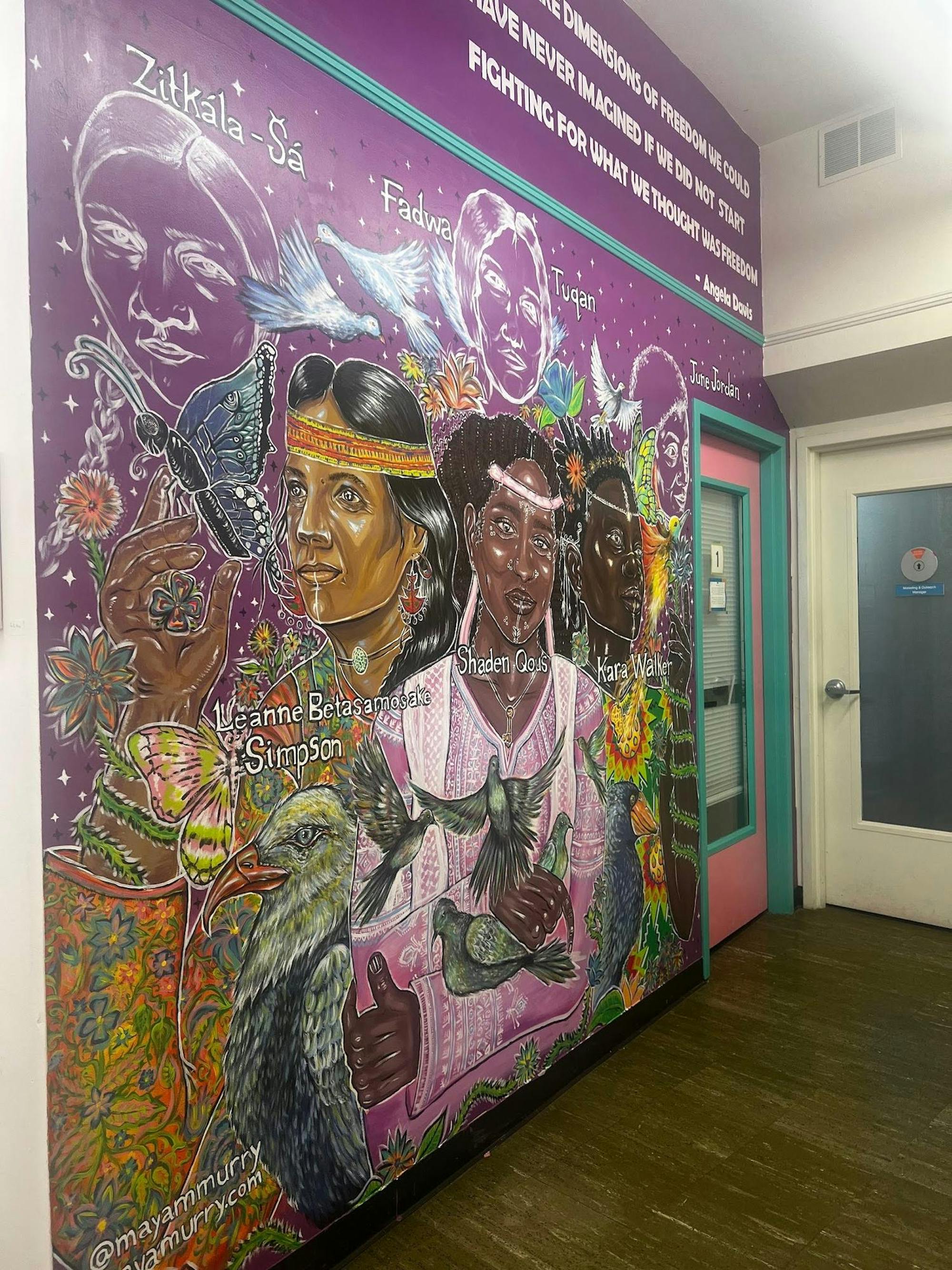
A mural depicting Leanne Betasamosake Simpson, Shaden Qous and Kara Walker alongside other famous female artists.
In that way, many of Ithaca Murals’ pieces are meant to “take up some space with a different version of inclusion, and cultural diversity and welcoming people of all kinds into the space,” Thomas said.
Ithaca Murals encourages everyone to get involved with the creation of public art, as Thomas puts it, “the pieces turn out better... when we just [provide] resources and connections in the community to make a project happen.”
Bringing the Conversation to Campus
One Cornell student is partnering with Ithaca Murals to create a mural in Ujamaa Residential College. Jocelyn Swavy ’28, founder and president of The Black Arts Collective and College of Arts & Sciences representative for the Student Assembly, said she wants the piece “to depict Black joy” and to combat “the fact that a lot of us aren’t in [Ujamaa], but it still is our space.”
Ujamaa, a program house founded to serve Black students at Cornell, has seen its Black resident population decline significantly, and residents have voiced concerns that the dorm is grappling with low funding, deteriorating conditions and a shift away from its founding purpose.
The Black Arts Collective received a grant from the Community Partnership Funding Board for this project, which requires collaboration with a community non-profit organization. Swavy chose Ithaca Murals. They will also be working with Cornell Black Architects, Artists and Planners, as well as Black Students United to plan and execute the piece.
Part of the reason for a decline in the number of Black students living in the program house, Swavy said, is a lack of priority for the building. She pointed to declining facilities and “mold complaints.”
She hopes the mural will make Ujamaa feel “more like home.”
Community Impact and Involvement
Murals are an important part of the Ithaca community, Cornell students told The Sun.
Camilla MacLean ’28 said she believes Ithaca “has a knack for using murals to combine collective action, nature and social justice.” MacLean specifically highlighted an electrical box that says “Fall in Love Not In Line,” and said she thinks painted electrical boxes are “such a simple way to make a space feel owned and held by its community.”
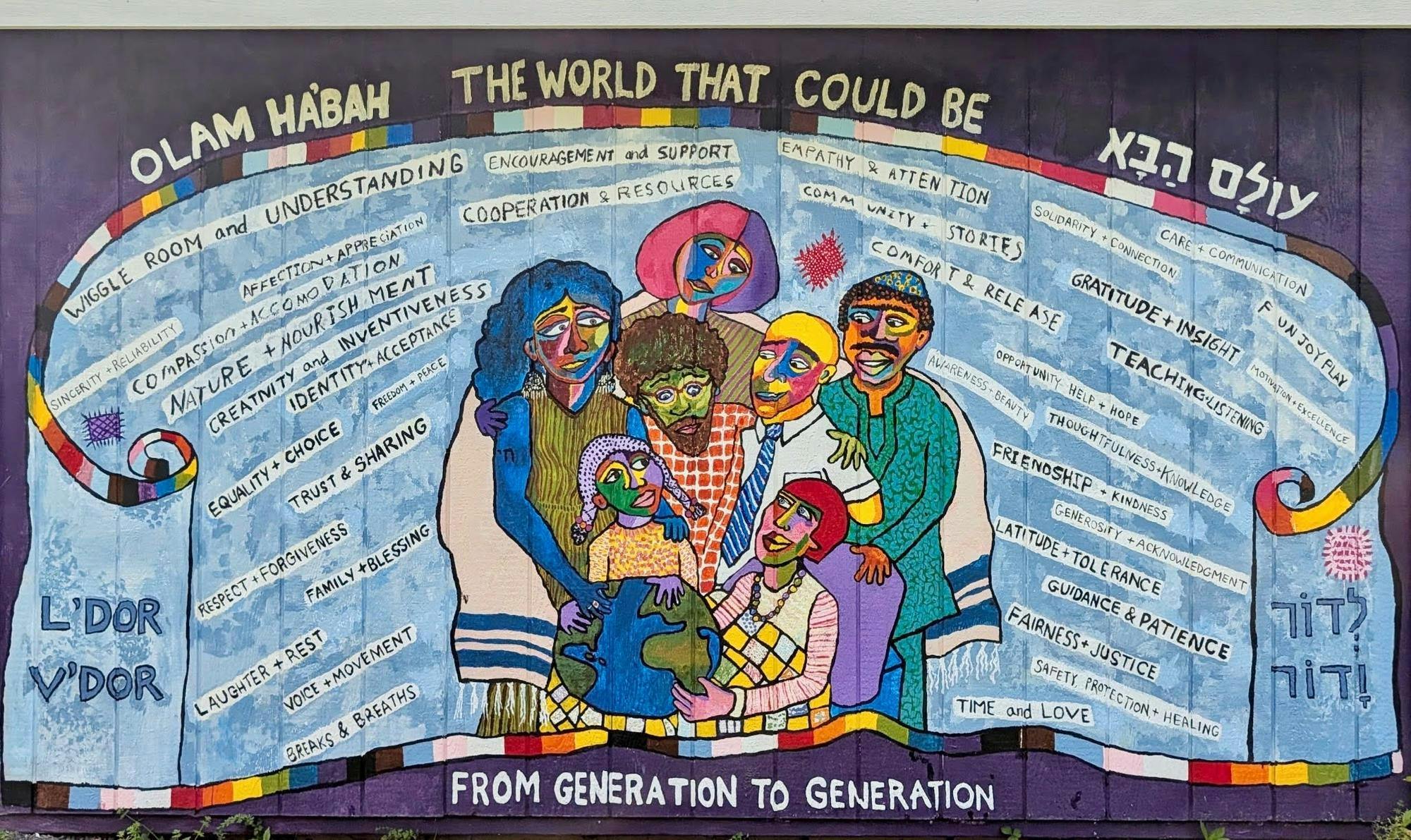
A mural depicting generations of people holding the Earth in their hands surrounded by positive phrases (Courtesy of Caleb Thomas).
Another student, Zahari Fine ’30, finds murals “a great way to uplift community.” Fine, who comes from a family of artists and can see herself “collaborating on public art.”
Lovelace told The Sun that at Ithaca Murals, “we want people to participate, not just digest the murals, but also paint their own murals.” She encourages anyone interested to get involved with public mural art.
Ithaca Murals will host a Mural Jam on Oct. 4, featuring music, art and food trucks. The event, hosted in the Southworks neighborhood, is open to the public. Thomas says the Jam will be “a big party with a purpose... bringing artists together and transforming the space.” Ithaca Murals encourages anyone interested to come, help paint, meet the artists and enjoy the festivities.
Lila Davis is a member of the Class of 2029 in the College of Agriculture and Life Sciences. She is a staff writer for the news department and can be reached at ldavis@cornellsun.com.


